Table of Contents
- Understanding Synthflow: The No-Code Promise
- The Hidden Costs: Why Businesses Seek a Synthflow Alternative
- Introducing AIO Orchestration: The Premier Self-Hosted Synthflow Alternative
- Synthflow vs. AIO Orchestration: A Head-to-Head Comparison
- ROI in Action: Slashing Your AI Voice Agent Costs by 80%+
- The GDPR & Data Sovereignty Advantage of Self-Hosting
- Voice Quality & Brand Identity: Synthflow vs. Custom mixael-TTS Voice Cloning
- Your Step-by-Step Migration from Synthflow
- Frequently Asked Questions
Are you leveraging AI voice agents to revolutionize your customer interactions but finding the monthly bill from platforms like Synthflow is scaling faster than your revenue? You're not alone. While no-code platforms offer incredible speed to market, their walled-garden approach and per-minute pricing models can become a significant operational expense, a data compliance risk, and a barrier to true customization.
This guide explores the leading Synthflow alternative for 2026 and beyond: a powerful, self-hosted, open-source stack that delivers the same no-code simplicity for your business teams but provides your technical teams with complete control, unparalleled cost savings, and ironclad data sovereignty. If you're looking for a solution that grows with you, not at your expense, you've come to the right place.
Understanding Synthflow: The No-Code Promise
Synthflow has made a significant impact by democratizing the creation of AI voice agents. Its core appeal lies in a beautifully designed no-code canvas where users can drag and drop nodes to build complex call flows without writing a single line of code.
- No-Code Appeal: Its primary strength is accessibility. Marketing teams, sales departments, and small business owners can design, build, and deploy sophisticated voicebots for tasks like appointment setting, lead qualification, and customer support in a matter of hours.
- Target Audience: Synthflow is ideal for startups, SMBs, and agencies that need to validate an idea quickly or deploy a voice agent without dedicated engineering resources. The all-in-one package (telephony, STT, LLM, TTS) simplifies deployment immensely.
- Pricing Model: The model is typically usage-based, often charging a flat rate per minute of call time (e.g., in the range of $0.12 - $0.20 per minute). This fee bundles all the underlying services, which is convenient at low volumes but becomes a major financial drain as call traffic increases.
While excellent for initial deployment, the convenience of a fully managed platform like Synthflow comes at the cost of control, customization, and long-term financial scalability.
The Hidden Costs: Why Businesses Seek a Synthflow Alternative
As businesses scale and their reliance on AI voice agents deepens, the very features that made Synthflow attractive can become significant limitations. This is the primary driver for users searching for a Synthflow competitor free from these constraints or a more robust Synthflow open source solution.
1. Prohibitive Cost at Scale
The per-minute pricing model is the number one reason users seek alternatives. A rate of $0.15/minute seems negligible for 100 minutes a month ($15). But for a business handling 10,000 minutes of calls, that cost balloons to $1,500/month. At 50,000 minutes, you're looking at $7,500/month for a service whose underlying component costs are a fraction of that price. This model punishes success and growth.
2. GDPR, EU Data Residency, and Compliance Nightmares
Synthflow, like many SaaS platforms, typically processes data on servers based in the US. For any business operating in the European Union, this is a massive red flag. The General Data Protection Regulation (GDPR) has strict rules about transferring personal data outside the EU. Sending sensitive customer information—names, phone numbers, and conversation content—to non-EU servers can lead to severe fines and loss of trust, especially in sectors like:
- Healthcare: Patient data is highly protected.
- Finance: Financial records and client information require strict data locality.
- Legal: Attorney-client privilege necessitates absolute data control.
A self-hosted solution allows you to deploy your entire AI stack on servers within the EU (e.g., in Frankfurt or Dublin), ensuring 100% GDPR compliance and data sovereignty.
3. The Black Box: Customization and Integration Limits
With Synthflow, you are locked into their chosen technology stack. You can't swap out their Speech-to-Text (STT) model for a custom-trained one that understands your industry's jargon. You can't replace their Large Language Model (LLM) with a fine-tuned open-source model like Llama 3 or Mistral that perfectly matches your brand's tone. You are limited to the voices they provide. This lack of control in a Synthflow vs self-hosted comparison is a critical disadvantage for businesses aiming for a truly unique and optimized customer experience.
The core issue: Managed platforms trade long-term control and cost-efficiency for short-term convenience. A self-hosted Synthflow alternative flips this equation, offering a sustainable, powerful, and fully-owned solution.
Introducing AIO Orchestration: The Premier Self-Hosted Synthflow Alternative
What if you could keep the intuitive, no-code call flow builder that your business teams love, but run the entire engine on your own infrastructure for a fraction of the cost? That's the promise of our open-source stack, AIO Orchestration.
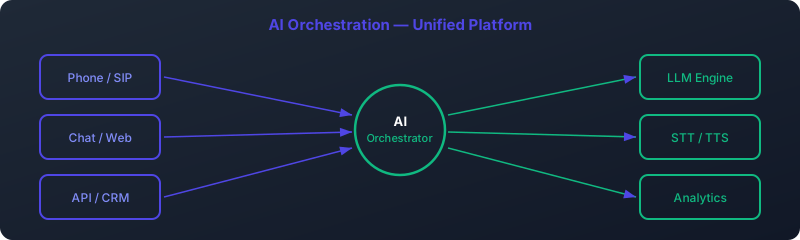
AIO Orchestration is designed to be the ultimate AI voice agent no code alternative. It decouples the user-friendly interface from the expensive, resource-intensive backend, giving you the best of both worlds.
Same No-Code Simplicity for Business Teams
Our solution features a web-based, drag-and-drop canvas that mirrors the simplicity of Synthflow. Your non-technical staff can continue to design, iterate, and manage call flows without needing to understand the underlying infrastructure. They can build logic, write prompts, and connect to APIs just as they do today. Learn more about our no-code interface.
Full Control and Transparency for Tech Teams
Behind the canvas is a powerful orchestration engine built on a modular, open-source foundation. Your engineering team can deploy this entire stack on your own cloud (AWS, GCP, Azure) or on a bare-metal provider like Hetzner or Vultr for maximum cost savings. This includes:
- Telephony Gateway: Connect directly to providers like Twilio, Vonage, or any SIP trunk, paying wholesale per-minute rates (often less than $0.01/min).
- Speech-to-Text (ASR): Deploy cutting-edge models like Whisper-Large-v3 for unmatched accuracy, running on your own GPU.
- Large Language Model (LLM): Choose your own adventure. Use OpenAI's GPT-4o via API, or run a self-hosted, fine-tuned Llama 3 70B model for complete data privacy and tailored responses.
- Text-to-Speech (TTS) & Voice Cloning: Utilize state-of-the-art models like Piper or mixael-TTSv2 to generate crystal-clear audio with incredibly low latency. Even better, clone your CEO's or a brand ambassador's voice for a truly unique audio identity.
# Example Docker Compose for a self-hosted stack
version: '3.8'
services:
  orchestrator:
    image: aio-orchestration/server:latest
    ports:
      - "8000:8000"
  stt_service:
    image: aio-orchestration/whisper-service:latest
    # GPU passthrough configuration...
  tts_service:
    image: aio-orchestration/xtts-service:latest
    # GPU passthrough configuration...
  llm_service:
    image: aio-orchestration/llama3-service:latest
    # GPU passthrough configuration...
Synthflow vs. AIO Orchestration: A Head-to-Head Comparison
This table breaks down the essential differences between staying with a managed platform and migrating to a self-hosted Synthflow alternative.
| Feature | Synthflow | AIO Orchestration (Self-Hosted) |
|---|---|---|
| Pricing Model | Per-minute bundle (~$0.15/min) | Fixed server cost + wholesale telephony (~$0.01/min) |
| Monthly Cost (5,000 calls) | ~$2,250 | ~$250 - $400 |
| Data Residency & GDPR | Often US-based servers; potential compliance risk | Full control; deploy in any EU region for 100% compliance |
| Voice Customization | Limited to a pre-selected library of voices | Unlimited. Use any open-source TTS or clone any voice with mixael-TTS |
| LLM Choice | Locked into their provider (e.g., a specific GPT model) | Total freedom. Use OpenAI, Anthropic, Google, or any self-hosted model |
| Technical Control | Zero. It's a "black box" platform. | Complete. Full access to logs, code, and infrastructure. |
| Latency Optimization | Dependent on their infrastructure and load | Can be fine-tuned by co-locating services for sub-300ms latency |
| Onboarding Speed | Very Fast (Hours) | Slower (Days for initial setup); fast for ongoing flow creation |
ROI in Action: Slashing Your AI Voice Agent Costs by 80%+
Let's translate the comparison into real numbers. The financial argument for a self-hosted Synthflow alternative is overwhelming at any significant scale.
Scenario: A European e-commerce company handling customer support inquiries.
- Monthly Call Volume: 5,000 calls
- Average Call Duration: 3 minutes
- Total Monthly Minutes: 15,000 minutes
Cost with Synthflow
Using a conservative estimate of $0.15 per minute:
15,000 minutes * $0.15/minute = $2,250 per month
Cost with AIO Orchestration (Self-Hosted)
This involves a fixed infrastructure cost and a variable telephony cost.
- Infrastructure: A capable dedicated GPU server from a provider like Hetzner (e.g., an AX52 with a dedicated GPU) can run the entire stack (STT, LLM, TTS).
- Cost: ~$150 per month
- Telephony: Using a provider like Twilio for inbound calls to a local number.
- Cost: 15,000 minutes * ~$0.013/minute = ~$195 per month
Total Self-Hosted Cost = $150 (Server) + $195 (Telephony) = $345 per month
Monthly Savings: $2,250 (Synthflow) - $345 (Self-Hosted) = $1,905
Annual Savings: $1,905 * 12 = $22,860
Percentage Savings: ~85%
The business case is clear. The annual savings alone can fund an entire engineering project or a significant marketing campaign. This is the power of moving from a high-margin SaaS to an efficient, self-owned infrastructure model. Check our interactive ROI calculator to model your own savings.
The GDPR & Data Sovereignty Advantage of Self-Hosting
For businesses in the EU, the cost savings are secondary to the critical advantage of compliance. When your AI voice agent handles personal data, the question of "where" that data is processed is not trivial—it's a legal necessity.
By deploying the AIO Orchestration stack on a server located within an EU member state (e.g., on an AWS instance in `eu-central-1` Frankfurt or a Hetzner server in Falkenstein), you ensure that all data—from the phone number to the voice recording to the transcript—never leaves the legal jurisdiction of the EU. This instantly solves major GDPR hurdles:
- Data Sovereignty: You own the data and the infrastructure it lives on. You are not subject to the policies or potential data access requests of a third-party US company.
- No International Data Transfers: You eliminate the complex legal justification required for transferring personal data to countries without an EU adequacy decision, like the US.
- Full Auditability: Your technical team has access to every log and every data point, making security audits and compliance checks straightforward.
This makes a self-hosted solution the only viable path forward for any serious European business in regulated industries.
Voice Quality & Brand Identity: Synthflow vs. Custom mixael-TTS Voice Cloning
Customer experience is defined by details, and the sound of your AI agent's voice is paramount. While Synthflow offers a selection of high-quality, professional voices, they are ultimately generic and used by hundreds of other companies. Your brand sounds like everyone else's.
A self-hosted approach using modern open-source TTS engines like Coqui's mixael-TTSv2 completely changes the game.
With mixael-TTS, you can:
- Perform Custom Voice Cloning: Provide just 10-30 seconds of high-quality audio of any voice—your founder, a trusted employee, or a voice actor—and create a perfect digital replica. This becomes your unique, ownable brand voice.
- Achieve Unmatched Realism: mixael-TTS models capture the nuance, intonation, and emotional inflection of the source speaker, creating a voice that is often indistinguishable from a human.
- Control Latency: By running the TTS engine on the same server or in the same VPC as your orchestration logic, you can dramatically reduce the time-to-first-byte of audio, leading to more natural, responsive conversations.
This level of vocal customization is impossible on a closed platform. It transforms your voice agent from a generic tool into a core part of your brand identity.
Your Step-by-Step Migration from Synthflow
Migrating from a platform like Synthflow to a self-hosted stack may seem daunting, but it's a structured process. Here’s a high-level overview:
- Audit & Export: Document your existing call flows in Synthflow. Take screenshots of the logic and copy all text prompts, API calls, and conditions.
- Set Up Infrastructure: Provision your chosen cloud or bare-metal server. A Linux server with a modern NVIDIA GPU (like an RTX 4060 or A10G) is recommended.
- Deploy the AIO Stack: Use our provided Docker containers or Kubernetes manifests to deploy the AIO Orchestrator, STT, LLM, and TTS services. See our detailed deployment guide.
- Recreate Call Flows: Log into the AIO Orchestration web interface and use the no-code canvas to rebuild your call flows. This is often a quick process as the logic is already defined.
- Clone Your Voice (Optional but Recommended): Use the built-in mixael-TTS utility to upload your source audio file and create your custom brand voice. Assign this voice in your call flows.
- Configure Telephony: Sign up with a SIP trunk provider like Twilio. Purchase a phone number and point it to your AIO Orchestrator's public endpoint.
- Test, Test, Test: Run dozens of test calls to ensure the logic is correct, the voice sounds perfect, and the integrations are working as expected.
- Go Live: Port your main business number over to your new telephony provider or update your website and marketing materials with the new number. Decommission your Synthflow account and start saving.
While there is an initial technical lift, the long-term benefits in cost, control, and compliance are well worth the one-time effort.
Frequently Asked Questions
Is a self-hosted stack still a "no-code" solution?
Yes, for the end-user. The AIO Orchestration platform provides a complete no-code, drag-and-drop interface for designing and managing call flows. The "code" part is the one-time infrastructure setup, which is typically handled by an IT or DevOps team. Once set up, your business teams operate in a 100% no-code environment, just like they do with Synthflow.
What technical skills are needed to set up the AIO Orchestration stack?
You'll need someone comfortable with the Linux command line, Docker, and basic cloud infrastructure management. If you've ever deployed a web server or a database, you have the requisite skills. We provide comprehensive documentation and Docker Compose files to make the process as simple as possible.
How much does it really cost to run a self-hosted AI voice agent?
The two main costs are the server and telephony. A powerful GPU server from a budget provider like Hetzner can cost between $60-$200/month. Telephony costs are variable but are typically very low, around $0.008 - $0.015 per minute. For most businesses, the total monthly cost will be under $400, a massive saving compared to the thousands you might pay for a managed platform at scale.
Can I use my own fine-tuned LLM with this Synthflow alternative?
Absolutely. This is a key advantage. Our orchestration engine can connect to any LLM that has an API endpoint. You can call OpenAI's API, or better yet, run your own instance of a model like Llama 3 or Mistral that you've fine-tuned on your own company data for superior performance and complete privacy.
How does a self-hosted solution handle security?
You have full control over security. You can place the entire stack within your own Virtual Private Cloud (VPC), restrict access with firewalls, and implement your own security and logging protocols. Since the data never leaves your infrastructure, you eliminate the risk of a third-party data breach. This is far more secure than relying on the security practices of an external platform.
What is the typical latency, and can it be improved?
With a self-hosted stack where all components (STT, LLM, TTS) are on the same powerful machine or within the same low-latency network, you can achieve an end-to-end response latency of 300-500ms. This creates a much more fluid and natural conversation than cloud platforms where each service call can add hundreds of milliseconds of network delay.
How does the mixael-TTS voice cloning work?
mixael-TTS (Expressive Text-to-Speech) is a deep learning model. You provide it with a short, clean audio sample of a target voice (without background noise). The model analyzes the unique characteristics of that voice—pitch, tone, and cadence. It can then generate new speech in that voice from any text input. The AIO Orchestration stack includes a simple interface for uploading your sample and generating the voice model.
What kind of support is available for this open-source solution?
As an open-source project, community support is available through forums and Discord channels. For businesses requiring dedicated assistance, we offer enterprise support packages that include help with initial setup, optimization, and ongoing maintenance. Please see our Enterprise Support page for more details.