Table of Contents
- Why Are Businesses Searching for a Bland AI Alternative?
- Bland AI: A Quick Overview of Strengths and Weaknesses
- The Ultimate Bland AI Alternative: Self-Hosted Open Source
- Bland AI vs. Self-Hosted: A Detailed Feature Comparison
- Cost Analysis: How to Save Over 95% Compared to Bland AI
- How to Replace Bland AI in 4 Simple Steps
- Who Should Stick with Bland AI? (An Honest Look)
- Other Bland AI Competitors in the Market
- Frequently Asked Questions
Bland AI has made a significant impact on the AI telephony landscape. Its promise of deploying high-volume, conversational voice agents with a simple API call is compelling. For many US-based companies, it's been the go-to solution for getting an AI calling campaign off the ground quickly. But as the calendar pages turn towards 2026, businesses are starting to hit a wall. The very simplicity that made Bland AI attractive is now revealing its limitations in cost, control, and global reach.
If you're here, you're likely experiencing these growing pains. You've validated your use case, you see the massive potential of AI voice agents, but the monthly bill is becoming astronomical, or you're finding yourself constrained by a closed, US-centric ecosystem. You're looking for a professional-grade Bland AI alternative that can scale with your ambition, not your invoice.
This guide is for you. We'll dive deep into why companies are looking to replace Bland AI, introduce a powerful open-source, self-hosted model, and provide a clear cost-benefit analysis that demonstrates how you can achieve superior results while cutting your costs by up to 95%.
Why Are Businesses Searching for a Bland AI Alternative?
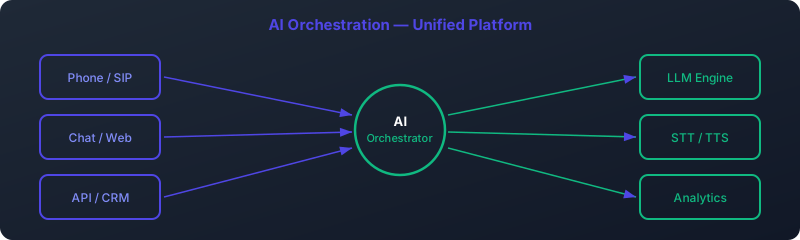
The initial magic of Bland AI—launching thousands of calls with a few lines of code—often gives way to practical business challenges. As companies move from pilot projects to full-scale deployment, four key issues consistently emerge.
1. Prohibitive Cost at Scale
Bland AI's pricing model, typically around $0.09 per minute, is manageable for small tests. However, for any significant outbound or inbound operation, this cost balloons uncontrollably. Consider a modest campaign of 50,000 two-minute calls a month. That's 100,000 minutes, translating to a staggering $9,000 monthly bill. This pricing model punishes success; the more effective your campaign, the more you pay, directly eating into your ROI.
2. US-Only Telephony and Limited Global Support
Bland AI is fundamentally a US-centric platform. Its telephony infrastructure is optimized for North American carriers, making international calling less reliable and more expensive, if available at all. For businesses targeting markets in Europe, Asia, or South America, this is a non-starter. Furthermore, this focus creates significant hurdles for EU/UK companies concerned with GDPR, as data routing and storage outside the EU can be a compliance nightmare.
3. No On-Premise or Self-Hosted Option
In an era of data sovereignty, the inability to self-host is a major drawback. When you use Bland AI, your data, your call logic, and your entire operation live on their servers. This presents several risks:
- Data Privacy & Compliance: For industries dealing with sensitive information, such as healthcare (HIPAA) or finance, sending customer data to a third-party black box is often unacceptable. You have no direct control over data handling or security protocols.
- Vendor Lock-in: Your entire AI telephony operation is tied to a single provider. If they change their prices, alter their API, or shut down, your business is at their mercy.
- Lack of Control: You cannot optimize the underlying infrastructure for latency, choose your own carriers for better rates, or deploy in a specific geographic region to be closer to your customers.
4. The "Black Box" Problem of Closed Source
Bland AI is a closed-source platform. You get an API, but you have no visibility or control over what happens behind it. You can't swap out the Large Language Model (LLM) for a more cost-effective or powerful one like Llama 3 or a fine-tuned open-source model. You're stuck with their Text-to-Speech (TTS) engine, even if a competitor like ElevenLabs or Play.ht offers a voice that better fits your brand. This lack of customization makes it impossible to truly innovate or differentiate your voice agent from any other Bland AI customer.
Bland AI: A Quick Overview of Strengths and Weaknesses
To find the right Bland AI alternative, it's important to have a balanced view of what the platform does well and where it falls short. This helps define the features you need to replicate and those you need to improve upon.
What Bland AI Gets Right
- Unmatched Simplicity and Speed: The single greatest strength of Bland AI is its developer experience for getting started. With a simple API call, you can initiate a sophisticated voice conversation. This is perfect for hackathons, MVPs, and teams without deep telephony experience.
- Built for High-Volume Outbound: The platform is architected to handle massive outbound call campaigns. Their infrastructure is designed to manage concurrency and throughput, assuming you can afford the per-minute cost.
- Integrated Enterprise Tooling: Bland AI provides a user-friendly dashboard for monitoring calls, viewing analytics, and managing campaigns. This all-in-one package is convenient for teams that don't want to build their own monitoring solutions.
Where Bland AI Falls Short
- Cloud-Only Architecture: As discussed, this is the root of many issues, from data privacy to lack of control and vendor lock-in.
- Punitive Per-Minute Pricing: The $0.09/min rate is simply not sustainable for high-volume applications, making it one of the most expensive options on the market.
- Geographic & Carrier Limitations: Being US-centric, it's a poor choice for global businesses or those wanting to optimize costs by choosing their own SIP trunking providers.
- Closed-Source & Inflexible: You are locked into their choice of LLM, TTS, and core logic. You can't innovate at the stack level, which is a critical limitation for any serious tech company looking for a long-term Bland AI competitor 2026.
The Ultimate Bland AI Alternative: Self-Hosted Open Source
Imagine a world where you have all the power of an AI voice agent but with none of the limitations. A world where you control the code, the data, the cost, and the user experience. This is the promise of a self-hosted, open source Bland AI alternative.
Using an open-source AI orchestration framework, you can build and deploy a voice AI system that is more powerful, flexible, and dramatically more cost-effective than any cloud-based provider. This approach is built on the principle of "Bring Your Own Everything" (BYOE).
Key Advantages of a Self-Hosted Solution
1. Complete Control and Data Ownership
When you self-host, the application runs on your servers—whether in your own data center (on-premise) or on your private cloud account (e.g., AWS, GCP, Azure). Your data never leaves your control, making it far easier to comply with regulations like HIPAA, CCPA, and GDPR. You own the roadmap and the intellectual property built around your voice agent.
2. Unprecedented Flexibility: Bring Your Own...
- SIP Provider: Don't be locked into a single telephony provider. Connect to any SIP trunking service like Twilio, Telnyx, Vonage, or even a local provider in Germany or Brazil. Shop around for the best rates and call quality, reducing your telephony costs by 80-90%.
- Large Language Model (LLM): Choose the best brain for your operation. Use OpenAI's GPT-4 for complex tasks, Anthropic's Claude 3 Sonnet for a balance of cost and performance, or a fast, open-source model like Llama 3 8B or Mistral 7B for incredible cost savings and speed.
- Text-to-Speech (TTS) & Speech-to-Text (STT): Craft the perfect voice for your brand. Integrate with premium, realistic voices from ElevenLabs or Play.ht, or use high-performance open-source options to further reduce costs. For transcription, you can choose between providers like Deepgram or run your own Whisper model.
3. Drastic Cost Reduction
By unbundling the services that Bland AI packages together, you pay wholesale rates for each component. Instead of a flat $0.09/min, your cost is a combination of cheap infrastructure, low-cost SIP minutes, and competitive API calls to your chosen LLM/TTS. As we'll show in the cost analysis, this routinely leads to savings of over 95%.
4. Global Scalability and Low Latency
Need to serve customers in Europe? Deploy your self-hosted instance in a Frankfurt data center. Expanding to Asia? Spin up another instance in Singapore. By placing your infrastructure close to your users and using local SIP providers, you dramatically reduce latency, leading to more natural, fluid conversations and a better customer experience.
Bland AI vs. Self-Hosted: A Detailed Feature Comparison
Let's break down the differences in a head-to-head comparison. For this table, "AIO (Self-Hosted)" represents a typical self-hosted deployment using an open-source AI orchestration framework.
| Feature | Bland AI | AIO (Self-Hosted) |
|---|---|---|
| Pricing Model | ~$0.09/minute (all-inclusive) | Component-based (Infra + SIP + AI APIs). Typically $0.005 - $0.02/minute total. |
| Data Location | On Bland AI's US-based servers | On your own infrastructure (any cloud region or on-premise) |
| EU/GDPR Compliance | Challenging; data processed in the US | Straightforward; deploy in an EU data center and control all data processing |
| SIP Providers | Locked into Bland AI's provider | Bring Your Own Carrier (BYOC): Twilio, Telnyx, Vonage, any global provider |
| LLM Choice | Locked into Bland AI's choice | Any API or open-source model (OpenAI, Anthropic, Google, Llama 3, Mistral) |
| TTS Choice | Locked into Bland AI's choice | Any API or open-source model (ElevenLabs, Play.ht, Google, Piper TTS) |
| Max Concurrency | High, but limited by your budget | Limited only by your infrastructure; scale horizontally as needed |
| Latency | Generally low, but fixed and can be high for international calls | Tunable; can be extremely low by co-locating infrastructure and using fast models |
| Setup Time | Minutes (for API access) | Hours to Days (for infrastructure setup and configuration) |
Cost Analysis: How to Save Over 95% Compared to Bland AI
This is where the argument to replace Bland AI becomes undeniable. Let's crunch the numbers for a realistic business scenario.
Scenario: An appointment setting campaign making 50,000 calls per month, with an average call duration of 2 minutes.
Total Monthly Minutes: 50,000 calls * 2 min/call = 100,000 minutes
Cost with Bland AI
The calculation is simple and painful:
100,000 minutes * $0.09/minute = $9,000 per month
Cost with a Self-Hosted Alternative (AIO)
Here, we break down the costs into their core components. We'll use conservative, market-rate estimates.
- Infrastructure: A robust cloud server (e.g., a virtual private server on Hetzner, Vultr, or an AWS EC2 instance) capable of handling the required concurrency.
Estimated Cost: $50 - $100 / month - SIP Trunking (Telephony): Using a competitive provider like Telnyx or Bandwidth. Outbound voice rates are often around $0.002 to $0.004 per minute. Let's use the higher end.
100,000 minutes * $0.004/min = $400 / month - AI APIs (LLM & TTS): This cost is variable based on your choice. Using a fast, efficient model like Groq with Llama 3 8B and a cost-effective TTS can be incredibly cheap. A budget for API calls to various services is prudent.
Estimated Cost: $200 - $400 / month
Total Self-Hosted Monthly Cost: $100 (Infra) + $400 (SIP) + $300 (AI) = ~$800 per month
The Final Tally
By switching to a self-hosted Bland AI alternative, you move from a fixed, high cost of $9,000/month to a variable, transparent cost of around $400-$800/month. This represents a saving of over 90%, freeing up more than $8,000 every single month that can be reinvested into growth, product development, or simply returned as profit.
How to Replace Bland AI in 4 Simple Steps
Migrating away from a managed service might seem daunting, but with modern open-source frameworks, it's a straightforward process. Here’s a high-level guide to making the switch.
Step 1: Choose Your Stack Components
Before you deploy, decide on the building blocks for your new system.
- Infrastructure: Select a cloud provider (AWS, GCP, Azure, Hetzner, DigitalOcean) based on your budget and location needs.
- SIP Provider: Sign up for an account with a provider like Twilio or Telnyx. You'll need to purchase a phone number and get your account SID and auth token.
- LLM & TTS Providers: Get API keys for the services you want to use (e.g., OpenAI, Anthropic, ElevenLabs).
Step 2: Deploy the Open-Source Orchestration Framework
Find a suitable open-source project on GitHub. These projects typically come with clear instructions and are often containerized with Docker for easy deployment.
# Example deployment process
git clone https://github.com/example/ai-orchestration-framework.git
cd ai-orchestration-framework
cp .env.example .env
# Now, you'll edit the .env file in the next step
docker-compose up -d
Step 3: Configure Your Providers
This is where you plug your chosen services into the framework. You'll typically edit a configuration file (e.g., `config.yaml` or `.env`) to add your API keys and credentials from Step 1.
# Example config.yaml
telephony:
  provider: telnyx
  api_key: "KEY_..."
  sip_connection_id: "12345..."

llm:
  provider: groq
  api_key: "gsk_..."
  model: "llama3-8b-8192"

tts:
  provider: elevenlabs
  api_key: "el_..."
  voice_id: "Rachel"
Step 4: Port Your Application Logic and Go Live
Your business logic—the script or purpose of your call—needs to be translated into the new framework. Most open-source solutions provide a clear structure for defining the conversation flow, tools, and goals. Replicate the logic from your Bland AI scripts here.
Start by testing with a single phone number. Make inbound and outbound calls to ensure everything is working. Once you're confident, you can begin migrating your traffic from Bland AI, starting with a small percentage and gradually increasing it until you've fully switched over. You now have a fully operational, scalable, and cost-effective Bland AI alternative.
Who Should Stick with Bland AI? (An Honest Look)
A self-hosted solution is not for everyone. To maintain credibility, it's important to acknowledge the scenarios where Bland AI remains a viable choice.
- Rapid Prototyping & MVPs: If your goal is to test an idea in a weekend and cost is not a primary concern, Bland AI's speed is hard to beat.
- Teams with No Technical Resources: If you don't have a developer or anyone with DevOps experience, the setup and maintenance of a self-hosted solution can be a barrier. Bland AI is a fully managed service.
- Very Low-Volume Use Cases: If you're only making a few hundred calls per month, the cost savings of self-hosting ($50-$100/month) may not be worth the initial setup time.
Other Bland AI Competitors in the Market
While we firmly believe that self-hosting is the superior long-term strategy, several other cloud-based Bland AI alternatives exist. These platforms often share similar "platform-as-a-service" models but may differ in features or focus.
- Retell AI: A strong competitor focused on achieving extremely low-latency, human-like conversations. They are also developer-focused but operate on a similar per-minute cloud model.
- Vapi AI: Another developer-first platform for building voice agents, offering a robust API and similar functionality to Retell and Bland.
- Synthflow: A platform that aims to simplify the creation of voice agents, often targeting both developers and non-developers with a more UI-driven approach.
- Vocode: Started as a popular open-source library and now offers a managed cloud platform as well. They provide a good bridge between the open-source world and a managed service.
These are all valid options, but they generally share the same fundamental drawbacks as Bland AI: higher costs at scale and less control compared to a true self-hosted solution.
faq">Frequently Asked Questions
Is a self-hosted Bland AI alternative difficult to set up?
It's more involved than a single API call, but modern open-source projects with Docker support have simplified the process immensely. A developer with basic DevOps knowledge can typically get a system running in a few hours to a day. The main tasks involve configuring cloud infrastructure and editing a configuration file with your API keys.
What are the hidden costs of self-hosting?
The primary "hidden" cost is developer time for the initial setup and ongoing maintenance. However, this is often a one-time setup cost, and maintenance is minimal for well-built frameworks. Compared to saving over $8,000 per month on a 50,000-call campaign, the ROI on that developer time is typically realized within the first month.
Can I achieve the same low latency as Bland AI with a self-hosted solution?
Yes, and in many cases, you can achieve even lower latency. By choosing a data center region close to your customers, selecting a low-latency SIP provider, and using fast LLMs (like Groq-hosted models) and TTS engines, you have full control over every component that contributes to latency. You can fine-tune your stack for speed in a way that's impossible with a black-box service.
How does self-hosting affect compliance with TCPA, HIPAA, or GDPR?
Self-hosting gives you a massive advantage in compliance. For GDPR, you can deploy your entire stack within the EU, ensuring data never leaves the jurisdiction. For HIPAA, you can run on a HIPAA-compliant cloud environment (like AWS) and sign a Business Associate Agreement (BAA) with your cloud provider, ensuring full control over Protected Health Information (PHI). For TCPA in the US, you still need to follow all regulations regarding call times, consent, and the Do Not Call list, but your choice of platform