Table of Contents
- What is Air AI? A Quick Overview
- The Hidden Costs & Limitations: Why Businesses Seek an Air AI Alternative
- The Self-Hosted Revolution: A Powerful Air AI Competitor
- Key Differentiators: Air AI vs. Open Source Self-Hosted
- At a Glance: Air AI vs. AIO Self-Hosted Comparison
- ROI in Action: A Real-World Cost Breakdown
- A Brief Look at Other Air AI Alternatives
- Conclusion: Why Self-Hosted is the Future for AI Telephony
- Frequently Asked Questions
The promise of AI is no longer a distant dream; it's a daily reality for sales and support teams across the USA. Platforms like Air AI have pioneered the use of autonomous AI agents capable of holding long, human-like phone conversations to qualify leads, book appointments, and handle customer inquiries. It's a game-changer for productivity. But as businesses scale, a critical question emerges: is there a better, more cost-effective way? The answer is a resounding yes.
While Air AI offers a glimpse into the future, its closed, cloud-based model comes with significant drawbacks—most notably, a per-minute pricing structure that can quickly spiral into tens of thousands of dollars per month. This has led a growing number of forward-thinking companies to search for a more sustainable Air AI alternative. This article explores a powerful, open-source, self-hosted solution that delivers the same conversational power at a fraction of the cost (up to 95% cheaper), while giving you complete control over your data, voice identity, and global reach.
What is Air AI? A Quick Overview
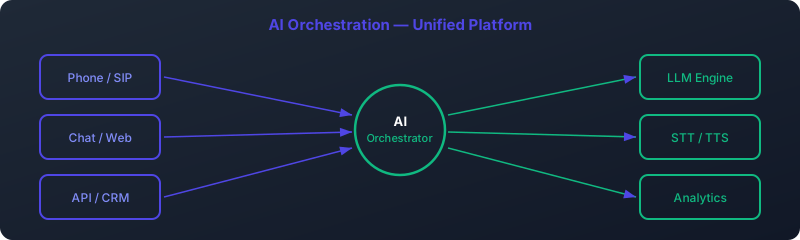
Air AI (also known as Agent AI) is a Software-as-a-Service (SaaS) platform designed to create and deploy AI-powered voice agents. These agents can autonomously handle phone calls from start to finish. Unlike simple IVR bots, they are built to manage complex, long-duration conversations that can last 10, 20, or even 30 minutes.
The primary function is to replicate the role of a human sales development representative (SDR) or support agent. Key capabilities include:
- Autonomous Conversations: The AI can understand context, handle interruptions, and navigate complex dialogue trees without human intervention.
- Objection Handling: It's trained to respond to common sales objections, questions, and concerns.
- Task Execution: It can book appointments directly into calendars, send follow-up information, and log call details in a CRM.
- Sales Focus: The platform is heavily optimized for outbound sales, lead qualification, and appointment setting.
It's used by high-growth startups, marketing agencies, and BPOs that need to scale their outreach efforts without linearly scaling their headcount. However, this power comes at a specific price: a pay-per-minute model that becomes a major operational expense at scale.
The Hidden Costs & Limitations: Why Businesses Seek an Air AI Alternative
On the surface, Air AI's pricing of $0.11 per minute might seem reasonable. But for its intended use—long-form conversations—the costs quickly become prohibitive. This is the number one reason companies start looking to replace Air AI.
1. The Prohibitive Cost at Scale
Let's break down the math. The value of an AI agent is its ability to handle detailed calls, not just 60-second reminders. When you apply the per-minute fee to realistic sales scenarios, the picture changes dramatically.
Cost Calculation Example:
- A standard 8-minute lead qualification call: 8 minutes * $0.11/min = $0.88 per call.
- A more in-depth 25-minute discovery call: 25 minutes * $0.11/min = $2.75 per call.
Now, imagine scaling this to 5,000 calls a month. At an average of 8 minutes, your monthly bill would be a staggering $4,400. This cost scales infinitely with your success, penalizing you for running more campaigns.
2. Data Privacy and Security Concerns
When you use a cloud-based SaaS like Air AI, you are sending your most valuable asset—customer data—to a third-party server. Every call recording, transcript, and piece of customer information is stored in their cloud.
Warning: Cloud Data Risks
For businesses in regulated industries like healthcare (HIPAA) or finance, or those handling sensitive personal information (CCPA), this lack of data sovereignty is a significant compliance risk. An Air AI self-hosted approach eliminates this risk by keeping all data within your own secure infrastructure.
3. Lack of Control and Customization
Using a closed platform means you are confined to their ecosystem. You are limited to:
- Their choice of voices: You can't clone the voice of your top salesperson or CEO to create a truly unique brand experience.
- Their feature roadmap: If you need a specific integration or a unique workflow, you have to wait and hope they build it.
- Their integrations: While they connect to major CRMs, custom or internal tool integration can be difficult or impossible.
4. Geographic and Language Limitations
Air AI is primarily built for the US market and operates in English. For companies with a global footprint or a diverse customer base in the US, this is a non-starter. You can't run campaigns in Spanish for your Miami office or in French for your Canadian customers. This is a major driver for businesses to find more flexible Air AI alternatives.
The Self-Hosted Revolution: A Powerful Air AI Competitor
What if you could have all the conversational power of Air AI without the per-minute fees and data privacy headaches? That's the promise of a self-hosted, open-source approach. Instead of renting access to a closed platform, you deploy a complete AI telephony orchestration platform on your own infrastructure.
This "AIO Self-Hosted" model works by integrating best-in-class open-source components into a cohesive system:
- Telephony Engine: A robust engine to manage calls over the internet (VoIP).
- Speech-to-Text (STT): An AI model (like Whisper) to instantly transcribe what the customer is saying.
- Large Language Model (LLM): The "brain" of the operation (like Llama 3 or Mixtral) that understands the context and decides what to say next.
- Text-to-Speech (TTS): A voice generation model (like the powerful mixael-TTS) that converts the LLM's response into natural-sounding human speech.
With an Air AI self-hosted platform, you run this entire stack on your own servers—either on-premise or in your private cloud account (AWS, Azure, GCP). The result? You eliminate the platform's per-minute fee entirely. Your only variable cost is the wholesale rate for the phone call itself from a SIP trunking provider, which is typically less than a cent per minute ($0.008/min), not $0.11/min.
Key Differentiators: Air AI vs. Open Source Self-Hosted
When you compare the two models, the advantages of a self-hosted solution become crystal clear. It's not just about cost; it's about control, flexibility, and future-proofing your AI strategy.
Ultimate Cost Savings
This is the most significant differentiator. Instead of a variable cost that punishes scale, you have a predictable, fixed cost for your server infrastructure. Whether you make 1,000 calls or 100,000 calls, the cost of running the AI software remains the same. This fundamentally changes the ROI of AI telephony.
Unrivaled Data Sovereignty & Compliance
With a self-hosted platform, your customer data, call recordings, and AI models never leave your environment. This is a crucial advantage for:
- HIPAA Compliance: Healthcare organizations can maintain full control over Protected Health Information (PHI).
- GDPR & CCPA: Ensuring compliance with data privacy regulations is simplified when the data resides on your servers.
- Intellectual Property: Your proprietary sales scripts and customer interaction data remain your own.
Hyper-Realistic Voice Cloning with mixael-TTS
Modern open-source TTS engines like mixael-TTS allow for incredible realism and customization. With just a few minutes of audio, you can create a high-fidelity digital clone of any voice. This allows you to:
- Use the voice of your founder or top salesperson for outreach.
- Create a unique, consistent, and ownable brand voice.
- A/B test different voice profiles to see which performs best.
Global Reach with Multilingual Support
An open-source framework is not locked into a single language. By design, our AIO Self-Hosted platform supports multiple languages out-of-the-box, including English, Spanish, French, German, and more. You can deploy agents for different regions and demographics, all managed from a single platform. This makes it a truly global Air AI competitor.
No Call Duration Limits or Penalties
Are your support calls sometimes an hour long? Does a great sales discovery call take 45 minutes? With a self-hosted solution, you are encouraged to have longer, more meaningful conversations. There is no per-minute clock ticking in the background, so your AI agent can spend as much time as needed to resolve an issue or close a deal without bankrupting you.
At a Glance: Air AI vs. AIO Self-Hosted Comparison
This table summarizes the core differences between the two platforms, highlighting why a self-hosted solution is the superior Air AI alternative for businesses focused on scale and control.
| Feature | Air AI | AIO Self-Hosted (Open Source) |
|---|---|---|
| Pricing Model | Pay-per-minute | Fixed infrastructure cost + wholesale telephony |
| Average Platform Cost | $0.11 / minute | $0.00 / minute (platform is free) |
| Data Privacy & Control | Data stored on third-party cloud | 100% on-premise or in your private cloud |
| Voice Cloning | Limited to platform-provided voices | Unlimited, high-fidelity cloning (mixael-TTS) |
| Language Support | English (US-focused) | Multilingual (EN, ES, FR, DE, etc.) |
| Call Duration | Financially penalized for long calls | Unlimited, no per-minute cost penalty |
| Infrastructure | Closed SaaS platform | Runs on your own hardware or cloud |
| Customization & Integration | Limited by platform's API and roadmap | limitless, full source code access |
ROI in Action: A Real-World Cost Breakdown
Let's revisit the cost analysis with a concrete example. Consider a US-based sales team that needs to make 10,000 outbound qualification calls per month, with an average call length of 5 minutes.
Total Monthly Call Time: 10,000 calls * 5 minutes/call = 50,000 minutes
(50,000 min * $0.11/min)
(Infrastructure + Wholesale Telephony)
With Air AI, the cost is straightforward and high: $5,500 every single month.
With an AIO Self-Hosted solution, the cost structure is different. You have a fixed cost for the server running the AI, plus the wholesale cost of the calls. A capable server can be run in the cloud for a low monthly fee, and wholesale telephony costs are minimal. For this volume, a realistic all-in monthly cost is around $200-$300. This includes your server and all your telephony minutes.
The result is a cost saving of over 95%. That's more than $60,000 a year back in your budget that can be reinvested into growth, not operational overhead.
A Brief Look at Other Air AI Alternatives
While our focus is on the Air AI vs open source debate, it's worth noting other players in the market to provide a complete picture.
Bland AI
Bland AI is another cloud-based competitor that offers a similar service to Air AI. Their main selling point is a slightly lower per-minute rate (often around $0.07-$0.10/min) and a developer-friendly API. However, it shares the same fundamental drawbacks as Air AI: it's a closed, cloud-based system where you pay per minute and your data resides on their servers. It's a cheaper alternative, but not a fundamentally different one.
Retell AI
Retell AI is an API-first platform for developers looking to build their own voice agents. It provides a lower-level infrastructure for managing the real-time conversation flow. While powerful, it requires significant development resources to build a complete solution. It's less of a direct Air AI competitor and more of a toolkit for engineering teams. A platform like our AIO Self-Hosted solution sits in the sweet spot, providing a pre-integrated, complete application that is still fully customizable, saving you months of development time compared to starting with Retell.
Conclusion: Why Self-Hosted is the Future for AI Telephony
Air AI deserves credit for popularizing the concept of long-form conversational AI. However, its first-generation SaaS model is already becoming obsolete for savvy businesses. The "tax" of per-minute pricing, coupled with valid concerns over data privacy and lack of customization, makes it an unsustainable choice for any company looking to scale its voice AI operations.
The clear winner and the most logical next step is a self-hosted, open-source Air AI alternative. This approach delivers:
- Massive Cost Reduction: Slashing operational expenses by up to 95%.
- Complete Data Control: Ensuring security and simplifying compliance.
- Unlimited Customization: From voice cloning to deep CRM integrations.
- Global Scalability: Deploying multilingual agents anywhere in the world.
If you're ready to move beyond the limitations of the cloud and take full ownership of your AI telephony stack, it's time to explore a self-hosted solution. Explore our AI Orchestration platform and discover how you can achieve superior performance and ROI.
Frequently Asked Questions
Is a self-hosted Air AI alternative difficult to set up?
While building a system from individual open-source components requires deep technical expertise, using a pre-packaged orchestration platform like ours makes it much simpler. We provide a streamlined deployment process for on-premise servers or major cloud providers like AWS and GCP, complete with comprehensive documentation. It's designed to be managed by a standard IT team.
What kind of hardware do I need to run a self-hosted solution?
The hardware requirements depend on your concurrent call volume. For most small to medium-sized businesses, a single server equipped with a modern consumer or professional-grade GPU (e.g., an NVIDIA RTX 4070 or A-series card) is more than sufficient to handle dozens of simultaneous calls. We provide detailed hardware recommendations based on your specific needs.
Is the voice quality as good as Air AI?
Yes, and in many ways, it's better because it's more flexible. We utilize state-of-the-art, open-source Text-to-Speech (TTS) engines like Coqui mixael-TTS. These models produce incredibly natural, low-latency speech and, most importantly, allow for high-fidelity voice cloning from just a small audio sample. You can create a voice that is unique to your brand, which is a powerful advantage.
How does self-hosting affect compliance with regulations like the TCPA?
Your legal obligations under the Telephone Consumer Protection Act (TCPA)—such as obtaining consent, respecting do-not-call lists, and adhering to calling time restrictions—remain the same regardless of the technology you use. A self-hosted platform does not change these business process requirements. However, it gives you greater technical control over data handling and storage, which is a major benefit for complying with data privacy laws like HIPAA and CCPA.
Can I integrate a self-hosted solution with my CRM like Salesforce or HubSpot?
Absolutely. This is one of the core strengths of an open, self-hosted platform. They are built with an API-first philosophy. This means you can create deep, custom integrations with any system that has an API, including CRMs, internal databases, and proprietary business software. You are not limited to the pre-built, often shallow integrations offered by SaaS vendors.
What are the "hidden" costs of going self-hosted?
The costs are transparent and predictable. The main components are: 1) The server hardware, which is either a one-time capital expense or a predictable monthly fee from a cloud provider. 2) The wholesale SIP trunking cost for your phone numbers and per-minute telephony, which is typically under one cent per minute. 3) The internal IT time to manage the server. When you compare this predictable model to the infinitely scaling per-minute fees of SaaS, the total cost of ownership for a self-hosted solution is dramatically lower at any significant scale.