Table of Contents
- The Unspoken Crisis in US Healthcare Communication
- The HIPAA Compliance Game-Changer: Why Self-Hosted AI is the Safest Path
- Transforming Patient Journeys: 7 Core Use Cases for AI Voice in Healthcare
- Seamless Integration with Your Existing EHR System
- An AI Voice Solution for Every US Healthcare Specialty
- The Modern Healthcare Workflow: Humans and AI in Harmony
- Calculating Your ROI: More Than Just Saved Time
- The Competitive Landscape: Why Self-Hosted AI Voice Beats Subscription Models
- A Multi-Layered Compliance & Accessibility Framework
- Frequently Asked Questions
The Unspoken Crisis in US Healthcare Communication
In the bustling environment of a modern US healthcare practice, the telephone is both a lifeline and a bottleneck. Your front desk staff are heroes, managing a relentless flood of calls while simultaneously greeting patients, handling paperwork, and coordinating care. But the numbers paint a stark picture of an unsustainable situation. The average general practitioner's office in the USA fields over 200 calls per day. A staggering 40% of these calls—up to 80 a day—are for the routine, yet time-consuming, task of appointment scheduling.
This constant deluge of calls creates a cascade of negative consequences:
- Patient Frustration: Long hold times and busy signals lead to frustrated patients who may delay care or switch providers.
- Staff Burnout: Administrative staff are overwhelmed, leading to high turnover rates and a decline in the quality of patient interaction.
- Operational Inefficiency: When staff are tied up on the phone scheduling appointments, critical tasks like processing insurance claims or assisting in-office patients are delayed.
- Lost Revenue: Every abandoned call is a potentially lost appointment. Inefficient scheduling can lead to gaps in the calendar and underutilized resources.
As we look towards 2026, the challenges of rising patient expectations and nationwide staffing shortages are set to intensify. The solution isn't to hire more staff to answer phones; it's to fundamentally change how your practice handles voice communication. This is where the strategic implementation of AI voice for healthcare in the USA becomes a revolutionary advantage, turning your phone system from a liability into your most efficient asset.
The HIPAA Compliance Game-Changer: Why Self-Hosted AI is the Safest Path
For any healthcare technology in the USA, the conversation begins and ends with HIPAA. The Health Insurance Portability and Accountability Act sets the standard for protecting sensitive patient data, or Protected Health Information (PHI). When a healthcare provider uses a third-party vendor that handles PHI—like a typical cloud-based AI service—they must have a signed Business Associate Agreement (BAA) in place. This BAA legally obligates the vendor to uphold HIPAA standards.
However, this model introduces inherent risks. Your patients' sensitive data is transmitted to and processed on a third-party's servers, creating another potential point of failure or data breach. You are placing trust in their security protocols, their employee training, and their entire infrastructure.
Warning: The Hidden Risks of Cloud-Based Healthcare AI
Most AI voice solutions are cloud-based SaaS (Software-as-a-Service) products. While they will offer a BAA, your patient data still leaves your direct control. A data breach at their end becomes your problem, potentially leading to hefty fines, reputational damage, and a loss of patient trust. You are outsourcing your security, not just a service.
Our approach is fundamentally different and inherently more secure. We offer a self-hosted or on-premise HIPAA AI receptionist. This means the AI software runs entirely within your own secure IT environment—on your servers, behind your firewall.
The advantages are profound:
- No BAA Required: Because the AI and all the data it processes never leave your controlled environment, it's not considered a separate business associate. This dramatically simplifies your compliance burden.
- Ultimate Data Sovereignty: You maintain 100% control over all PHI. Data is not transmitted to or stored by any third party, eliminating a major vector for cyberattacks.
- Enhanced Security: The AI is protected by your existing, trusted security infrastructure, from firewalls to access control policies.
- Improved Performance: With the AI running on your local network, latency is minimized, resulting in faster, more natural-sounding conversations with patients.
By choosing a self-hosted solution, you are not just buying a tool; you are adopting the most secure and compliant architecture for a medical AI answering service in the USA.
Transforming Patient Journeys: 7 Core Use Cases for AI Voice in Healthcare
An advanced healthcare AI phone agent does far more than just answer calls. It intelligently manages the entire patient communication lifecycle, 24/7, freeing your staff to focus on high-value, in-person care. Here are the core use cases transforming practices across the United States.
1. AI Scheduling for Medical Offices: Reclaim Your Calendar
This is the number one time-saver. Our AI agent can handle the entire appointment scheduling process over the phone. It integrates directly with your EHR's calendar via FHIR APIs, ensuring real-time availability. The AI can:
- Differentiate between new and existing patients.
- Understand requests like "I need a check-up next Tuesday afternoon" or "Do you have anything for Dr. Smith this week?"
- Offer available slots and confirm appointments via voice and an automated SMS confirmation.
- Handle cancellations and rescheduling requests, automatically opening up the slot for another patient.
- Manage complex schedules for multiple doctors, locations, and appointment types (e.g., annual physical vs. sick visit).
2. Streamlined Patient Intake: Better Data, Faster Visits
Reduce waiting room time and improve data accuracy. Before a scheduled appointment, the AI can proactively call the patient to conduct a preliminary intake. It can conversationally collect and update:
- Basic demographic information.
- Insurance policy and group numbers.
- Primary symptoms or reason for the visit.
- Allergies and current medications.
This information is then securely pushed directly into the patient's record in your EHR, ensuring the clinical team is fully prepared before the patient even walks through the door.
3. Automated Prescription Refill Requests
Free up your nurses and medical assistants from fielding dozens of refill calls a day. The AI voice agent acts as a secure gatekeeper. The process is simple and safe:
- The patient calls and requests a refill.
- The AI authenticates the patient's identity (e.g., name and date of birth).
- It confirms the medication name and dosage.
- The AI creates a task or secure message within the EHR, assigned to the appropriate clinical staff for review and approval.
Crucially, the AI does not approve prescriptions. It simply automates the tedious information-gathering and request-logging process, ensuring every request is documented, tracked, and sent to a human for clinical sign-off.
4. Proactive Lab Result Notifications
This is a delicate but powerful use case. To maintain strict HIPAA compliance, the AI does not deliver the actual results. Instead, it provides a simple, automated notification: "Hello, this is a message from [Your Practice Name] for John Doe. Your recent lab results are now available. Please log in to your patient portal or call our office during business hours to discuss them with our clinical team." This simple outbound call eliminates patient anxiety from waiting and prevents them from calling your office repeatedly.
5. Intelligent After-Hours Triage
A sophisticated AI voice for doctor office can provide immense value and reduce liability after your office is closed. When a patient calls with a concern, the AI can guide them through a carefully scripted triage protocol:
- Non-Urgent: "It sounds like this can be addressed during normal business hours. Would you like me to schedule an appointment for tomorrow?"
- Urgent: "Based on your symptoms, we recommend you contact our on-call provider. Please hold while I connect you."
- Emergency: "If you are experiencing chest pain, difficulty breathing, or a medical emergency, please hang up and dial 911 immediately."
6. Instant Insurance Verification
Before a new patient's first appointment, the AI can perform a basic, automated insurance eligibility check. By connecting to insurance clearinghouses via API, it can confirm if a patient's policy is active. This simple step can prevent costly billing errors and claim denials down the line, saving your administrative team hours of follow-up work.
7. Post-Discharge Follow-up & Reminders
Improve patient outcomes and reduce readmission rates with automated follow-up calls. The AI can call patients a day or two after a procedure or hospital discharge to:
- Ask a series of simple wellness questions ("Are you experiencing a fever?").
- Remind them to take their medication.
- Confirm their follow-up appointment.
Any concerning answers can trigger an alert for a nurse to follow up with a personal call.
Seamless Integration with Your Existing EHR System
An AI voice agent is only as smart as the data it can access. That's why deep, bidirectional integration with your Electronic Health Record (EHR) system is non-negotiable. Our platform is built on modern standards, primarily using the FHIR (Fast Healthcare Interoperability Resources) API. This is the universal language for health data exchange, supported by all major EHR vendors.
This allows our AI voice healthcare USA solution to read calendar availability, write appointment data, create tasks, and update patient records in real-time. We have proven, robust integrations with the systems you use every day:
| EHR Vendor | Scheduling Integration | Patient Intake Integration | Task/Messaging Integration |
|---|---|---|---|
| Epic | ✅ Full Read/Write | ✅ Write to Patient Chart | ✅ Create In Basket Message |
| Cerner | ✅ Full Read/Write | ✅ Write to Patient Record | ✅ Create Task |
| athenahealth | ✅ Full Read/Write | ✅ Write to Patient Case | ✅ Create Patient Case |
| eClinicalWorks | ✅ Full Read/Write | ✅ Write to Progress Note | ✅ Create Telephone Encounter |
This seamless integration, powered by our AI Orchestration Engine, ensures that the AI phone agent acts as a true extension of your clinical and administrative workflow, not just another siloed tool.
An AI Voice Solution for Every US Healthcare Specialty
While the core challenges of phone-based communication are universal, each medical specialty has unique needs. Our AI voice platform is highly customizable to serve a wide range of practices:
- Primary Care: Manages the high volume of annual physicals, sick visits, and follow-up appointments, differentiating between appointment types to allocate the correct amount of time.
- Dental Practices: Can distinguish between a routine cleaning, a filling, and a consultation for a complex procedure like a root canal, booking appointments with the right provider (dentist vs. hygienist) for the right duration.
- Dermatology: Handles scheduling for cosmetic consultations, routine skin checks, and specific procedures, while also managing waitlists for popular providers.
- Optometry & Vision: Schedules comprehensive eye exams, contact lens fittings, and medical eye condition follow-ups, ensuring a smooth patient flow.
- Physical Therapy: Manages the complexity of recurring appointments, scheduling a full series of visits at once and sending reminders to reduce no-shows.
- Mental Health: Provides a discreet, non-judgmental, and always-available first point of contact for new patients seeking care, gathering initial information privately before connecting them with staff.
The Modern Healthcare Workflow: Humans and AI in Harmony
The goal of a healthcare AI phone agent is not to replace your valued front desk staff, but to empower them. By automating the high-volume, repetitive tasks, you elevate your human staff to roles where their empathy, critical thinking, and personal touch matter most.
Here’s how the new workflow looks in practice:
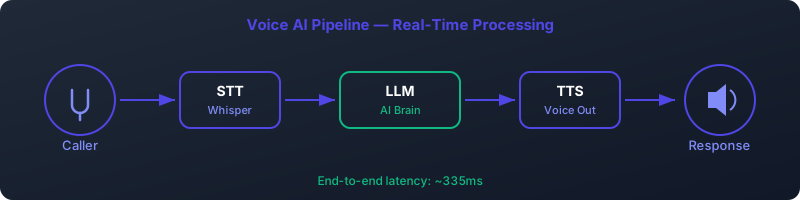
- AI First: All calls are initially answered by the AI agent, instantly and without a busy signal, 24/7.
- Intent Recognition: The AI determines the caller's need (e.g., scheduling, refill, question for a nurse).
- Automated Resolution: For routine tasks—which account for ~70% of calls—the AI completes the request independently. A patient schedules an appointment and the call ends in under two minutes.
- Intelligent Escalation: For complex clinical questions, billing disputes, or when a caller is emotionally distressed or simply says "I want to speak to a person," the AI seamlessly transfers the call to the appropriate staff member. It can even provide a "whisper" to the staff member summarizing the caller's request, so they are prepared before saying hello.
This symbiotic relationship means your patients get immediate service for simple needs, and your staff are free to provide focused, high-quality support for more complex issues.
Calculating Your ROI: More Than Just Saved Time
Implementing an AI voice solution is an investment in your practice's efficiency and profitability. The Return on Investment (ROI) is clear, measurable, and rapid.
Let's focus on the most significant impact: freeing up front desk staff from scheduling calls. If your practice receives 200 calls per day, and 40% are for scheduling (80 calls), with each call taking an average of 3-4 minutes, that's 240-320 minutes spent just on scheduling. Our AI can handle the vast majority of these.
A Simple ROI Calculation
Let's be conservative. The AI handles 150 routine calls per day. At an average of 2 minutes per call saved (compared to a manual process), that's 300 minutes, or 5 hours of staff time saved every single day.
If your front desk staff's blended hourly rate (including benefits) is $25/hour, that's $125 saved per day, or approximately $2,500 per month. This allows your existing staff to focus on revenue-generating activities like pursuing unpaid claims or improving patient experience, further compounding your ROI.
Beyond direct time savings, the ROI includes:
- Reduced No-Shows: Automated reminders and easy rescheduling reduce missed appointments by up to 30%.
- Increased Patient Acquisition: By answering 100% of calls, you capture potential new patients who would have hung up and called a competitor.
- Improved Staff Retention: Reducing burnout and administrative burden leads to happier employees and lower turnover costs.
- Enhanced Reputation: A modern, efficient patient experience leads to better online reviews and stronger word-of-mouth referrals.
The Competitive Landscape: Why Self-Hosted AI Voice Beats Subscription Models
The market for AI voice healthcare USA is growing, with several players like Nuance (now part of Microsoft), Hyro AI, and Suki making inroads. Most of these competitors operate on a cloud-based, Software-as-a-Service (SaaS) model. You pay a recurring monthly or annual subscription fee for access to their platform.
While this model can have a lower initial cost, it presents long-term challenges:
- Perpetual Costs: Subscription fees are a permanent operational expense that often increases over time.
- Data Control Issues: As discussed, your PHI resides on their servers, creating a compliance and security dependency.
- Vendor Lock-In: Migrating away from a deeply integrated SaaS provider can be complex and costly.
- Limited Customization: You are often limited to the features and workflows offered by the vendor, with less flexibility to tailor the solution to your unique practice needs.
Our self-hosted model offers a compelling alternative, positioning the technology as a long-term capital asset rather than a recurring expense. The key advantages are:
- Ownership & Control: You own the software license and control the infrastructure. There are no perpetual subscription fees for the core platform.
- Unmatched Security: Your data never leaves your firewall, providing the highest level of HIPAA compliance and peace of mind.
- Total Customization: We work with you to tailor the AI's scripts, workflows, and integrations to perfectly match your practice's operations.
- Predictable Costs: A one-time licensing fee (or a clear, finite payment structure) and an optional annual maintenance contract make budgeting predictable and transparent.
For practices that prioritize data security, long-term cost control, and operational autonomy, a self-hosted medical AI answering service is the clear strategic choice.
A Multi-Layered Compliance & Accessibility Framework
True enterprise-grade healthcare technology must go beyond the basics. Our platform is built on a foundation of multi-layered compliance and accessibility:
- HIPAA: As detailed, our self-hosted architecture provides the most robust path to HIPAA compliance by keeping PHI within your control. All data, both in transit and at rest, is encrypted.
- State Medical Board Guidelines: We work with you to ensure all automated communication, from triage scripts to notifications, adheres to the specific guidelines set forth by your state's medical board.
- TCPA (Telephone Consumer Protection Act): For all outbound automated calls (like reminders or notifications), we manage an ironclad consent process, ensuring you have documented permission to contact patients, protecting you from potential litigation.
- ADA (Americans with Disabilities Act): Accessibility is paramount. Our AI voice agents are designed with clear, natural-sounding speech. For patients who are deaf or hard of hearing, the system can seamlessly integrate with TTY/TDD services and offer SMS/text-based interaction as an alternative, ensuring equitable access for all.
By addressing compliance from every angle, we provide a solution that is not only powerful but also safe, legal, and ethical. Ready to see how a dedicated AI voice agent can revolutionize your practice? The future of patient communication is here.
Frequently Asked Questions
How does the AI handle different patient accents, dialects, and languages?
Our AI is trained on vast datasets of spoken language from across the United States, allowing it to understand a wide variety of regional accents and dialects with high accuracy. For non-English speaking patients, we can deploy models for common languages like Spanish, Mandarin, and others, automatically detecting the language spoken or offering a prompt (e.g., "Para continuar en español, oprima dos").
What is the implementation and training process like for our staff?
Implementation is a collaborative process. Our team works with your IT staff to deploy the software within your environment and with your practice manager to configure the call flows and scripts. Training for your staff is minimal because the AI is designed to work in the background. We provide a short training session on how to handle escalated calls and view the AI's activity log, but most staff simply notice their phones ring less often.
How much does a self-hosted AI voice solution cost?
Unlike subscription models, our pricing is based on a one-time perpetual license fee, which varies based on the size of your practice (number of providers and locations) and the complexity of the required EHR integrations. We also offer an optional annual support and maintenance contract. This model provides a much lower Total Cost of Ownership (TCO) over 3-5 years compared to a recurring SaaS fee. A typical small-to-medium practice can expect to see a full return on investment in 12-18 months. For a detailed quote, please contact our sales team.
Is my patient data truly safe?
Yes. This is the cornerstone of our self-hosted model. All voice data and PHI are processed and stored entirely within your own secure server environment, behind your firewall. Data never travels to our servers or any third party. You maintain 100% control, making it the most secure and HIPAA-compliant architecture available.
Can the AI understand complex medical terminology or symptom descriptions?
The AI is designed to handle common medical terms related to scheduling and intake (e.g., "follow-up," "consultation," "physical," "headache," "fever"). However, its primary role is not to diagnose. For complex symptom descriptions or clinical questions, it is programmed to safely escalate the call to a qualified human, such as a nurse or medical assistant, ensuring no medical advice is ever given by the AI.
What happens if the AI makes a mistake or misunderstands a patient?
Our system has several layers of safeguards. If the AI is uncertain about a caller's intent after two attempts, its default behavior is to politely escalate to a human operator. "I'm having a little trouble understanding. Let me connect you with one of our patient coordinators who can help." All calls are logged and can be reviewed, allowing for continuous improvement of the AI's performance and scripts.
Will this AI voice agent replace my front desk staff?
No. It will empower them. The AI handles the repetitive, low-value calls, which frees your staff to focus on more complex, high-value tasks: providing exceptional in-person service, managing complex billing issues, conducting detailed patient follow-ups, and handling calls that require human empathy and judgment. Practices that adopt our AI report higher staff morale and lower turnover.
How does this integrate with our existing PBX or VoIP phone system?
Our solution is designed to integrate seamlessly with virtually any modern phone system, whether it's an on-premise PBX or a cloud-based VoIP service (like RingCentral, 8x8, etc.). We use standard SIP (Session Initiation Protocol) trunking to receive and manage calls. From your phone system's perspective, our AI simply looks like another phone line or extension.
Can we customize the AI's voice and greeting scripts?
Absolutely. We offer a selection of high-quality, natural-sounding male and female voices. More importantly, all scripts are fully customizable. We work with you during the setup process to ensure the AI's language, tone, and call flows perfectly match your practice's brand and operational procedures, from the initial greeting to the closing confirmation.
How does the AI handle emergency calls?
This is a critical safety feature. The AI is programmed with keyword spotting for emergency terms (e.g., "chest pain," "can't breathe," "emergency"). Upon detecting these terms, or if