Table of Contents
- Understanding HIPAA in the Age of AI Voice
- The Cloud Conundrum: Why SaaS AI Voice Agents Create HIPAA Headaches
- The On-Premise Revolution: A Truly HIPAA Compliant AI Voice Agent
- Your Responsibilities: Securing Your Self-Hosted HIPAA AI
- Transforming Patient Engagement: Use Cases for a HIPAA Voice AI
- Seamless Integration with Your Healthcare Ecosystem
- Our Approach to Compliance and Security
- Frequently Asked Questions
The healthcare industry stands at a crossroads. The potential for Artificial Intelligence to revolutionize patient communication, streamline administrative tasks, and improve outcomes is immense. Yet, one monumental regulation stands as a gatekeeper to this innovation: the Health Insurance Portability and Accountability Act of 1996 (HIPAA). For years, the complexities of HIPAA have made adopting cutting-edge AI voice technology a risky, expensive, or outright impossible proposition for most healthcare organizations.
The core of the problem lies in the cloud. Nearly every AI voice agent on the market operates on a Software-as-a-Service (SaaS) model, processing sensitive patient data on third-party servers. This model inherently creates a chain of liability that requires expensive, complex legal agreements and places ultimate trust in vendors. But what if there was a better way? What if you could harness the full power of conversational AI without ever letting a single byte of Protected Health Information (PHI) leave your secure environment? This is not a far-off future concept; this is the reality of a HIPAA compliant AI voice agent built for 2026 and beyond—an agent that runs entirely on-premise, under your control.
Understanding HIPAA in the Age of AI Voice
Before diving into the solution, it's crucial to understand the specific HIPAA rules that govern the use of technologies like AI voice agents. While the full text of the law is vast, its application to AI telephony boils down to a few core principles. Understanding these is the first step toward a compliant implementation.
What is Protected Health Information (PHI)?
Under HIPAA, PHI is any individually identifiable health information. The "identifiable" part is key. If a piece of health data can be linked back to a specific person, it's PHI. This includes not just the obvious, but a wide range of data points an AI voice agent will encounter in a typical conversation:
- Patient names, addresses, phone numbers, and birth dates
- Social Security numbers
- Medical record numbers
- Diagnoses, conditions, or treatments (e.g., "I'm calling to refill my prescription for Metformin.")
- Appointment dates and times linked to a patient
- Test results or discussions about them
- Any unique identifying number, characteristic, or code
In short, nearly any meaningful conversation between a patient and a healthcare provider's phone system involves PHI.
Who Must Comply: Covered Entities and Business Associates
HIPAA regulations apply to two main groups:
- Covered Entities (CEs): These are the frontline healthcare organizations. This includes hospitals, clinics, private practices, dental offices, pharmacies, and health insurance companies. If you provide treatment, bill for healthcare, or are involved in healthcare operations, you are likely a Covered Entity.
- Business Associates (BAs): This is any person or entity that performs functions or activities on behalf of a Covered Entity that involve the use or disclosure of PHI. This includes billing companies, IT providers, data analytics firms, and, crucially, any cloud-based AI voice platform that processes your calls.
Key HIPAA Safeguards for AI
The HIPAA Security Rule mandates specific safeguards to protect electronic PHI (ePHI). For a HIPAA AI voice agent, these are non-negotiable.
- Technical Safeguards: These are the technology-based controls.
- Access Control: Systems must be in place to ensure only authorized individuals can access ePHI. This means unique user IDs, role-based permissions, and automatic logoffs.
- Audit Controls: You must have the ability to record and examine activity in information systems that contain or use ePHI. This means detailed logs of who accessed what data, and when.
- Integrity Controls: You must protect ePHI from improper alteration or destruction.
- Transmission Security: ePHI must be encrypted whenever it is transmitted over an external network.
- Administrative Safeguards: These are the policies and procedures that govern your organization's conduct.
- Business Associate Agreement (BAA): This is the most critical administrative safeguard when dealing with third-party vendors. A BAA is a legally binding contract that requires a Business Associate to maintain the same level of PHI protection as the Covered Entity. Without a BAA in place, sharing PHI with a vendor is a direct HIPAA violation.
The BAA is Non-Negotiable
If a vendor's technology touches, processes, or stores your patients' PHI in any way, you MUST have a signed Business Associate Agreement with them. There are no exceptions. Failure to do so can result in significant fines, reputational damage, and corrective action plans from the U.S. Department of Health and Human Services (HHS).
The Cloud Conundrum: Why SaaS AI Voice Agents Create HIPAA Headaches
The modern AI stack is a marvel of interconnected cloud services. A typical AI voice agent, even one marketed for business, relies on a chain of external platforms to function. This "cloud-native" approach is the single biggest obstacle to achieving true HIPAA compliance in AI telephony.
Consider the data flow for a standard SaaS AI voice agent when a patient calls your clinic:
- The patient's voice is streamed from your phone line to the AI vendor's platform (e.g., Vapi, Retell AI). PHI has now left your building.
- The AI platform sends the audio to a cloud Speech-to-Text (STT) service like Google Cloud Speech or Deepgram to be transcribed. PHI has been shared with a second vendor.
- The resulting text ("Hi, this is Jane Doe, I need to reschedule my 3 PM appointment with Dr. Smith") is sent to a Large Language Model (LLM) like OpenAI's GPT-4 or Anthropic's Claude for understanding. PHI has been shared with a third vendor.
- The LLM generates a response, which is sent to a cloud Text-to-Speech (TTS) service like ElevenLabs or Play.ht to create audio. PHI (in the context of the response) is processed by a fourth vendor.
- The final audio is streamed back to the patient.
In this common scenario, sensitive patient data has been processed by at least four different companies. To be compliant, you would need a signed BAA not only with the primary AI platform but also assurances that they have BAAs with all their downstream subprocessors (OpenAI, Google, etc.). This creates a fragile and complex chain of custody for your most sensitive data.
The BAA Bottleneck
The reality is that obtaining these BAAs is a significant challenge. The AI market was not built with HIPAA in mind.
- High Costs: Some platforms, like Vapi, do offer a BAA. However, this is typically restricted to their highest-tier "Enterprise" plans, which can cost upwards of $10,000 per year just for the legal agreement, before you even pay for usage. This prices out most clinics and mid-sized practices.
- Limited Support: Other vendors, like Retell AI, have vague or limited HIPAA policies, leaving the burden of compliance and risk squarely on the healthcare provider.
- No BAA Available: The vast majority of AI telephony startups and even major players like ElevenLabs (for their standard tiers) simply do not offer a BAA. Using their services for any patient-facing communication is a guaranteed HIPAA violation.
This leaves healthcare organizations with a terrible choice: pay exorbitant enterprise fees, assume massive compliance risks, or forgo the benefits of modern AI altogether. Until now.
The On-Premise Revolution: A Truly HIPAA Compliant AI Voice Agent
We've engineered a solution that sidesteps the cloud conundrum entirely. Our approach is built on a simple but powerful principle: Your patients' data should never leave your control. By deploying our entire AI voice stack on-premise—on your servers, within your firewall—we eliminate the fundamental risk vector of cloud-based solutions.
The Paradigm Shift: PHI Never Leaves Your Servers
With our self-hosted HIPAA AI solution, the data flow is completely transformed. It becomes internal, secure, and entirely under your governance.
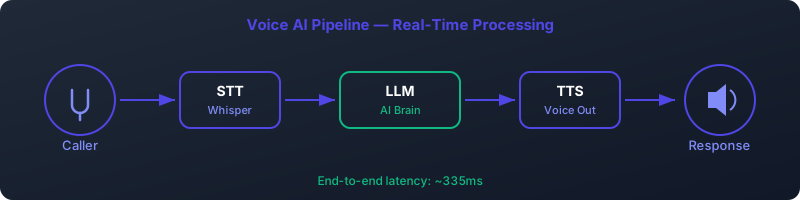
- The patient's voice enters your telephony system (PBX or SIP Trunk).
- The call is routed to a server inside your network running our AI orchestration software.
- Our software processes the audio using an on-premise STT engine (e.g., a local instance of Whisper). The audio and text never leave the server.
- The transcript is passed to an on-premise LLM (e.g., a fine-tuned Llama 3 or Mixtral model) running on the same or an adjacent server in your data center.
- The LLM's response is generated and converted back to audio by an on-premise TTS engine.
- The audio is passed back through your telephony system to the patient.
At no point in this process is PHI transmitted to us, OpenAI, Google, Amazon, or any other third party. The data lives and dies within your secure infrastructure. This fundamental architectural difference is what makes our solution uniquely suited for healthcare.
No BAA Required with Us
Because our software runs on your hardware and we never see, receive, process, or store any PHI, we function as a pure software provider, not a Business Associate. This dramatically simplifies your compliance overhead. You buy the software license, you own the data, and you maintain full control. It's that simple.
Our Self-Hosted Technology Stack
We provide a complete, containerized software package that your IT team can deploy on your own servers. This package includes state-of-the-art, open-source components configured for security and performance.
- AI Orchestration: Our proprietary engine, the "brain" of the system, manages the flow of data between components, handles telephony integration, and connects to your EHR. Learn more about our self-hosted AI orchestration platform.
- Speech-to-Text (STT): We utilize locally hosted, GPU-accelerated versions of models like OpenAI's Whisper, which provide exceptional accuracy, even with medical terminology and diverse accents.
- Large Language Models (LLM): Deploy powerful open-source models like Llama 3 or Mixtral 8x7B. These can be fine-tuned on your specific workflows and knowledge bases for unparalleled contextual understanding.
- Text-to-Speech (TTS): Use high-quality, on-premise TTS engines that produce natural, low-latency voice responses, which can be cloned or customized to fit your clinic's brand.
Your Responsibilities: Securing Your Self-Hosted HIPAA AI
An on-premise solution provides ultimate control, and with that control comes responsibility. While we provide the secure software, you provide the secure environment. This "shared responsibility" model is the foundation of a robust, defensible compliance strategy. You are not outsourcing your security; you are extending your existing HIPAA compliance framework to a powerful new tool.
Here’s what you’ll need to provide and maintain for a compliant deployment of a self-hosted HIPAA AI:
Infrastructure and Network Security
- Secure Server Environment: The AI software needs to be installed on a server—either physical or virtual—that is under your control. This server should be hardened according to security best practices.
- Encrypted Storage: The server's disks must be encrypted at rest (e.g., using BitLocker, LUKS, or native VM encryption). This ensures that even if the physical hardware is compromised, the data, call logs, and transcripts remain unreadable.
- Access Controls: Physical and network access to the server must be strictly controlled and logged, just as you would for your primary EHR database server.
- Firewall and Network Segmentation: The server should be placed in a secure network segment, with firewall rules that only allow the minimum necessary traffic (e.g., from your SIP trunk and to your EHR API endpoint).
- Secure Remote Access: Any administrative access to the system must be conducted over a secure, encrypted connection, such as a VPN with multi-factor authentication.
Operational Best Practices
- Regular Audits: Your IT team should perform regular security audits and vulnerability scans on the host server and the AI software stack.
- Patch Management: A formal process for applying security patches to the underlying operating system and software components is essential.
- Staff Training: Personnel who will administer the system or review its logs must be trained on your organization's HIPAA policies and procedures, as well as the specifics of the AI system.
- Policy and Procedure Updates: Your organization's HIPAA policies should be updated to include the use of the AI voice agent, covering data retention for logs, access protocols, and incident response.
This may seem like a lot, but for any healthcare organization already compliant with HIPAA, these are extensions of processes you already have in place for your EHR and other critical systems.
Transforming Patient Engagement: Use Cases for a HIPAA Voice AI
Once you have a truly HIPAA compliant AI voice agent, the possibilities for improving efficiency and patient experience are vast. This technology can act as a tireless, 24/7 front-line assistant, handling routine tasks and freeing up your valuable human staff to focus on more complex patient care.
Automated Appointment Scheduling
The AI can integrate with your EHR's scheduling module. Patients can call and say, "I'd like to book a new patient appointment with Dr. Evans," and the AI can conversationally find and offer available slots, then book the appointment directly in your system. It can also handle cancellations and rescheduling, dramatically reducing front-desk call volume. This is the ultimate AI receptionist HIPAA solution.
Intelligent Prescription Refill Requests
A patient can call, authenticate themselves (e.g., with name and DOB), and say, "I need to refill my lisinopril." The AI can query the EHR via its API to verify the prescription is active and has available refills, then route the request to the appropriate provider's queue for one-click approval. If there's an issue (e.g., no refills left), it can intelligently route the call to a nurse.
Pre- and Post-Procedure Communication
Automate outbound calls to deliver pre-op instructions (e.g., "This is a reminder from University Hospital about your procedure tomorrow. Please remember not to eat or drink after midnight.") or post-op check-ins ("This is an automated check-in. On a scale of 1 to 5, how is your pain level?"). Responses can be logged directly into the patient's chart.
Routine Test Result Notification
For non-critical results, the AI can be a huge time-saver. It can make outbound calls to inform patients that their results are normal and available in the patient portal, preventing anxious inbound calls and freeing up nurses from making dozens of routine calls a day.
Important Limitation: Not for Clinical Decision-Making
It is critical to understand that this HIPAA voice AI healthcare tool is designed for administrative and informational tasks. It is not a medical device and should never be used for diagnosis, medical advice, triage of emergent symptoms, or treatment recommendations. All clinical judgment must remain with licensed healthcare providers. The system should be configured to immediately transfer a call to a human if a patient mentions critical symptoms like "chest pain" or "difficulty breathing."
Seamless Integration with Your Healthcare Ecosystem
An AI agent is only as smart as the data it can access. Our on-premise solution is designed from the ground up to integrate securely and deeply with the systems you already use.
Connecting to Your EHR/EMR via HL7 and FHIR
The lifeblood of any modern healthcare IT system is its ability to communicate. Our AI voice agent speaks the language of healthcare data through its native support for industry-standard protocols:
- HL7 (Health Level Seven): The long-standing standard for exchanging clinical and administrative data between healthcare applications.
- FHIR (Fast Healthcare Interoperability Resources): The next-generation standard, providing a more modern, web-based API approach (RESTful APIs) for accessing and manipulating electronic health records.
Our AI agent acts as a secure client within your network. When it needs to check a patient's appointment history or find an open scheduling slot, it sends a secure API call directly to your EHR's FHIR or HL7 endpoint. Because this communication happens entirely within your firewall, it's fast, reliable, and maintains the integrity of your secure perimeter.
This allows for real-time, dynamic conversations. The AI isn't working from a static script; it's interacting with live data from your single source of truth—be it Epic, Cerner, Allscripts, eClinicalWorks, or any other major EHR system with an accessible API.
Telephony and PBX Integration
Our system is also flexible on the voice front, designed to work with your existing telephony infrastructure. It can connect via the standard Session Initiation Protocol (SIP), allowing it to integrate with most modern on-premise or cloud-based PBX systems. Whether you use Cisco, Avaya, Mitel, or a cloud provider like Twilio (for voice transit only), our agent can be configured to receive calls and make outbound dials through your existing channels. See more on our SIP integration capabilities.
Our Approach to Compliance and Security
In the world of healthcare, claiming compliance is easy; proving it is hard. While no software can be "HIPAA Certified" by a government body, we've built our solution to be "HIPAA Ready" by adhering to the principles and technical requirements outlined by the HHS.
Our commitment to security is demonstrated through our architecture:
- Data Isolation by Design: The core principle of keeping PHI on-premise is the single most effective security control.
- Component-Level Security: Each part of our software stack—the database for logging, the containerization technology, the inter-process communication—is configured with security best practices. We utilize technologies that have been vetted and are used in high-security environments worldwide.
- Configurability for Compliance: We provide you with all the necessary controls to meet your HIPAA obligations.
- Audit Logs: Our system generates detailed, immutable audit logs of every call, every API request, and every administrative action. These logs are encrypted and can be exported for review.
- Access Controls: We provide a granular, role-based access control (RBAC) system for managing the AI agent, ensuring that only authorized personnel can change settings or view sensitive logs.
- Data Retention Policies: You can configure the system to automatically purge call recordings and transcripts according to your organization's data retention policies, minimizing your data footprint.
We provide a comprehensive deployment guide and partner with your IT and compliance teams during implementation to ensure every component is configured to align with your organization's specific security posture and HIPAA policies.
Frequently Asked Questions
Q? Since your solution is self-hosted, do I need a Business Associate Agreement (BAA) with your company?
A. No. A BAA is only required when a vendor receives, stores, processes, or transmits PHI on your behalf. Because our software runs entirely on your servers and we never have access to any PHI, we function as a pure software vendor, not a Business Associate. This is the primary compliance advantage of our on-premise model.
Q? What happens if my on-premise server is breached? Who is liable?
A. Under the HIPAA shared responsibility model, the Covered Entity (your organization) is responsible for securing the infrastructure where PHI is stored and processed. This is the same responsibility you have for your EHR server. Our software provides the necessary tools—such as encryption at rest, detailed audit logs, and access controls—to help you secure the data and investigate any incidents, but the ultimate responsibility for securing the server and network lies with you.
Q? Can the AI understand complex medical terms, accents, and low-quality phone lines?
A. Yes. We use state-of-the-art on-premise Speech-to-Text models (like local Whisper) that have excellent performance with medical terminology and a wide range of accents. For specific use cases, the LLM can be further fine-tuned on your organization's documents and common patient interactions to improve its domain-specific knowledge and understanding.