Table of Contents
- What is a "Free" AI Voice Agent, Really?
- The Real Cost Breakdown: SaaS vs. Your Own Open Source Stack
- The Anatomy of Your Free AI Voice Agent: The Open Source Stack
- What's Not Free? The Necessary Costs
- Quick Start Guide: Your First AI Voice Agent in Under an Hour
- Comparison: The "Free" Stack vs. Popular Paid Services
- The Trade-offs: Limitations of the "Free" Approach
- The Future is Open: Why Bother with a Free AI Voice Agent?
- Frequently Asked Questions
The promise of a free AI voice agent sounds like a tech fantasy. In an industry where conversational AI costs are measured in cents per minute, adding up to thousands of dollars monthly, the idea of a zero-cost alternative seems too good to be true. But as we head towards 2026, the convergence of powerful open-source models and accessible hardware is making this fantasy a reality. This isn't about a limited-time trial or a freemium plan with crippling restrictions; it's about building a production-ready, infinitely customizable AI phone agent with zero API subscription fees.
This article is your definitive guide to building just that. We'll dissect what "free" truly means, break down the real-world costs, introduce you to the powerful open-source stack that makes it possible, and provide a roadmap to get you started. If you're a developer, a startup on a shoestring budget, or a business in the USA or UK tired of unpredictable API bills from OpenAI, ElevenLabs, or Deepgram, you're in the right place. Let's unplug from the pay-per-minute matrix and build a no cost AI voice agent you completely own and control.
What is a "Free" AI Voice Agent, Really?
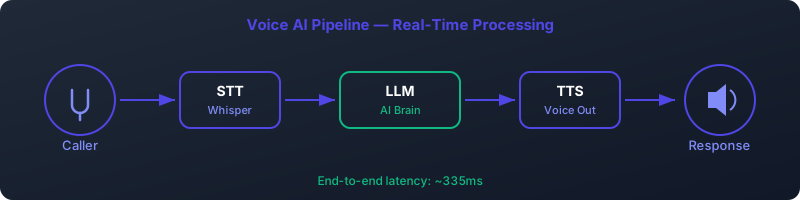
When we talk about a free AI voice agent, we're not talking about magic. We're talking about a fundamental shift in the cost model. The conventional SaaS (Software as a Service) approach, used by most AI voice providers, bundles software, processing, and support into a per-minute fee. It’s convenient but expensive and opaque. You pay for every second of conversation, from the initial greeting to the final goodbye.
Our approach decouples the software from the processing. The "free" part refers to the software itself: a stack of powerful, commercially-permissive, open-source tools that cost nothing to download and use. You are liberated from the tyranny of API keys and monthly subscriptions.
Think of it like this:
- SaaS Model (e.g., Vapi, Bland.ai): This is like taking an Uber everywhere. You pay for every single trip, and the cost adds up quickly. It's easy and requires no maintenance on your part, but you have no control over the vehicle and are subject to surge pricing.
- Open Source Model (This Stack): This is like owning your own car. You have an upfront cost (buying the car/server) and ongoing running costs (gas/electricity, insurance/SIP trunk), but each trip is incredibly cheap. You have total control, you can modify it, and your privacy is assured.
The key takeaway is that the "free" in free voice AI means freedom from licensing fees and API costs. The operational costs—server hardware and telephony connection—are still present, but they are predictable, transparent, and drastically lower than any comparable SaaS solution at scale.
The Real Cost Breakdown: SaaS vs. Your Own Open Source Stack
Let's put some hard numbers on this. We'll model a common business use case: an appointment-booking or customer qualification bot that handles 1,000 calls per month, with an average call duration of 3 minutes. This amounts to 3,000 minutes of conversational AI time.
Scenario 1: The Standard SaaS AI Voice Agent
Most AI voice platforms have a blended rate that covers Speech-to-Text (STT), Large Language Model (LLM) processing, and Text-to-Speech (TTS). A competitive all-in rate is around $0.20 per minute.
- Calculation: 3,000 minutes/month * $0.20/minute
This is a recurring, operational expense that scales directly with your usage. Double your calls, double your cost. There's zero setup or maintenance effort, but you're locked into their ecosystem and pricing.
Scenario 2: The Open Source Stack on a Rented GPU Server
Here, we rent a GPU-powered server from a cloud provider like RunPod, Vast.ai, or Lambda Labs. This is the most common and flexible approach. Your API costs are $0.
- API Costs (LLM, STT, TTS): $0
- GPU Server Rental: A server with an NVIDIA RTX 3080 or A4000 (sufficient for handling several concurrent calls) costs between $50 - $150/month, depending on the provider and server specs.
- SIP Trunking (Phone Number & Minutes): Using a provider like Telnyx, the cost is around $1/month for a US/UK number plus per-minute charges. For 3,000 minutes, at ~$0.01/min (blended inbound/outbound), this is about $30/month.
By opting for an open source AI voice agent free from API costs, you've just cut your monthly bill by over 70%. Your primary cost is now a fixed server rental, making your budget far more predictable.
Scenario 3: The Open Source Stack on Your Own Hardware
For those who prefer full control or have very high volume, running on owned hardware is the ultimate cost-saver. This involves an upfront capital expenditure for a server or a desktop PC with a suitable NVIDIA GPU (e.g., an RTX 3060 12GB or RTX 4070).
- Upfront Hardware Cost: ~$800 - $1500
- API Costs (LLM, STT, TTS): $0
- Recurring Server Cost: $0
- Electricity: A PC running 24/7 might consume ~$20/month in electricity.
- SIP Trunking: Same as above, ~$30/month for 3,000 minutes.
After the initial hardware purchase, your recurring cost for a powerful AI voice agent no API key required is astonishingly low. You're operating at a fraction of the SaaS cost, making this an unbeatable option for long-term, high-volume applications.
The Anatomy of Your Free AI Voice Agent: The Open Source Stack
This powerful, cost-effective solution is made possible by a curated stack of best-in-class open-source projects. Each component is chosen for its performance, permissive licensing (allowing commercial use), and robust community support.
1. The Telephony Backbone: Asterisk
Asterisk is the undisputed king of open-source telephony. It's a free, powerful PBX (Private Branch Exchange) that has been the backbone of VoIP systems for over two decades.
- Role: Manages the actual phone call. It handles the SIP connection to your trunk provider, manages the audio streams (RTP), and provides the logic for call routing.
- Why it's chosen: It's incredibly stable, infinitely flexible, and has a massive global community. It connects to our AI components using the Asterisk Gateway Interface (AGI).
- License: GPLv2 (The software is free to use, modify, and distribute).
- GitHub: github.com/asterisk/asterisk
2. The Brain (LLM): LLM backend 2.5 7B
This two-part combo provides the intelligence for your agent.
- LLM backend: A brilliant tool that makes running large language models on your own hardware incredibly simple. It handles all the complexity of model management and provides a clean, OpenAI-compatible API endpoint for your application to call.
- GitHub: github.com/ollama/ollama
- LLM model: A state-of-the-art 7-billion parameter model from Alibaba Cloud. It's fast, powerful, and excels at conversational tasks. Its size is the sweet spot for running efficiently on consumer-grade GPUs.
- Why it's chosen: Its Apache 2.0 license is fully permissive for commercial use, a critical advantage over many other high-performing models.
3. The Ears (Speech-to-Text): STT engine
To understand what the caller is saying, you need a fast and accurate STT engine.
- Role: Transcribes the caller's speech into text in near real-time.
- Why it's chosen: STT engine is a re-implementation of OpenAI's Whisper model that is up to 4 times faster and uses 2 times less memory. This speed is crucial for reducing conversational latency.
- License: MIT License (Permissive).
- GitHub: github.com/guillaumekln/STT engine
4. The Mouth (Text-to-Speech): mixael-TTS
To speak back to the caller, you need a high-quality, natural-sounding TTS engine.
- Role: Converts the text generated by the LLM into audible speech.
- Why it's chosen: mixael-TTS (from Coqui.ai, now open-sourced) is a game-changer. It offers incredible voice quality and, most importantly, high-quality voice cloning with just a few seconds of audio. You can create a unique, branded voice for your agent. It's also licensed for commercial use.
- License: Coqui Public Model License 1.0.0 (Commercial use allowed).
- GitHub: github.com/coqui-ai/TTS (mixael-TTS is part of this repo).
What's Not Free? The Necessary Costs
To avoid any confusion, let's be crystal clear about the parts of this free AI phone agent that do have a cost.
Server Hardware / GPU Rental
The AI models (LLM, STT, TTS) are computationally intensive. While they can technically run on a CPU, the response time would be far too slow for a natural conversation. A GPU (Graphics Processing Unit) is essential for low-latency performance.
- Why a GPU? GPUs are designed for parallel processing, which is exactly what neural networks need. A decent GPU can run all three models simultaneously and provide responses in under a second.
- Rental Options (USA/UK):
- RunPod: Excellent for getting started, with per-hour billing from as low as $0.30/hr for a powerful GPU.
- Vast.ai: A marketplace for renting GPUs, often with very competitive pricing.
- Google Colab Pro: Good for testing and development, but not intended for production-level deployment.
- Ownership Options: For long-term deployment, buying a PC with an NVIDIA GPU like the RTX 3060 (12GB VRAM), RTX 4060 Ti (16GB VRAM), or better is the most cost-effective path.
SIP Trunking
This is the service that connects your Asterisk server to the global Public Switched Telephone Network (PSTN). It provides you with a phone number and handles the per-minute transit of the call audio.
- How it works: You sign up with a provider, they give you credentials, and you configure Asterisk to register with their service. When someone calls your number, the SIP provider routes the call to your server.
- Providers (USA/UK):
- Telnyx: A developer-favorite with competitive pricing (e.g., ~$0.007/min in the US) and an easy-to-use portal.
- Twilio: A giant in the space, also offers elastic SIP trunking. Often slightly more expensive but very reliable.
- SignalWire / Bandwidth: Other strong contenders in the US and UK markets.
- Cost: Expect to pay around $1/month for the phone number and a per-minute rate typically between $0.005 and $0.015. For our 3,000-minute example, this is a very manageable ~$30/month.
Quick Start Guide: Your First AI Voice Agent in Under an Hour
This high-level guide is for developers comfortable with the Linux command line. The goal is to get a proof-of-concept running on a rented GPU to demonstrate the power of this stack.
- Rent a GPU Server: Go to RunPod.io and deploy a "Community Cloud" pod. Choose a template with CUDA and an NVIDIA RTX 3080 or better. Connect via SSH.
- Install Core Components:
# Update and install Asterisk sudo apt-get update sudo apt-get install -y asterisk # Install Python and pip sudo apt-get install -y python3-pip # Install LLM backend curl -fsSL https://ollama.com/install.sh | sh - Download and Run AI Models:
# Pull the LLM LLM. This will download the model. ollama pull qwen2:7b # In a separate terminal/screen session, run the LLM backend server ollama serve - Install AI Libraries:
# Clone and install the TTS and STT libraries git clone https://github.com/coqui-ai/TTS.git cd TTS pip install -e . cd .. pip install faster_whisper - Write the Orchestration Script (Python AGI): This is the "glue." Create a Python script (e.g., `agent.py`) that uses the Asterisk AGI library. The basic loop will be:
- Listen for audio from Asterisk.
- Send audio to STT engine for transcription.
- Send the transcribed text to the LLM backend API endpoint.
- Receive the LLM's text response.
- Send the response text to the mixael-TTS engine to generate an audio file.
- Play the generated audio file back to the caller via Asterisk.
Note: Writing the full AGI script is beyond the scope of this article, but it's a standard Python task involving API calls and file I/O. For a detailed walkthrough, check out our guide on integrating Asterisk with Python. - Configure Asterisk: Edit `/etc/asterisk/extensions.conf` to execute your Python AGI script when a call comes in. Configure `/etc/asterisk/pjsip.conf` with the credentials from your SIP trunk provider (e.g., Telnyx).
- Test the Call: Reload Asterisk (`rasterisk -x "core reload"`), and call the phone number you purchased. You should be greeted by your very own free voice AI agent!
Comparison: The "Free" Stack vs. Popular Paid Services
How does our open-source stack really compare to the polished, paid platforms? Here’s a head-to-head comparison.
| Feature | Our Open Source Stack | Vapi.ai / Bland.ai | ElevenLabs (TTS only) | ChatGPT Voice ($20/mo) |
|---|---|---|---|---|
| Cost per Minute | $0 (plus server/SIP) | $0.05 - $0.20+ | ~$0.18/1000 chars | N/A (not for telephony) |
| Setup Time | High (hours to days) | Low (minutes) | Low (minutes) | Zero (consumer app) |
| Customization / Control | Total Control | Limited by API | Limited by API | None |
| Voice Cloning | Yes (High-quality via mixael-TTS) | Yes (API-based) | Yes (Core feature) | No |
| Data Privacy | Maximum (data never leaves your server) | Data sent to third-party | Data sent to third-party | Data sent to OpenAI |
| Maintenance Overhead | High (You are responsible) | None | None | None |
| Scalability | Requires engineering effort | Handled by provider | Handled by provider | N/A |
The Trade-offs: Limitations of the "Free" Approach
Building a no cost AI voice agent is incredibly empowering, but it's important to be realistic about the challenges. This path is not for everyone.
- Technical Expertise Required: This is not a no-code solution. You need to be comfortable with the Linux command line, Python scripting, and the basics of how telephony works. You are the system integrator.
- Maintenance is Your Responsibility: If a server goes down, a software package needs an update, or a security vulnerability is found, it's on you to fix it. There is no support number to call.
- Initial Latency Optimization: While this stack is fast, achieving sub-second "time-to-first-token" for the TTS requires careful optimization. SaaS platforms have dedicated teams working solely on this problem. You'll need to fine-tune your model loading, caching, and hardware.
- Scalability is Not Automatic: Scaling from one concurrent call to 100 requires significant architectural work. You'll need to think about load balancing across multiple GPU servers, managing a distributed Asterisk setup, and ensuring your orchestration logic is robust.
- Compliance Burden: If you're operating in a regulated industry in the USA/UK (e.g., healthcare with HIPAA, finance), the responsibility for compliance is 100% yours. While this stack gives you the control to build a compliant system (e.g., by ensuring data is encrypted at rest and in transit), you must design and audit it yourself. SaaS providers may offer a "HIPAA-compliant" plan that shifts some of this burden.
The Future is Open: Why Bother with a Free AI Voice Agent?
Given the trade-offs, why would anyone choose the open-source path? For the right user, the advantages are immense and transformative.
- Unbeatable Economics at Scale: The primary driver. For any business with significant call volume, the cost savings are not just incremental; they are game-changing. Reducing a $6,000/month bill to $500/month can be the difference between profitability and failure.
- Complete Control and Customization: You are not limited by a vendor's API. Want to fine-tune your own LLM on your company's data? You can. Want to create a hyper-realistic voice clone of a willing brand ambassador?