Table of Contents
The 2026 Open Source Voice AI Landscape
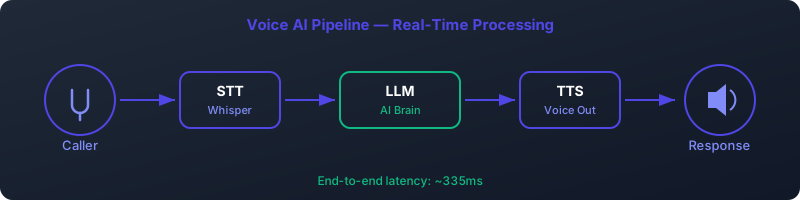
The world of conversational AI is no longer dominated by closed, expensive APIs. The year 2026 marks a pivotal moment for developers in the USA and UK, as the open-source community has delivered a powerful suite of tools for building sophisticated, real-time voice agents. The ability to self-host and customize every component of the AI stack—from speech-to-text to the large language model (LLM) and text-to-speech—has unlocked unprecedented levels of control, privacy, and cost-efficiency.
But with this power comes a crucial decision: which voice AI framework open source solution is right for your project? The foundation you choose will dictate your capabilities, scalability, and connection methods. Are you building an AI agent that talks to customers over traditional phone lines (PSTN)? Or a next-gen web application that uses WebRTC? Do you need production-grade reliability for thousands of concurrent calls, or a rapid way to prototype an idea?
This guide cuts through the noise. We'll compare the leading open-source voice AI frameworks—the veteran Asterisk, the modern Pipecat, the accessible Vocode, and the versatile LiveKit—to help you make an informed decision. We'll examine their strengths, weaknesses, and ideal use cases, ultimately providing a clear recommendation for developers focused on robust telephony integration.
Framework Comparison Matrix: At a Glance
Before our deep dive, let's get a high-level overview. This matrix summarizes the key technical and community metrics for each framework, providing a quick reference for your initial evaluation. Note that "latency" refers to the typical time-to-first-token (TTFT), a critical factor for natural-sounding conversations.
| Framework | Primary Telephony | Avg. Latency | GPU Needed? | License | Production Ready? | GitHub Stars |
|---|---|---|---|---|---|---|
| Asterisk + EAGI | Yes (SIP/PSTN) | ~335ms | Optional | GPLv2 | Yes, 20+ years | N/A (Part of Asterisk) |
| Pipecat | WebRTC (SIP via plugins) | ~400ms | Yes | BSD-3-Clause | Growing | 8k+ |
| Vocode | WebRTC + Tel (via CPaaS) | ~450ms | Yes | MIT | Beta | 3k+ |
| LiveKit Agents | WebRTC | ~350ms | Yes | Apache 2.0 | Yes | 12k+ |
| LiveKit + SIP | SIP (via plugin) | ~400ms | Yes | Apache 2.0 | Beta | (Part of LiveKit) |
Deep Dive: The Top 4 Open Source Voice AI Frameworks
The matrix gives us the "what," but the "why" is in the details. Let's explore the architecture, philosophy, and ideal developer profile for each of these powerful tools.
Asterisk + EAGI: The Battle-Tested Telephony Titan
Asterisk isn't a new kid on the block; it's the bedrock of modern VoIP telephony. First released in 1999, it's an open-source PBX (Private Branch Exchange) that powers countless communication systems worldwide. Its superpower for AI is the Enhanced Asterisk Gateway Interface (EAGI).
EAGI allows an external script (written in Python, Go, Node.js, etc.) to take control of a call's audio stream. This is the hook for voice AI. Your EAGI script can stream the caller's audio to a speech-to-text engine, send the resulting text to an LLM, and stream the synthesized audio response back into the call. This happens in real-time, directly on the telephony layer.
- Telephony & Connectivity: Unmatched. Asterisk speaks SIP fluently. It can connect to virtually any SIP trunk provider in the USA (like Twilio, Telnyx, Bandwidth) or the UK (like Gamma, BT). This makes it the undisputed champion for applications that need to interact with the Public Switched Telephone Network (PSTN)—i.e., real phone numbers.
- Performance & Latency: Because it operates at a low level, Asterisk with a well-written EAGI script can achieve remarkably low latency. The ~335ms figure is achievable because the audio path is direct and highly optimized. It doesn't require a GPU for its core telephony functions, but your connected AI services (STT/TTS) will.
- Maturity & Reliability: It's been hardened by over two decades of production use in every conceivable environment. For mission-critical telephony applications, this history is invaluable.
- The Catch (License): Asterisk is licensed under GPLv2. This is a "copyleft" license, meaning if you modify the Asterisk source code and distribute your modified version, you must also make your modifications open source under the same license. For most users who are simply *using* Asterisk and connecting via EAGI, this is not an issue. However, for businesses planning to build a proprietary, distributable product based on a modified Asterisk core, legal counsel is essential.
Pipecat: The Modern Pythonic Contender
Pipecat emerges from the modern AI-native world. It's a Python-first framework designed specifically for building real-time, conversational voice and video AI applications. It leverages Python's powerful `asyncio` library to handle the complex, concurrent tasks of streaming audio, processing AI models, and managing state.
As a newer open source voice AI solution, it represents a more developer-friendly approach for those accustomed to modern web frameworks. It's an excellent choice for web-based interactions.
- Telephony & Connectivity: Pipecat's primary focus is WebRTC. It excels at creating AI agents that live inside a web browser. While it can connect to SIP/PSTN, this is typically handled through third-party plugins or gateways, adding a layer of complexity compared to Asterisk's native support.
- Developer Experience: This is where Pipecat shines. Its Pythonic API is intuitive for the vast number of developers in that ecosystem. It provides abstractions for the entire AI pipeline, from transport (WebRTC) to AI services (STT, LLM, TTS), making it faster to get a complex agent running.
- Ecosystem & Maturity: With over 8,000 stars on GitHub, Pipecat has a rapidly growing and enthusiastic community. However, it's still younger than Asterisk or LiveKit. While increasingly used in production, it hasn't faced the same decades-long trial by fire. It's a strong Vocode alternative for developers wanting more control and a pure Python environment.
- License: The BSD-3-Clause license is highly permissive, making it very attractive for commercial use. You can modify the code and incorporate it into proprietary, closed-source products without needing to release your changes.
Vocode: The Rapid Prototyping Specialist
Vocode's mission is simplicity. It aims to be the fastest way for a developer to get a talking AI agent up and running. It provides a simple, high-level API that abstracts away much of the underlying complexity of real-time audio streaming and AI model integration.
This ease of use makes it a fantastic tool for hackathons, proofs-of-concept, and initial MVPs. However, its "Beta" production status and reliance on CPaaS for telephony mean it's less suited for large-scale, self-hosted deployments.
- Telephony & Connectivity: Vocode supports both WebRTC for web-based agents and telephony. However, its telephony integration typically works by abstracting a CPaaS provider like Twilio. This is convenient but means you're not truly self-hosting the telephony layer and are dependent on that provider's infrastructure and pricing.
- Simplicity vs. Control: The API is dead simple. You can often get a basic agent running in under 50 lines of code. The trade-off is a loss of granular control over the audio pipeline and transport layer. Fine-tuning for ultra-low latency or implementing complex call logic can be more challenging than with a framework like Asterisk or LiveKit.
- Maturity & Production Readiness: The "Beta" tag should be taken seriously. While many have built successful projects with Vocode, it's generally considered less mature for high-stakes, high-volume production environments compared to the other frameworks on this list. It serves as a great starting point, from which teams might migrate to a more robust solution as they scale.
- License: The MIT license is extremely permissive, similar to BSD, making it a worry-free choice for any type of project, commercial or otherwise.
LiveKit: The WebRTC Powerhouse with Growing Ambitions
LiveKit is an open-source real-time communication (RTC) stack. Its core competency is delivering high-quality, scalable, and resilient WebRTC experiences. On top of this robust foundation, the team has built LiveKit Agents, a framework specifically for creating AI participants in RTC sessions.
With a massive community and a stellar reputation in the WebRTC world, LiveKit is a formidable player. It's a strong Pipecat alternative for WebRTC and is now encroaching on Asterisk's territory with its burgeoning SIP support.
- Telephony & Connectivity: LiveKit's bread and butter is WebRTC. The Agents framework is designed to make it easy for an AI to join a LiveKit "room" as a participant. Recently, they've introduced a SIP plugin, allowing for ingress and egress to the PSTN. This is a game-changer, but as of 2026, it's still in Beta and less mature than Asterisk's two decades of SIP development. This makes it a compelling LiveKit alternative telephony solution for those willing to bet on its future development.
- Scalability & Resilience: LiveKit's architecture is designed for scale. It can handle massive numbers of concurrent users in WebRTC sessions, and this scalability extends to the Agents framework. Its cloud-native design makes it well-suited for deployment on Kubernetes.
- Community & Ecosystem: With over 12,000 GitHub stars and a vibrant community, finding support and examples is easy. The project is well-documented and actively maintained by a commercial entity, which provides a degree of confidence in its long-term viability.
- License: The Apache 2.0 license is another permissive, business-friendly license. It allows for commercial use and modification without the copyleft requirements of GPL.
When to Choose Each Voice AI Framework
Choosing the right voice AI framework depends entirely on your project's primary interface and production requirements.
For Production-Grade PSTN/Telephony (Calling Phone Numbers)
Winner: Asterisk + EAGI
If your AI agent's main job is to make and receive calls from standard phone numbers, there is no substitute for Asterisk's reliability and universal SIP trunk compatibility. It's built for the telephone network. For applications requiring high availability and compliance with US regulations like TCPA (Telephone Consumer Protection Act), a battle-tested telephony engine is non-negotiable.
For Modern Web-Based AI Agents (In-Browser)
Winner: LiveKit Agents or Pipecat
Both are excellent choices. Choose LiveKit if you need extreme scalability and are building within a larger real-time video/audio ecosystem. Choose Pipecat if you value a pure, elegant Python developer experience and your team lives and breathes `asyncio`.
For Rapid Prototyping and MVPs
Winner: Vocode
Nothing gets you from zero to a talking agent faster. Its simple API is perfect for testing an idea over a weekend. If your concept proves viable, you can then plan a migration to a more scalable framework like Pipecat or LiveKit for your production build.
For a Future-Proof Hybrid (WebRTC + PSTN) Platform
Winner: LiveKit + SIP Plugin
If you're building a platform that needs to serve both web users via WebRTC and phone users via SIP, and you're willing to accept that the SIP functionality is still maturing, LiveKit is a very compelling option. It offers the chance to unify your entire real-time communication stack under one open-source roof. Keep a close eye on the maturity of its SIP integration.
Our Recommendation for Production Telephony
Our Pick: Asterisk + EAGI
For any serious business application in the US or UK that relies on interacting with the public telephone network, Asterisk with an EAGI script is the most robust, reliable, and flexible choice in 2026.
Its two-decade track record is not a sign of being outdated; it's a testament to its stability. When your business depends on every call connecting perfectly, "battle-tested" is the most important feature. The ability to connect to any SIP trunk provider without hassle gives you the freedom to optimize for cost and quality, a crucial advantage over frameworks that lock you into specific partners. While newer frameworks are exciting, for mission-critical PSTN voice AI, we choose the proven titan of telephony.
For more advanced call routing and AI-driven IVR systems, check out our guide on AI orchestration with Asterisk.
Integration Guide: Connecting to a Self-Hosted AI Stack
One of the biggest advantages of using an open source voice AI framework is the ability to connect it to your own self-hosted AI models. This gives you maximum privacy (especially important for HIPAA or CCPA compliance in the US) and can dramatically reduce costs compared to per-minute API calls to proprietary services. Here's the conceptual flow for connecting any of these frameworks to a local stack using Ollama, Whisper, and XTTS.
The Local AI Stack:
- Speech-to-Text (STT): Whisper. OpenAI's open-source model is the gold standard for accuracy. For lower latency, consider using distilled versions like `distil-whisper`.
- Large Language Model (LLM): Ollama. A fantastic tool that makes it incredibly easy to run open-source LLMs like Llama 3, Mistral, or Phi-3 on your own hardware (with a GPU).
- Text-to-Speech (TTS): XTTS-v2. A high-quality, multilingual, voice-cloning TTS engine that is now openly available and delivers very natural-sounding speech.
The Integration Flow:
Your "glue" code, whether it's an EAGI script for Asterisk or a Python handler in Pipecat, will manage this pipeline:
- Receive Audio Stream: The voice framework (Asterisk, LiveKit, etc.) captures the raw audio from the user (e.g., a 16-bit, 8000Hz mono stream for telephony).
- Stream to STT: Your code continuously streams this audio to a running Whisper process or API endpoint. Whisper transcribes it in real-time or in chunks.
- Send Text to LLM: Once a complete utterance is detected (e.g., after a pause), the transcribed text is sent to the Ollama API, along with the conversation history and your system prompt.
- Stream Response from LLM: The LLM will start generating a response. Crucially, you should stream this response token-by-token, not wait for the full text. This is key to reducing perceived latency.
- Stream Text to TTS: As you receive tokens from the LLM, you can group them into sentences and send them immediately to your XTTS engine's streaming endpoint.
- Stream Audio to User: XTTS will generate audio chunks for each sentence. Your code immediately takes these audio chunks and streams them back into the call via the voice framework.
Here is a conceptual Python-like pseudo-code for the main loop:
# This is a conceptual loop, not runnable code.

# 1. Framework provides audio_input_stream and audio_output_stream
async for audio_chunk in audio_input_stream:

    # 2. Stream to STT
    stt_service.stream(audio_chunk)

    if stt_service.has_complete_utterance():
        full_text = stt_service.get_text()

        # 3. Send to LLM
        llm_response_stream = ollama.stream(
            model="llama3",
            prompt=full_text,
            history=conversation_history
        )

        # 4 & 5. Stream LLM response to TTS
        # Use a sentence-based generator for better TTS performance
        sentence_generator = group_tokens_into_sentences(llm_response_stream)

        for sentence in sentence_generator:
            tts_audio_chunk_stream = xtts.stream(text=sentence)

            # 6. Stream TTS audio back to the user
            async for tts_chunk in tts_audio_chunk_stream:
                await audio_output_stream.send(tts_chunk)
This streaming, pipelined approach is the secret to building a responsive-feeling voice agent, even with the inherent latency of each AI model.
Frequently Asked Questions
What is the difference between a voice AI framework and a CPaaS like Twilio?
A CPaaS (Communications Platform as a Service) like Twilio or Vonage provides a fully managed, cloud-based suite of APIs for communication, including voice calls. You pay them per minute, per message, etc. An open-source voice AI framework is software you run on your own servers. It gives you the core engine to handle audio and connect to telephony networks, but you are responsible for the hosting, scaling, and maintenance. The benefit is complete control, no per-minute platform fees, and enhanced privacy.
Can I use these frameworks for HIPAA-compliant applications in the US?
Yes, self-hosting is often a prerequisite for HIPAA compliance. By using an open-source framework on your own infrastructure (that is configured to be HIPAA-compliant) and connecting it to a self-hosted AI stack (like the Ollama/Whisper guide above), you can ensure no Protected Health Information (PHI) ever leaves your control. Using a cloud CPaaS or proprietary AI APIs would require a Business Associate Agreement (BAA) and careful vetting of their compliance.
How much does it cost to self-host an open-source voice AI?
The software is free, but you pay for hardware and connectivity. Costs include: 1) A server to run the framework (can be a small VM for a few calls, starting around $20/month). 2) A server with a powerful GPU (like an NVIDIA A10G or L4) to run the STT, LLM, and TTS models. This is the main cost, ranging from $500 to $2000+/month depending on the provider (e.g., AWS, GCP, or a dedicated GPU provider like Runpod or Vast.ai). 3) A SIP trunk provider, which charges per phone number (e.g., $1/month) and per-minute rates for calls (e.g., $0.005/minute).
What is EAGI and why is it important for Asterisk?
EAGI stands for Enhanced Asterisk Gateway Interface. It's a specific type of script interface in Asterisk that gives an external program full, bidirectional control over a call's audio stream. While the older AGI (Asterisk Gateway Interface) could control call flow (hang up, transfer), EAGI is what allows you to read the caller's audio and write new audio back in real-time, making it the essential component for voice AI integration.
Is WebRTC better than SIP for voice AI?
Neither is "better"; they serve different purposes. SIP is the protocol for the global telephone system. It's essential for calling real phone numbers. WebRTC is a protocol designed for real-time communication directly between web browsers (and mobile apps). If your users are on a website, WebRTC is the native and higher-quality choice (it often uses better audio codecs like Opus). If your users are on the phone, you must use SIP.
What are the legal considerations for voice AI in the US/UK?
In the US, the TCPA governs automated calls and requires express consent for marketing calls. You must also consider state-level wiretapping laws, many of which require two-party consent for call recording (which is inherent to how voice AI works). In the UK and EU, GDPR requires a legal basis for processing personal data (like a person's voice) and transparency about how the AI works. Disclosure ("You are speaking with an AI assistant") is a best practice in both regions.
How does latency impact the user experience?
Latency is the delay between when a user stops speaking and when the AI starts responding. High latency makes the conversation feel unnatural and stilted. Humans typically expect a response within 300-500ms in a normal conversation. Total latency in a voice AI system is a sum of multiple parts: network latency, STT processing time, LLM time-to-first-token, and TTS processing time. Minimizing each step is critical for a good UX.
Ready to Deploy Your AI Voice Agent?
Self-hosted, 335ms latency, HIPAA & GDPR ready. Live in 2-4 weeks.
Get Free Consultation Setup Guide