Predictive AI: Forecast the Future with Artificial Intelligence
Published: March 15, 2026
Table of Contents
What is Predictive AI?
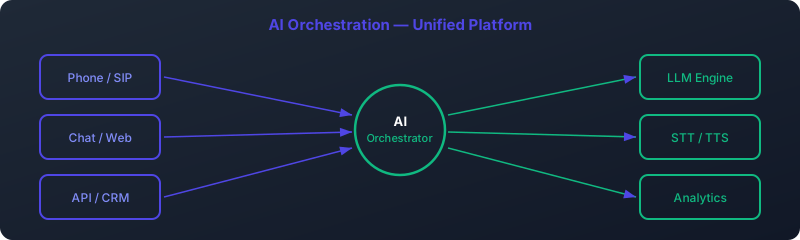
Predictive AI refers to the use of artificial intelligence and machine learning techniques to analyze historical and current data in order to forecast future outcomes. Unlike descriptive analytics, which tells us what has happened, or diagnostic analytics, which explains why it happened, predictive AI aims to anticipate what will happen—giving organizations a strategic edge in decision-making.
At its core, predictive AI leverages patterns found in data to build models that can generalize beyond the training set. These models learn from past observations to make informed predictions about future events. For example, a retail company might use predictive AI to forecast next quarter’s sales based on past trends, seasonality, marketing spend, and economic indicators.
Did you know? Predictive AI is not about fortune-telling—it’s about quantifying uncertainty. A good predictive model doesn’t claim to know the future with 100% certainty but instead provides probabilistic forecasts with confidence intervals.
Types of Predictive Models
Predictive models fall into several categories, each suited to different types of problems and data. Understanding these types is crucial for selecting the right approach.
1. Classification
Classification models predict discrete outcomes—essentially answering “which category?” For example:
- Will a customer churn? (Yes/No)
- Is this email spam? (Spam/Not Spam)
- What type of product will a user buy? (Category A, B, or C)
Common algorithms include logistic regression, decision trees, random forests, and support vector machines (SVMs).
2. Regression
Regression models predict continuous numerical values—answering “how much?” or “how many?” Examples include:
- What will the temperature be tomorrow?
- How much will a house sell for?
- What will next month’s revenue be?
Linear regression, polynomial regression, and ridge regression are foundational techniques, but modern AI often uses neural networks for complex regression tasks.
3. Time Series Forecasting
Time series models analyze data points collected over time to predict future values. These models account for trends, seasonality, and cyclical patterns. Examples:
- Daily stock prices
- Hourly energy consumption
- Monthly website traffic
Traditional methods like ARIMA and Exponential Smoothing are widely used, but deep learning models like LSTM have gained popularity for their ability to capture long-term dependencies.
4. Anomaly Detection
Anomaly detection identifies rare items, events, or observations that deviate significantly from the norm. This is critical in:
- Fraud detection
- Network intrusion detection
- Predictive maintenance (detecting equipment failure)
Techniques include statistical methods, isolation forests, autoencoders, and one-class SVMs.
| Model Type | Output Type | Example Use Case | Common Algorithms |
|---|---|---|---|
| Classification | Categorical | Customer churn prediction | Logistic Regression, XGBoost, Random Forest |
| Regression | Continuous | House price estimation | Linear Regression, Neural Networks |
| Time Series | Sequential | Stock price forecasting | ARIMA, LSTM, Prophet |
| Anomaly Detection | Binary (Normal/Anomaly) | Fraud detection | Isolation Forest, Autoencoder, One-Class SVM |
Key Algorithms in Predictive AI
The performance of predictive AI depends heavily on the choice of algorithm. Let’s explore some of the most powerful and widely used models.
XGBoost (Extreme Gradient Boosting)
XGBoost is a highly optimized implementation of gradient boosting designed for speed and performance. It builds decision trees sequentially, with each new tree correcting errors made by the previous ones. XGBoost excels in structured/tabular data and has won numerous Kaggle competitions.
Pros: High accuracy, handles missing data, regularization to prevent overfitting.
Cons: Can be a “black box,” requires careful hyperparameter tuning.
Neural Networks
Neural networks are inspired by the human brain and consist of layers of interconnected nodes (neurons). They are particularly effective for unstructured data like images, text, and audio, but also powerful for complex regression and classification tasks.
Feedforward neural networks (FNNs) are used for standard prediction tasks, while convolutional neural networks (CNNs) dominate image-based predictions.
LSTM (Long Short-Term Memory)
LSTM is a type of recurrent neural network (RNN) designed to handle sequential data with long-term dependencies. Unlike traditional RNNs, LSTMs have memory cells that can retain information over long periods, making them ideal for time series forecasting.
For example, LSTMs are used to predict energy demand, stock prices, and even natural language sequences.
| Algorithm | Best For | Strengths | Weaknesses |
|---|---|---|---|
| XGBoost | Structured data, classification, regression | High accuracy, fast training | Less interpretable, sensitive to noise |
| Neural Networks | Complex patterns, unstructured data | Universal approximators, scalable | Requires large data, computationally expensive |
| LSTM | Time series, sequence prediction | Handles long-term dependencies | Slow training, complex to tune |
| Random Forest | Classification, regression | Robust, handles non-linearity | Can overfit, less accurate than boosting |
Pro Tip: No single algorithm is best for all problems. Always start with a baseline (e.g., logistic regression) and experiment with more complex models. Use cross-validation to compare performance objectively.
The Predictive Analytics Pipeline
Building a predictive AI system is not just about choosing an algorithm—it’s a structured process. Here’s a step-by-step pipeline:
1. Problem Definition
Clearly define the business question. Is it churn prediction? Demand forecasting? Fraud detection? The goal shapes the entire project.
2. Data Collection
Gather relevant data from databases, APIs, logs, sensors, or third-party sources. Ensure data quality and completeness.
3. Data Preprocessing
Raw data is rarely ready for modeling. Steps include:
- Handling missing values (imputation or removal)
- Outlier detection and treatment
- Encoding categorical variables (one-hot, label encoding)
- Feature scaling (standardization, normalization)
- Feature engineering (creating new variables like ratios, lags, or aggregates)
4. Model Training
Split data into training and validation sets. Train multiple models using the training data and tune hyperparameters via cross-validation.
5. Model Evaluation
Assess performance using appropriate metrics (see next section). Avoid overfitting by testing on unseen data.
6. Deployment
Deploy the model into production using APIs, batch processing, or real-time inference engines. Monitor performance continuously.
7. Monitoring and Retraining
Data drift and concept drift can degrade model performance over time. Schedule regular retraining with fresh data.
Best Practice: Use MLOps tools (e.g., MLflow, Kubeflow) to automate the pipeline, track experiments, and manage model versions.
Real-World Applications of Predictive AI
Predictive AI is transforming industries. Let’s explore key use cases:
Fraud Detection
Financial institutions use predictive models to flag suspicious transactions in real time. By analyzing spending patterns, location, and device data, AI can detect anomalies that indicate fraud—reducing losses and improving customer trust.
Demand Prediction
Retailers and e-commerce platforms forecast product demand to optimize inventory, reduce waste, and improve supply chain efficiency. For example, Amazon uses predictive analytics to pre-ship products to warehouses near anticipated demand.
Customer Churn Prediction
Telecom, SaaS, and subscription-based companies identify customers at risk of leaving. By analyzing usage patterns, support tickets, and billing history, they can intervene with targeted retention offers.
Predictive Maintenance
Manufacturers use sensors and AI to predict equipment failures before they occur. This reduces downtime, extends asset life, and cuts maintenance costs. For instance, General Electric uses predictive AI in jet engines and wind turbines.
Healthcare Diagnostics
Hospitals use predictive models to forecast patient readmissions, disease outbreaks, or treatment outcomes. AI can analyze electronic health records (EHRs) to identify high-risk patients early.
Marketing Personalization
AI predicts which customers are most likely to respond to a campaign, enabling hyper-targeted advertising. Netflix and Spotify use predictive AI to recommend content, increasing engagement.
Evaluation Metrics for Predictive Models
Choosing the right metric is critical. Here are the most common:
For Classification
- Accuracy: (TP + TN) / Total. Good for balanced datasets.
- Precision: TP / (TP + FP). Measures false positives.
- Recall (Sensitivity): TP / (TP + FN). Measures false negatives.
- F1-Score: Harmonic mean of precision and recall.
- ROC-AUC: Area under the ROC curve; measures separability.
For Regression
- Mean Absolute Error (MAE): Average absolute error.
- Mean Squared Error (MSE): Average squared error (penalizes large errors).
- Root Mean Squared Error (RMSE): Square root of MSE.
- R² (R-squared): Proportion of variance explained by the model.
For Time Series
- Mean Absolute Percentage Error (MAPE): Average percentage error.
- Symmetric MAPE (sMAPE): Symmetric version of MAPE.
- Mean Absolute Scaled Error (MASE): Compares to a naive forecast.
Remember: Always align metrics with business goals. For fraud detection, recall is often more important than precision—missing a fraud case is costlier than a false alarm.
Challenges and Limitations of Predictive AI
Despite its power, predictive AI faces several challenges:
- Data Quality: Garbage in, garbage out. Missing, biased, or noisy data leads to poor predictions.
- Overfitting: Models that perform well on training data but fail on new data.
- Interpretability: Deep learning models are often black boxes, making it hard to trust or explain predictions.
- Data Drift: Real-world data changes over time, degrading model performance.
- Ethical Concerns: Biased data can lead to discriminatory predictions (e.g., in hiring or lending).
Mitigation strategies include robust data validation, regularization, explainable AI (XAI) techniques, and continuous monitoring.
The Future of Predictive AI
The field is evolving rapidly. Key trends include:
- AutoML: Automated machine learning tools that simplify model selection and tuning.
- Real-Time Predictions: Edge AI and streaming analytics enable instant forecasts.
- Generative AI Integration: Combining predictive models with generative AI for synthetic data and scenario simulation.
- Explainable AI (XAI): Tools like SHAP and LIME make models more transparent and trustworthy.
- Federated Learning: Training models on decentralized data without sharing raw data, enhancing privacy.
As AI becomes more accessible, predictive analytics will move from enterprise systems to everyday applications—empowering small businesses and individuals alike.
Frequently Asked Questions
Predictive analytics is a broader field that includes statistical and machine learning methods to forecast outcomes. AI forecasting specifically refers to using artificial intelligence—especially deep learning and advanced algorithms—to make predictions. AI forecasting is a subset of predictive analytics with greater complexity and scalability.
While AI models typically require large datasets, techniques like transfer learning, data augmentation, and using simpler models (e.g., linear regression) can make predictive AI feasible with limited data. However, performance may be constrained compared to models trained on large, rich datasets.
Accuracy varies by domain, data quality, and model choice. In well-controlled environments (e.g., time series with strong patterns), models can achieve over 90% accuracy. In complex domains like healthcare or finance, accuracy may be lower but still valuable for decision support. Always validate with real-world testing.
No—predictive AI is a decision-support tool. It provides insights and probabilities, but humans remain responsible for final decisions, especially in ethical or high-stakes contexts. The best outcomes come from human-AI collaboration.
Start by defining a clear business problem. Collect and clean relevant data. Learn Python and libraries like pandas, scikit-learn, and TensorFlow. Begin with simple models, evaluate performance, and iterate. Consider using cloud platforms (e.g., AWS SageMaker, Google Vertex AI) for scalable infrastructure.
Industries with high data volume and decision complexity benefit most: finance (fraud detection, risk assessment), retail (demand forecasting), healthcare (diagnostics, readmission prediction), manufacturing (predictive maintenance), and telecommunications (churn prediction).
Conclusion
Predictive AI is no longer science fiction—it’s a powerful tool transforming how organizations operate. By leveraging historical data, advanced algorithms like XGBoost and LSTM, and robust pipelines, businesses can forecast customer behavior, detect fraud, optimize supply chains, and prevent equipment failures.
However, success requires more than just technology. It demands clean data, clear objectives, ethical considerations, and continuous monitoring. As AI evolves, the ability to predict the future will become increasingly precise, accessible, and integrated into everyday decision-making.
Whether you're a data scientist, business leader, or curious learner, now is the time to embrace predictive AI and unlock its potential.
Ready to Harness the Power of Predictive AI?
Our team at AIO Orchestration specializes in building custom predictive models for fraud detection, demand forecasting, churn prediction, and more. From data strategy to deployment, we guide you every step of the way.
Start Your AI Journey TodayOr call us at +33 7 59 02 45 36