Multimodal AI: Combining Text, Image, Audio & Video Intelligence
Published: March 1, 2026 | Last Updated: March 15, 2026
Table of Contents
- What is Multimodal AI?
- Modalities in Artificial Intelligence
- Key Multimodal Models: GPT-4V, Gemini, and Claude Vision
- Architectures for Multimodal Learning
- Fusion Techniques in Multimodal AI
- Real-World Use Cases of Multimodal AI
- Voice + Vision Assistants: The Future of Interaction
- Challenges in Multimodal AI Development
- Future Outlook and Trends
- Frequently Asked Questions (FAQ)
What is Multimodal AI?
Multimodal AI, or multimodal artificial intelligence, refers to systems that can process, interpret, and generate information across multiple data types—commonly known as "modalities"—such as text, images, audio, video, and sensor data. Unlike traditional AI models that specialize in a single modality (e.g., language models for text or convolutional networks for images), multimodal models integrate diverse inputs to create a more holistic and context-aware understanding of the world.
The rise of multimodal models marks a significant leap toward human-like perception in machines. Humans naturally perceive and interpret the world using multiple senses: we read text, see visuals, hear sounds, and respond to physical cues. Multimodal AI aims to replicate this integrated sensory experience, enabling machines to understand complex, real-world scenarios with greater accuracy and nuance.
For example, a multimodal system could analyze a video clip by simultaneously processing spoken words (audio), facial expressions (video), background music (audio), on-screen text (OCR), and even environmental sensor data (e.g., temperature or motion). This combined analysis allows the AI to infer emotional tone, context, and intent far more effectively than any single-modality system.
💡 Did You Know? The term "modality" in AI refers to a type of data input—such as visual, auditory, textual, or tactile information. Multimodal AI combines two or more of these modalities to improve decision-making and user interaction.
Modalities in Artificial Intelligence
To understand multimodal AI, it's essential to explore the different modalities it integrates. Each modality presents unique challenges and opportunities for machine learning models.
Text
Text is the most mature modality in AI, powered by natural language processing (NLP) models like BERT, GPT, and LLaMA. These models excel at tasks such as translation, summarization, sentiment analysis, and question answering. In multimodal systems, text often serves as a grounding mechanism—providing labels, captions, or descriptions that help interpret other modalities.
Image
Computer vision models, particularly convolutional neural networks (CNNs) and vision transformers (ViTs), enable AI to "see" and interpret visual content. From object detection to image classification, visual understanding is critical in applications like autonomous vehicles, medical imaging, and augmented reality. In multimodal AI, images are often paired with text (e.g., image captioning) or audio (e.g., video description) to enrich context.
Audio
Audio processing includes speech recognition (ASR), speaker identification, emotion detection, and environmental sound classification. Models like Whisper (OpenAI) and Wav2Vec (Meta) have significantly advanced automatic speech recognition. In multimodal systems, audio is often synchronized with video or text to enhance understanding—such as transcribing spoken words in a video or detecting sarcasm through tone.
Video
Video combines spatial (image) and temporal (audio + motion) information, making it one of the most complex modalities. Video understanding involves action recognition, scene segmentation, and temporal reasoning. Multimodal models analyze video frames, audio tracks, and subtitles simultaneously to extract meaning, enabling applications like content moderation, video search, and intelligent surveillance.
Sensor Data
Emerging multimodal systems incorporate data from physical sensors—such as accelerometers, gyroscopes, GPS, LiDAR, and thermal cameras. This is especially relevant in robotics, smart cities, and healthcare wearables. For example, a multimodal health assistant might combine voice input, facial expression analysis, heart rate data, and movement patterns to assess a user's emotional and physical state.
| Modality | Key Technologies | Common Applications | Challenges |
|---|---|---|---|
| Text | Transformers, BERT, GPT | Chatbots, Translation, Summarization | Context ambiguity, Sarcasm, Multilingual support |
| Image | CNNs, Vision Transformers | Object Detection, Medical Imaging | Lighting, Occlusion, Scale variation |
| Audio | Whisper, Wav2Vec, Spectrograms | Speech Recognition, Emotion Detection | Background noise, Accents, Overlapping speech |
| Video | 3D CNNs, Temporal Transformers | Surveillance, Video Search, AR | High computational cost, Temporal alignment |
| Sensor Data | Time-series models, Kalman filters | Wearables, Robotics, IoT | Data fusion, Calibration, Noise filtering |
Key Multimodal Models: GPT-4V, Gemini, and Claude Vision
The landscape of multimodal AI is rapidly evolving, driven by breakthroughs from leading AI labs. Below are some of the most influential multimodal models shaping the future of artificial intelligence.
GPT-4 with Vision (GPT-4V)
Developed by OpenAI, GPT-4V extends the capabilities of GPT-4 to process both text and images. Users can upload images and ask questions about their content—such as identifying objects, interpreting charts, or describing scenes. GPT-4V uses a vision encoder to convert images into embeddings, which are then combined with text tokens in the transformer architecture.
Use Case: A user uploads a photo of a restaurant menu in a foreign language. GPT-4V identifies the dishes, translates the text, and even suggests popular items based on regional cuisine.
Google Gemini
Google’s Gemini is a natively multimodal model designed from the ground up to handle text, images, audio, and video. Unlike models that retrofit vision capabilities, Gemini uses a unified architecture that processes all modalities in parallel. It powers features in Google Lens, YouTube summaries, and Bard (now Gemini Advanced).
Strengths: Real-time multimodal reasoning, strong integration with Google’s ecosystem, and support for code generation from diagrams.
Claude Vision (Anthropic)
Claude 3 with vision capabilities allows users to analyze documents, screenshots, and images with high accuracy. Anthropic emphasizes safety and alignment, making Claude Vision suitable for enterprise use. It excels in understanding structured data like tables, forms, and UI mockups.
Use Case: A developer uploads a wireframe, and Claude generates front-end code with accessibility considerations.
| Model | Developer | Modalities Supported | Key Features | Access |
|---|---|---|---|---|
| GPT-4V | OpenAI | Text, Image | Image captioning, Chart interpretation, Multilingual support | ChatGPT Plus, API |
| Gemini | Text, Image, Audio, Video | Native multimodality, YouTube integration, Code generation | Gemini Advanced, Free tier | |
| Claude Vision | Anthropic | Text, Image | Document analysis, UI understanding, Safety-first design | Claude Pro, API |
Architectures for Multimodal Learning
The success of multimodal AI depends on how effectively different modalities are integrated. Several architectural approaches have emerged, each with trade-offs in performance, complexity, and scalability.
Early Fusion
In early fusion, raw or preprocessed data from different modalities are combined at the input level before being fed into a shared model. This approach is simple but can be sensitive to noise and requires careful alignment of modalities.
Late Fusion
Late fusion processes each modality separately using specialized models (e.g., CNN for images, transformer for text) and combines their outputs at the decision level. This allows for modality-specific optimization but may miss cross-modal interactions.
Hybrid Fusion
Hybrid approaches combine early and late fusion, allowing partial integration at multiple stages. This balances flexibility and performance, making it popular in modern systems.
Cross-Attention Mechanisms
One of the most powerful techniques in multimodal AI is cross-attention, where one modality attends to another. For example, in image captioning, the text decoder uses cross-attention to focus on relevant image regions while generating each word. This enables dynamic, context-aware integration.
🧠 Technical Insight: In cross-attention, queries from one modality (e.g., text) are matched against keys and values from another (e.g., image patches), allowing the model to "attend" to relevant visual features when generating language.
Fusion Techniques in Multimodal AI
Fusion is the process of combining information from multiple modalities. The choice of fusion technique significantly impacts model performance.
Concatenation
The simplest method—concatenating feature vectors from different modalities. While easy to implement, it assumes equal importance of all modalities and may dilute meaningful signals.
Weighted Fusion
Assigns learnable weights to each modality based on context. For example, in a noisy environment, the model might rely more on visual input than audio.
Transformer-Based Fusion
Using transformers with cross-attention layers allows dynamic, context-sensitive fusion. Models like Flamingo (DeepMind) and LLaVA use this approach to achieve state-of-the-art results in vision-language tasks.
Modality-Specific Encoders with Shared Decoder
A common architecture uses separate encoders (e.g., ViT for images, BERT for text) and a shared decoder (e.g., transformer) that fuses representations. This enables transfer learning and modularity.
Real-World Use Cases of Multimodal AI
Multimodal AI is transforming industries by enabling richer, more intuitive human-machine interactions.
Healthcare
Hospitals use multimodal AI to analyze medical records (text), radiology scans (images), and patient interviews (audio). For example, a system can correlate a radiologist’s notes with CT scans and voice annotations to flag inconsistencies or suggest diagnoses.
Autonomous Vehicles
Self-driving cars rely on multimodal fusion of camera images, LiDAR, radar, GPS, and traffic signs. AI models must process this data in real time to detect pedestrians, predict behavior, and make driving decisions.
Customer Service
Contact centers deploy voice + vision assistants that analyze customer tone, facial expressions, and spoken words to assess satisfaction and route calls appropriately.
Content Creation
Tools like Runway ML and Pika Labs use multimodal AI to generate videos from text prompts, edit scenes using voice commands, or convert sketches into animations.
Accessibility
Multimodal AI powers assistive technologies—for example, apps that describe scenes to visually impaired users by combining camera input and speech synthesis.
Voice + Vision Assistants: The Future of Interaction
The next generation of AI assistants will be multimodal by design. Imagine saying, “What’s that plant?” while pointing your phone camera—your assistant identifies the species, reads care instructions aloud, and adds watering reminders to your calendar.
Companies like Apple (Siri), Amazon (Alexa), and Google (Assistant) are investing heavily in voice + vision capabilities. These assistants combine:
- Speech recognition to understand commands
- Computer vision to interpret scenes
- NLP to reason and respond
- AR/VR to overlay information
Such systems require tight integration of modalities, low-latency processing, and privacy-preserving design—challenges that are driving innovation in edge AI and federated learning.
Challenges in Multimodal AI Development
Despite rapid progress, multimodal AI faces significant hurdles:
Data Alignment
Synchronizing modalities in time and space (e.g., matching audio to video frames) is complex and often requires manual annotation.
Computational Cost
Processing high-resolution video and audio in real time demands immense computational resources, limiting deployment on mobile devices.
Bias and Fairness
Multimodal models can inherit and amplify biases from training data—e.g., misidentifying emotions based on skin tone or accent.
Privacy and Ethics
Collecting and processing sensitive data (e.g., facial expressions, voiceprints) raises serious privacy concerns. Transparent data policies and on-device processing are critical.
Interpretability
Understanding why a multimodal model made a decision—especially when modalities conflict—is challenging, limiting trust in high-stakes applications.
⚠️ Caution: As multimodal AI becomes more pervasive, ensuring ethical use, data consent, and algorithmic transparency must remain top priorities for developers and policymakers alike.
Future Outlook and Trends
The future of multimodal AI is bright, with several emerging trends:
- Generalist Models: AI systems that learn across dozens of modalities, from text and video to smell and touch (via sensors).
- Edge Multimodal AI: On-device processing for privacy and speed, enabled by efficient models like MobileViT and TinyML.
- Affective Computing: AI that understands and responds to human emotions through voice, facial cues, and biometrics.
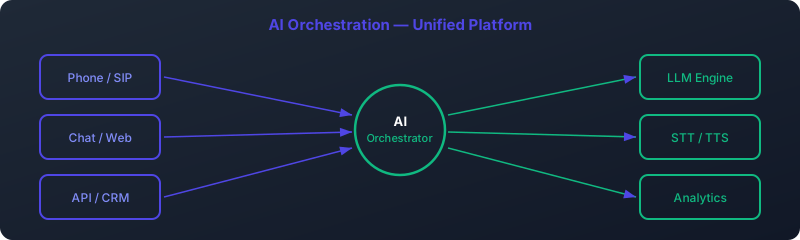
- AI Orchestration: Platforms that dynamically route tasks to the best modality or model, optimizing performance and cost.
As multimodal artificial intelligence matures, it will blur the line between digital and physical interaction, creating seamless, intuitive experiences that feel truly intelligent.
Frequently Asked Questions (FAQ)
Multimodal AI refers to artificial intelligence systems that can process and understand multiple types of data—such as text, images, audio, and video—simultaneously. This enables more human-like perception and context-aware decision-making.
Traditional AI models typically specialize in one modality (e.g., NLP for text or CNNs for images). Multimodal AI integrates multiple modalities, allowing richer understanding—like interpreting a video by analyzing both visuals and spoken words.
Notable examples include GPT-4V (text + image), Google Gemini (text, image, audio, video), and Claude Vision (text + image). These models can analyze complex inputs like screenshots, documents, and videos.
Cross-attention is a mechanism where one modality (e.g., text) attends to features of another (e.g., image regions). It enables dynamic fusion—such as focusing on a specific part of an image while generating a caption.
Key challenges include data alignment, high computational cost, bias amplification, privacy concerns, and lack of interpretability. Ensuring ethical and fair deployment remains critical.
Applications include healthcare diagnostics (text + scans + voice), autonomous vehicles (cameras + LiDAR + GPS), customer service (voice + emotion analysis), and content creation (text-to-video generation).
Ready to Leverage Multimodal AI?
At AIO Orchestration, we help businesses integrate advanced multimodal models into their workflows—boosting efficiency, creativity, and customer experience.
Explore Our AI Solutions Call Us: +33 7 59 02 45 36