Generative AI: Complete Guide to AI Content Creation Technologies
Published: March 2026 | By AIO Orchestration Team
Table of Contents
What is Generative AI?
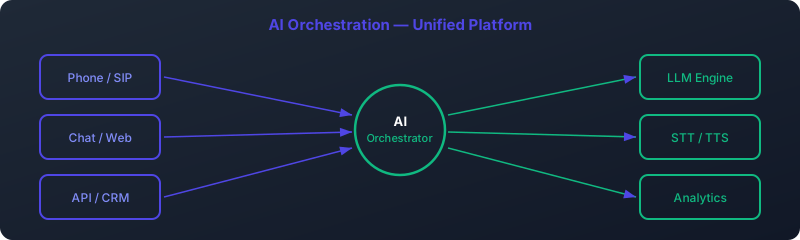
Generative Artificial Intelligence (AI) refers to a class of machine learning models capable of creating new content—such as text, images, audio, video, and code—based on patterns learned from vast datasets. Unlike traditional AI systems that classify or predict outcomes, generative AI produces original outputs that did not exist before.
At its core, generative AI leverages deep learning architectures to understand data distributions and generate novel instances that resemble the training data. This capability has revolutionized industries ranging from marketing and entertainment to software development and healthcare.
The rise of large language models (LLMs), diffusion models, and other advanced neural networks has made generative AI accessible to businesses and individuals alike. Today, tools like ChatGPT, DALL·E, and GitHub Copilot are empowering users to generate high-quality content in seconds.
Types of Generative AI
Generative AI spans multiple modalities, each tailored to a specific type of content creation. Below are the primary categories of AI content generation technologies currently in use.
Text Generation
Text generation is the most widely adopted form of generative AI. These models analyze vast corpora of written language and learn to produce coherent, contextually relevant text.
Applications include:
- Automated article and blog writing
- Email and message drafting
- Creative storytelling and scriptwriting
- Customer support chatbots
- Translation and summarization
Leading models such as GPT-4 and Claude excel at mimicking human writing styles, adapting tone, and maintaining logical flow across long-form content.
Image Generation
AI-powered image generation allows users to create visual content from textual descriptions (prompts). This technology has transformed digital art, design, and advertising.
Key features include:
- Photorealistic image creation
- Style transfer (e.g., turning photos into paintings)
- Concept art for games and films
- Product visualization for e-commerce
- Custom illustrations for marketing
Models like Midjourney and Stable Diffusion enable both professionals and hobbyists to generate high-resolution images with minimal input.
Video Generation
Video generation is one of the fastest-evolving areas in generative AI. These models can create short clips, animate still images, or even generate full scenes from scratch.
Use cases include:
- Marketing and social media content
- AI avatars for presentations
- Prototyping animations for film and gaming
- Educational and explainer videos
- Deepfake detection and synthesis research
OpenAI’s Sora model represents a breakthrough in this domain, capable of generating minute-long videos with complex scenes and camera motion.
Audio Generation
Generative AI can synthesize speech, music, and sound effects with remarkable fidelity. These systems are used in voice assistants, podcasting, and music production.
Applications include:
- Text-to-speech (TTS) with emotional tone control
- AI voice cloning for narration
- Music composition in various genres
- Sound design for games and films
- Real-time language dubbing
Tools like ElevenLabs and Google’s MusicLM are pushing the boundaries of what’s possible in synthetic audio.
Code Generation
AI-driven code generation accelerates software development by suggesting, completing, or writing entire functions and scripts.
Benefits include:
- Faster prototyping and debugging
- Automated documentation
- Learning new programming languages
- Refactoring legacy code
- Generating boilerplate code
GitHub Copilot, powered by OpenAI’s Codex, is a prime example of how generative artificial intelligence is reshaping developer workflows.
Key Generative AI Models
Several foundational models have driven the generative AI revolution. These architectures serve as the backbone for most commercial and open-source applications.
GPT-4
Developed by OpenAI, GPT-4 is a multimodal large language model capable of processing both text and images. It represents a significant leap over its predecessor, GPT-3.5, in terms of reasoning, accuracy, and contextual understanding.
Key Features:
- Handles complex instructions and multi-step tasks
- Supports 25+ languages
- Integrated into Microsoft products (e.g., Bing Chat, Office 365)
- Used in customer service, content creation, and education
GPT-4 powers ChatGPT Plus and is accessible via API for enterprise integration.
Claude
Created by Anthropic, Claude is designed with a focus on safety, reliability, and ethical AI. It uses Constitutional AI principles to reduce harmful outputs.
Advantages:
- Strong performance in summarization and analysis
- Larger context window (up to 200K tokens)
- Less prone to hallucination than earlier models
- Preferred for legal, financial, and compliance use cases
Claude 3 Opus is currently one of the most capable models available for enterprise applications.
Stable Diffusion
Developed by Stability AI, Stable Diffusion is an open-source image generation model that runs locally or in the cloud. It uses latent diffusion techniques to create high-quality visuals from text prompts.
| Feature | Stable Diffusion | Midjourney |
|---|---|---|
| Open Source | ✅ Yes | ❌ No |
| Local Deployment | ✅ Yes | ❌ No |
| Commercial Use | ✅ Allowed | ✅ With subscription |
| Community Plugins | ✅ Extensive | ❌ Limited |
Its flexibility makes it popular among developers and artists who want full control over their AI tools.
Midjourney
Midjourney is a proprietary image generation tool known for its artistic quality and ease of use. It operates via Discord and produces visually stunning results with minimal prompt engineering.
Strengths:
- High aesthetic quality
- Strong community and prompt sharing
- Excellent for concept art and design
- Iterative refinement with upscaling
While not open-source, Midjourney remains a favorite among creatives.
Sora
OpenAI’s Sora is a breakthrough text-to-video model capable of generating realistic, minute-long videos from natural language prompts. It can simulate complex scenes with multiple characters, motion, and camera dynamics.
Potential Uses:
- Film pre-visualization
- Advertising and branding
- Educational simulations
- Game development
As of March 2026, Sora is in limited access, with plans for broader release later this year.
How Generative AI Works
Understanding the underlying mechanisms of generative AI helps demystify its capabilities and limitations. Three primary architectures dominate the field: Transformers, Diffusion Models, and GANs.
Transformers
Introduced in 2017 by Google, the Transformer architecture revolutionized natural language processing. It relies on self-attention mechanisms to weigh the importance of different words in a sequence.
How it works:
- Processes input tokens in parallel (unlike RNNs)
- Uses attention weights to capture long-range dependencies
- Trained on massive text corpora using next-token prediction
- Enables bidirectional context understanding (e.g., BERT, GPT)
Transformers are the foundation of modern LLMs like GPT-4 and Claude.
Diffusion Models
Diffusion models generate data by gradually denoising random noise into structured outputs. They are the standard for image and video generation.
Process:
- Add noise to training images until they become pure noise
- Train a neural network to reverse this process
- Generate new images by starting from noise and iteratively removing it
This approach produces high-fidelity results and is used in Stable Diffusion, DALL·E 3, and Sora.
Generative Adversarial Networks (GANs)
Proposed by Ian Goodfellow in 2014, GANs consist of two competing neural networks: a generator and a discriminator.
How it works:
- The generator creates fake data (e.g., images)
- The discriminator tries to distinguish real from fake
- Both networks improve through adversarial training
- Eventually, the generator produces realistic outputs
While powerful, GANs are harder to train and have been largely supplanted by diffusion models in image generation.
Pro Tip: Transformers dominate text generation, diffusion models lead in image/video, and GANs remain useful for specific tasks like face synthesis.
Business Applications of Generative AI
Organizations across industries are leveraging AI content generation to boost productivity, reduce costs, and enhance customer experiences.
| Industry | Application | Example |
|---|---|---|
| Marketing | Ad copy, social media content | Automated campaign generation |
| E-commerce | Product descriptions, visuals | AI-generated product images |
| Healthcare | Medical documentation, patient summaries | AI scribes for doctors |
| Finance | Report generation, risk analysis | Automated quarterly summaries |
| Education | Personalized learning materials | Tutoring chatbots |
| Software | Code autocompletion, bug fixing | GitHub Copilot integration |
According to McKinsey (2025), companies adopting generative AI report a 25–40% increase in content creation efficiency and a 15–30% reduction in operational costs.
Ethical Considerations
While generative artificial intelligence offers immense benefits, it raises significant ethical concerns:
- Deepfakes and misinformation: AI can generate convincing fake videos and audio, threatening trust in media.
- Copyright infringement: Models trained on copyrighted data may reproduce protected content.
- Bias amplification: AI can perpetuate societal biases present in training data.
- Job displacement: Automation may impact creative and knowledge workers.
- Environmental impact: Training large models consumes significant energy.
Best Practice: Always verify AI-generated content, disclose AI use, and implement human oversight.
Global Regulations
Governments are responding with frameworks to ensure responsible AI use:
- EU AI Act (2025): Classifies generative AI as high-risk, requiring transparency and risk assessments.
- US Executive Order on AI (2023): Mandates safety testing and watermarking of AI-generated content.
- China’s Interim Measures (2023): Requires labeling of AI-generated content and approval for public services.
- France’s AI Strategy: Promotes innovation while enforcing strict data governance.
Compliance is critical for businesses deploying generative AI at scale.
Measuring ROI in Generative AI
To justify investment in generative AI, organizations should track key metrics:
- Time saved per content piece
- Reduction in creative agency costs
- Increase in content output volume
- Improvement in engagement (clicks, conversions)
- Developer productivity gains (lines of code per hour)
A 2026 Gartner study found that early adopters achieved ROI within 6–12 months through automation and innovation.
Caution: Poorly managed AI projects can lead to brand damage and legal exposure. Always start with pilot programs.
Frequently Asked Questions
Traditional AI focuses on classification, prediction, and decision-making (e.g., spam detection). Generative AI creates new content—text, images, code—that didn’t exist before. While traditional AI analyzes data, generative AI synthesizes it.
No—it augments them. AI excels at speed and scale but lacks human judgment, emotional depth, and ethical reasoning. The best outcomes come from human-AI collaboration, where AI handles repetitive tasks and humans provide oversight and creativity.
As of 2026, most jurisdictions (including the US and EU) do not grant copyright to fully AI-generated works. However, human-modified AI content may be protected. Always consult legal counsel before commercial use.
Security varies by platform. Enterprise-grade models offer encryption, access controls, and compliance certifications. Public models may expose sensitive data. Never input confidential information into unsecured AI tools.
Marketing, media, software development, healthcare, and education see the highest ROI. However, every sector can benefit from automation of content-heavy processes.
Begin with a pilot: identify a repetitive content task (e.g., email drafting), select a suitable tool (e.g., GPT-4), measure performance, and scale gradually. Consider partnering with AI orchestration experts for faster deployment.
Ready to Transform Your Business with Generative AI?
Our team at AIO Orchestration specializes in deploying secure, compliant, and high-ROI generative AI solutions.
Schedule a Free Consultation or call +33 7 59 02 45 36