Autonomous Systems AI: Revolutionizing Transportation
Published: March 15, 2026 | Jump to Table of Contents
Table of Contents
- What is Autonomous Systems AI?
- Levels of Autonomy in Vehicles
- Self-Driving Cars: Tesla, Waymo & Beyond
- Autonomous Drones: From Delivery to Surveillance
- Smart Factories: The AI-Powered Industrial Revolution
- Core Technologies Behind Autonomous Systems
- Safety, Edge Cases & Regulatory Hurdles
- Ethical Considerations in Autonomous AI
- The Future of Autonomous Systems
- Frequently Asked Questions (FAQ)
- Contact AIO Orchestration Today
What is Autonomous Systems AI?
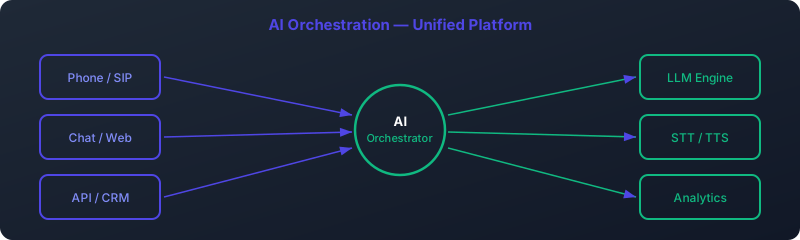
Autonomous Systems AI refers to intelligent machines capable of perceiving their environment, making decisions, and executing actions with minimal or no human intervention. These systems leverage artificial intelligence, machine learning, computer vision, and real-time data processing to operate independently in complex and dynamic environments.
From self-driving cars navigating city streets to drones delivering medical supplies in remote areas, and smart factories optimizing production lines, autonomous systems are reshaping industries. The convergence of AI with robotics, IoT, and 5G connectivity is accelerating this transformation, enabling machines to learn from experience, adapt to new inputs, and perform human-like tasks.
At the heart of autonomous systems lies AI orchestration—the seamless integration of multiple AI models, sensors, and decision-making modules to ensure reliable and safe operation. Whether it's a vehicle avoiding a pedestrian or a robotic arm adjusting its grip based on sensor feedback, these systems must process vast amounts of data in milliseconds.
Levels of Autonomy in Vehicles
The Society of Automotive Engineers (SAE) International defines six levels of driving automation (Level 0 to Level 5), which provide a standardized framework for classifying autonomous vehicles.
| Level | Name | Description | Examples |
|---|---|---|---|
| Level 0 | No Automation | Driver performs all tasks; system may issue warnings. | Traditional cars with ABS or lane departure alerts |
| Level 1 | Driver Assistance | One automated function (e.g., cruise control or steering assist). | Adaptive cruise control systems |
| Level 2 | Partial Automation | Combines steering and acceleration control; driver must remain engaged. | Tesla Autopilot, GM Super Cruise |
| Level 3 | Conditional Automation | Vehicle handles most tasks but requires driver intervention when needed. | Honda Legend, Mercedes Drive Pilot (limited deployment) |
| Level 4 | High Automation | Fully autonomous in specific conditions (e.g., geofenced areas). | Waymo One, Cruise AVs in San Francisco |
| Level 5 | Full Automation | No human intervention needed under any conditions. | Theoretical; not yet commercially available |
Most consumer vehicles today operate at Level 2, where AI assists with steering, braking, and acceleration, but the driver remains responsible for monitoring the environment. The leap to Level 3 introduces ethical and legal challenges, as the system may request human takeover in complex situations—a transition that can be dangerous if the driver is not attentive.
Self-Driving Cars: Tesla, Waymo & Beyond
Self-driving car AI is one of the most visible and debated applications of autonomous systems. Companies like Tesla, Waymo, Cruise, and Mobileye are leading the charge, each employing different strategies and technologies.
Tesla's Full Self-Driving (FSD) Vision
Tesla relies heavily on a camera-based vision system, dubbed "Tesla Vision," eschewing LiDAR in favor of neural networks trained on millions of real-world driving miles. Their FSD suite includes features like automatic lane changes, traffic light recognition, and urban navigation.
However, Tesla's approach has faced scrutiny. Despite marketing terms like "Full Self-Driving," the system remains at Level 2, requiring constant driver supervision. Regulatory bodies like the NHTSA have investigated multiple crashes involving Tesla vehicles operating with Autopilot engaged.
Waymo: The Lidar-Powered Leader
In contrast, Waymo—formerly Google's self-driving project—uses a sensor-rich approach combining LiDAR, radar, cameras, and detailed HD maps. Waymo operates a fully autonomous ride-hailing service in Phoenix and San Francisco under Level 4 autonomy.
Their vehicles can handle complex urban scenarios without a safety driver in certain zones. Waymo's emphasis on safety and rigorous testing has positioned it as a leader in reliable autonomy, though scalability remains a challenge due to high sensor costs.
Did You Know? Waymo vehicles have driven over 20 million miles on public roads and simulate 10 billion miles annually in virtual environments to train their AI models.
Autonomous Drones: From Delivery to Surveillance
Autonomous drones are revolutionizing logistics, agriculture, public safety, and entertainment. Unlike remote-controlled UAVs, autonomous drones use AI to navigate, avoid obstacles, and complete missions without human input.
Commercial & Delivery Applications
Companies like Amazon Prime Air, Wing (Alphabet), and Zipline operate drone delivery services in select regions. Zipline, for instance, delivers medical supplies in Rwanda and Ghana, reducing delivery times from hours to minutes.
These drones use GPS, computer vision, and terrain mapping to fly autonomously, landing at designated drop zones. AI algorithms optimize flight paths, monitor battery levels, and detect no-fly zones in real time.
Industrial & Emergency Use
In industrial settings, drones inspect pipelines, wind turbines, and cell towers, reducing risk to human workers. During disasters, autonomous drones map affected areas, locate survivors, and deliver emergency supplies.
| Use Case | AI Function | Key Players | Autonomy Level |
|---|---|---|---|
| Medical Delivery | Route optimization, obstacle avoidance | Zipline, Swoop Aero | Level 4 |
| Agricultural Monitoring | Image analysis, crop health detection | DJI Agras, PrecisionHawk | Level 3–4 |
| Infrastructure Inspection | Automated flight paths, anomaly detection | Skydio, Flyability | Level 3 |
| Search & Rescue | Thermal imaging, real-time tracking | FLIR, DJI Matrice | Level 3 |
Regulatory frameworks, such as the FAA’s Remote ID rule in the U.S., are evolving to enable safe integration of autonomous drones into national airspace.
Smart Factories: The AI-Powered Industrial Revolution
Smart factories represent the pinnacle of Industry 4.0, where autonomous systems AI optimizes every aspect of manufacturing. These facilities use interconnected machines, AI-driven analytics, and real-time data to achieve unprecedented efficiency, quality, and flexibility.
AI in Production & Quality Control
Robotic arms equipped with computer vision inspect products for defects at high speed. Machine learning models analyze sensor data to predict equipment failures before they occur—reducing downtime through predictive maintenance.
AI also optimizes supply chains, adjusting production schedules based on demand forecasts, inventory levels, and logistics data. Siemens, Bosch, and Foxconn operate some of the world’s most advanced smart factories.
Human-Robot Collaboration
Collaborative robots (cobots) work alongside humans, learning from their actions and adapting to new tasks. These systems use reinforcement learning to improve performance over time, making factories more agile and responsive.
Success Story: A German automotive plant reduced defect rates by 45% and energy consumption by 20% after deploying AI-powered predictive maintenance and quality control systems.
Core Technologies Behind Autonomous Systems
Sensor Fusion: The Eyes and Ears of AI
Sensor fusion combines data from multiple sources—cameras, LiDAR, radar, ultrasonic sensors, GPS, and IMUs—to create a comprehensive understanding of the environment. Each sensor has strengths and weaknesses:
- Cameras: High resolution, color, and depth perception (with stereo vision), but limited in low light.
- LiDAR: Precise 3D mapping, works in darkness, but expensive and affected by weather.
- Radar: Reliable in rain/fog, measures speed, but lower resolution.
- Ultrasonic: Short-range obstacle detection, used in parking systems.
AI algorithms, particularly deep learning models, fuse this data in real time to detect objects, classify them (car, pedestrian, cyclist), and predict their behavior.
Path Planning & Decision Making
Once the environment is understood, the system must decide where to go and how to get there safely. This involves:
- Global Path Planning: Using HD maps to determine the optimal route from A to B.
- Local Path Planning: Adjusting trajectory in real time to avoid obstacles, obey traffic rules, and ensure passenger comfort.
- Behavior Prediction: Anticipating the actions of other road users using probabilistic models.
Techniques like A* search, Dijkstra’s algorithm, and reinforcement learning are used to generate safe and efficient paths.
Edge Computing in AI Orchestration
Autonomous systems cannot rely on cloud computing alone due to latency. Edge computing processes data locally on the device, enabling real-time responses. For example, a self-driving car must react to a jaywalking pedestrian in under 100 milliseconds—far too slow for round-trip cloud communication.
AI orchestration platforms manage workloads between edge devices and the cloud, ensuring critical decisions are made locally while non-urgent tasks (e.g., model updates) are handled remotely.
Safety, Edge Cases & Regulatory Hurdles
Despite rapid progress, autonomous systems face significant safety challenges:
Edge Cases: The Long Tail of Rare Events
AI models are trained on vast datasets, but real-world environments present unpredictable scenarios—children chasing a ball into traffic, animals on the road, or construction zones with unclear signage. These "edge cases" are rare but critical.
Solutions include simulation environments (e.g., NVIDIA DRIVE Sim), where billions of miles are driven virtually to expose AI to rare events, and corner case mining to identify and retrain on problematic scenarios.
Regulatory Landscape
Regulations lag behind technology. In the U.S., the NHTSA is developing a Framework for Automated Vehicles, while the EU’s General Safety Regulation mandates advanced driver assistance systems (ADAS) in new vehicles.
Key issues include:
- Liability in accidents (who is responsible—the manufacturer, software developer, or user?)
- Standardized testing and certification
- Cybersecurity and data privacy
Warning: A 2025 study found that 78% of autonomous vehicle crashes occurred during handover scenarios (Level 3), highlighting the danger of human-machine miscommunication.
Ethical Considerations in Autonomous AI
As AI makes life-or-death decisions, ethical questions arise:
- The Trolley Problem: Should a self-driving car swerve to avoid hitting a pedestrian, risking the passenger’s life?
- Bias in AI: Training data may underrepresent certain demographics, leading to unequal safety outcomes.
- Job Displacement: Automation could disrupt millions of driving, delivery, and manufacturing jobs.
- Surveillance & Privacy: Drones and smart city systems raise concerns about constant monitoring.
Organizations like the IEEE and EU Commission are developing ethical AI guidelines, emphasizing transparency, accountability, and human oversight.
The Future of Autonomous Systems
The next decade will see:
- Widespread deployment of Level 4 autonomous taxis in urban centers
- Drone highways for commercial delivery networks
- AI-driven smart cities with integrated traffic, energy, and emergency systems
- Self-healing factories that adapt to disruptions in real time
Breakthroughs in AI safety, explainability, and human-AI collaboration will be crucial. As autonomous systems AI matures, it will not only enhance efficiency but also redefine how we live, work, and move.
Frequently Asked Questions (FAQ)
Autonomous Systems AI refers to artificial intelligence systems that can perceive their environment, make decisions, and act independently without human intervention. These include self-driving cars, autonomous drones, and AI-powered smart factories.
Self-driving cars use AI for sensor fusion, path planning, object detection, and decision-making. They combine data from cameras, LiDAR, radar, and GPS to navigate safely in dynamic environments.
The SAE defines six levels (0–5). Level 0 is no automation, Level 2 offers partial automation (e.g., Tesla Autopilot), and Level 5 is full autonomy under all conditions.
Autonomous drones use AI to navigate using GPS, computer vision, and obstacle avoidance algorithms. They are used in delivery, agriculture, surveillance, and emergency response.
In smart factories, AI optimizes production, predicts maintenance needs, controls robotic arms, and manages supply chains using real-time data from IoT sensors and machine learning models.
Ethical concerns include decision-making in life-threatening situations (e.g., trolley problem), data privacy, job displacement, algorithmic bias, and accountability in case of failure.
Ready to Implement Autonomous Systems AI?
Whether you're developing self-driving car AI, autonomous drones, or smart factory solutions, AIO Orchestration provides the expertise and infrastructure to bring your vision to life.
Call us today at +33 7 59 02 45 36 or schedule a consultation to learn how we can accelerate your AI journey.
Explore Our AI Orchestration Platform →