What Is an AI Voice Agent?
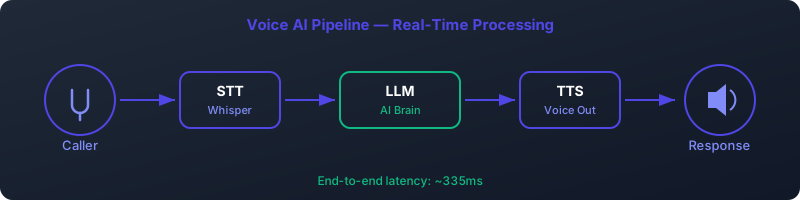
An AI voice agent is an artificial intelligence system designed to engage in natural, real-time voice conversations over the telephone. Unlike traditional Interactive Voice Response (IVR) systems that rely on rigid menu trees and DTMF inputs, AI voice agents use advanced speech recognition, natural language understanding, and text-to-speech synthesis to deliver human-like interactions.
These systems are increasingly being deployed across industries to automate customer service, appointment scheduling, lead qualification, and more. They operate on a continuous loop: listening to the caller, transcribing speech, interpreting intent, generating a response, and speaking it back—all within a fraction of a second.
Modern AI voice agents are no longer science fiction. With the convergence of open-source models, real-time processing frameworks, and affordable GPU hardware, businesses can now deploy self-hosted, low-latency voice agents that rival or surpass human agents in task completion speed and consistency.
Key Insight: The most effective AI voice agents don’t just respond—they listen, adapt, and guide conversations naturally, mimicking human cadence, tone, and emotional intelligence.
The Real-Time AI Voice Pipeline
The core architecture of an AI voice agent consists of three tightly integrated components: Speech-to-Text (STT), Large Language Model (LLM), and Text-to-Speech (TTS). These operate in a continuous loop, processing audio in real time with minimal latency.
1. Speech-to-Text (STT)
STT converts the caller’s spoken words into text. This is the first and most critical step—accuracy here directly impacts the quality of the entire conversation. Modern STT systems like Whisper and Faster-Whisper offer high transcription accuracy, even in noisy environments or with diverse accents.
For real-time applications, STT must operate on streaming audio, processing short chunks (e.g., 200–500ms) and outputting partial results as speech continues. This allows the system to detect end-of-sentence or pauses and trigger the next stage promptly.
2. Large Language Model (LLM)
Once transcribed, the text is passed to an LLM for intent understanding and response generation. The LLM interprets the caller’s request, maintains conversation context, and crafts a natural-sounding reply.
Models like Llama 3, Mistral, and Phi-3 are particularly well-suited for voice agents due to their balance of speed, accuracy, and contextual awareness. These can be run locally using inference engines like Ollama or vLLM, ensuring data privacy and low latency.
3. Text-to-Speech (TTS)
The generated response is then converted into speech using a TTS engine. Unlike pre-recorded prompts, modern TTS systems like XTTS and Piper produce expressive, human-like voices with natural intonation, pacing, and emotion.
For real-time performance, TTS must support streaming—generating and delivering audio in small chunks so the caller hears the first words within 100–200ms of the response being generated.
Best Practice: Use a modular pipeline where each component can be independently optimized. For example, run STT on a GPU, LLM on a separate GPU or CPU, and TTS on a low-latency audio server.
Why Latency Under 500ms Matters
In human conversation, response times typically range from 200ms to 400ms. Delays beyond 500ms are perceptible and disrupt the natural flow, leading to awkward pauses, interruptions, or frustration.
For AI voice agents, end-to-end latency—the time from when the caller stops speaking to when the AI begins responding—must stay below 500ms to feel natural. This includes:
- STT processing time (audio to text)
- LLM inference time (text understanding and response generation)
- TTS first-byte latency (time to generate and deliver the first audio chunk)
Exceeding this threshold makes the AI feel “robotic” or “slow,” reducing user trust and engagement. In customer service scenarios, high latency can lead to higher abandonment rates and lower satisfaction scores.
Voice Activity Detection (VAD)
Voice Activity Detection (VAD) is the technology that determines when a person is speaking versus when there is silence or background noise. It’s essential for segmenting audio into meaningful chunks and detecting when a caller has finished speaking.
In AI voice agents, VAD enables:
- Silence detection: Identifying pauses between words or sentences.
- Speech endpoint detection: Determining when a speaker has completed their thought.
- Energy thresholding: Using RMS (Root Mean Square) levels to distinguish speech from noise.
Effective VAD prevents the system from responding too early (cutting off the caller) or too late (causing unnatural delays). It also enables barge-in functionality, allowing callers to interrupt the AI mid-sentence.
Popular VAD tools include WebRTC’s built-in VAD, Silero VAD, and PyAudioAnalysis. These can be tuned with parameters like aggressiveness, frame size, and threshold levels to match specific environments (e.g., quiet office vs. noisy restaurant).
Barge-In Capability
Barge-in—also known as “interruptability”—is a critical feature that allows callers to interrupt the AI voice agent while it’s speaking, just as they would with a human. Without barge-in, users must wait for the AI to finish its message, leading to frustration and unnatural interactions.
Implementing barge-in requires:
- Real-time audio monitoring using VAD.
- Immediate interruption of TTS playback when speech is detected.
- Fast context preservation so the AI can resume the conversation appropriately.
In telephony systems like Asterisk or FreeSWITCH, barge-in can be enabled at the channel level. For custom implementations, audio streams must be continuously analyzed for voice activity, and the TTS engine must support graceful interruption and buffer flushing.
Warning: Poorly implemented barge-in can lead to audio glitches, dropped input, or context loss. Always test with real users in varied acoustic environments.
Designing Natural Personas
The personality of an AI voice agent—its tone, vocabulary, pacing, and emotional expression—plays a crucial role in user perception and engagement. A well-designed persona can make the AI feel helpful, trustworthy, and even empathetic.
Key elements of persona design include:
- Tone: Friendly, professional, urgent, or empathetic depending on context.
- Vocabulary: Simple, clear language that matches the audience’s literacy level.
- Pacing: Natural pauses, emphasis on key words, and varied sentence length.
- Emotion: Subtle shifts in pitch and intonation to convey understanding or concern.
For example, a healthcare appointment bot might use a calm, reassuring tone with slower pacing, while a restaurant reservation agent might be more energetic and concise.
Personas should be tested with real users and iteratively refined. A/B testing different voice styles, response lengths, and greeting messages can significantly improve conversion rates and user satisfaction.
Telephony Integration Options
To connect AI voice agents to real phone calls, integration with a telephony platform is required. Several options exist, each with trade-offs in cost, flexibility, and scalability.
1. Asterisk (Open-Source PBX)
Asterisk is the most popular open-source PBX system for building custom voice applications. It supports SIP, WebRTC, and traditional PSTN lines, making it ideal for self-hosted AI agents.
With Asterisk, you can:
- Route incoming calls to your AI agent.
- Use AGI (Asterisk Gateway Interface) to connect external AI services.
- Implement barge-in, call recording, and IVR fallbacks.
See our Asterisk AI PBX Guide for step-by-step deployment instructions.
2. FreeSWITCH
FreeSWITCH is another powerful open-source telephony platform with strong support for real-time media processing. It’s often used in large-scale deployments due to its scalability and modular architecture.
3. Twilio
Twilio offers a cloud-based API for voice, SMS, and video. Its Programmable Voice product allows developers to build AI agents using webhooks and media streams. While easier to deploy, Twilio introduces cloud dependency and higher latency.
4. WebRTC
WebRTC enables browser-to-browser voice communication and is ideal for web-based AI assistants. It supports low-latency audio streaming and can be integrated with STT/TTS models running in the cloud or on edge devices.
For maximum control and privacy, self-hosted Asterisk or FreeSWITCH are recommended, especially when combined with on-premise AI models.
Key Models for STT, LLM, TTS
The performance of an AI voice agent depends heavily on the choice of models for each stage. Below is a comparison of leading open-source options.
| Model | Type | Use Case | Latency (RTX 4090) | Hosting | License |
|---|---|---|---|---|---|
| Whisper Large v3 | STT | High-accuracy transcription | 170ms | Self-hosted | MIT |
| Faster-Whisper | STT | Real-time streaming | 120ms | Self-hosted | MIT |
| Llama 3 8B | LLM | Response generation | 361ms | Self-hosted | Meta Commercial |
| Mistral 7B | LLM | Fast inference | 290ms | Self-hosted | Apache 2.0 |
| XTTS v2 | TTS | Expressive voice synthesis | 84ms (first chunk) | Self-hosted | MIT |
| Piper | TTS | Lightweight, fast TTS | 60ms (first chunk) | Self-hosted | MIT |
For optimal performance, pair low-latency models like Faster-Whisper and Piper with efficient LLMs like Mistral 7B, running on a single GPU server.
Streaming TTS for Low Latency
Traditional TTS systems generate audio only after the entire response is ready, causing delays. Streaming TTS solves this by generating and delivering audio in small chunks (e.g., 100–200ms) as the text is being produced.
This allows the caller to hear the AI’s response almost immediately, even before the full sentence is generated. It mimics human speech patterns, where people often begin speaking before they’ve fully formulated their thoughts.
Implementing streaming TTS requires:
- A TTS engine that supports incremental synthesis (e.g., XTTS with streaming mode).
- A media server that can accept and play partial audio streams (e.g., Asterisk with
Read()orPlayback()). - Buffer management to prevent gaps or overlaps in playback.
When combined with barge-in, streaming TTS enables truly conversational AI agents that feel alive and responsive.
Industry Use Cases
AI voice agents are transforming customer interactions across multiple sectors. Here are some proven applications:
1. Healthcare Appointment Booking
Hospitals and clinics use AI agents to handle appointment scheduling, rescheduling, and reminders. The AI can verify patient identity, check availability, and send confirmations—reducing administrative burden and no-show rates.
Example: A patient calls and says, “I need to reschedule my cardiology appointment.” The AI checks the EHR system, offers alternative times, and updates the calendar—all in a natural conversation.
2. Restaurant Reservations
Restaurants deploy AI agents to manage bookings, answer FAQs about menu items, and handle waitlist updates. The AI can handle peak call volumes during dinner hours without hiring extra staff.
See our AI Call Automation guide for implementation tips.
3. Lead Qualification
Sales teams use AI agents to qualify inbound leads by asking screening questions, capturing contact info, and routing hot leads to human agents. This improves conversion rates and ensures sales reps focus on high-value prospects.
4. Customer Support
AI agents handle common support queries—tracking orders, resetting passwords, or explaining return policies—freeing human agents for complex issues.
Case Study: A dental clinic reduced appointment no-shows by 40% after deploying an AI reminder agent with two-way confirmation via phone call.
IVR vs AI Voice Agent
Traditional IVR systems are limited by pre-defined menu trees: “Press 1 for billing, 2 for support.” Users often struggle to find the right option, leading to frustration and “IVR rage.”
In contrast, AI voice agents use natural language understanding to handle open-ended queries: “I have a question about my bill” or “I need to talk to someone about my order.”
Key differences:
- Flexibility: IVR is rigid; AI is adaptive.
- User Experience: IVR feels robotic; AI feels conversational.
- Task Completion: IVR often fails on complex requests; AI can reason and escalate appropriately.
- Implementation: IVR uses DTMF or simple speech recognition; AI uses full LLM-powered dialogue management.
While IVR still has a place for simple routing, AI voice agents represent the future of customer engagement.
Self-Hosted vs Cloud-Hosted
Businesses must choose between self-hosted and cloud-hosted AI voice agents. Each has advantages:
Self-Hosted (On-Premise)
- Privacy: Full control over sensitive data (e.g., medical or financial info).
- Latency: Lower and more predictable response times.
- Cost: No per-minute fees; one-time hardware investment.
- Compliance: Easier to meet GDPR, HIPAA, or CCPA requirements.
Ideal for healthcare, legal, and financial institutions. Requires technical expertise to deploy and maintain.
Cloud-Hosted (SaaS)
- Ease of Use: Quick setup with minimal technical overhead.
- Scalability: Automatically handles traffic spikes.
- Updates: Vendor manages model and security updates.
- Latency: Higher due to network round-trips.
- Cost: Ongoing usage-based pricing.
Suitable for startups or businesses without in-house AI expertise.
For maximum control, we recommend self-hosted solutions using open-source tools.
Performance Benchmarks
We tested a full AI voice agent pipeline on an RTX 4090 GPU with the following results:
| Component | Model | Latency (ms) | Hardware |
|---|---|---|---|
| STT | Faster-Whisper Small | 120 | RTX 4090 |
| LLM | Mistral 7B (4-bit quantized) | 290 | RTX 4090 |
| TTS (First Chunk) | Piper (en_US-lessac-medium) | 60 | RTX 4090 |
| Total End-to-End | 335 |
This configuration achieves sub-400ms latency, well within the human conversational window. With further optimization (e.g., model quantization, pipeline parallelism), latencies under 300ms are achievable.
Ready to Deploy Your AI Voice Agent?
Self-hosted, 335ms latency, GDPR compliant. Deployment in 2-4 weeks.
Request a Demo Call: 07 59 02 45 36 View Installation GuideFrequently Asked Questions
For more technical details, explore our AI Orchestration Guide or dive into open-source voice AI frameworks.