AI Recommendation Systems: Algorithms, Architecture & Applications
Published: March 15, 2026 | By AIO Orchestration Team
Table of Contents
- What is an AI Recommendation System?
- How Do Recommendation Engines Work?
- Types of Recommendation Algorithms
- Deep Learning in Recommendation Systems
- Real-World Examples: Netflix, Amazon, Spotify
- AI in E-Commerce: Personalization at Scale
- Architecture of AI Recommendation Systems
- Personalization vs. Privacy: The Ethical Balance
- Implementing a Recommendation Engine: A Step-by-Step Guide
- The Future of AI Recommendation Systems
- Frequently Asked Questions (FAQ)
- Conclusion
What is an AI Recommendation System?
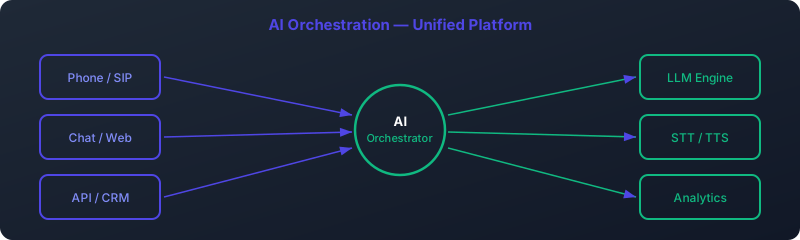
An AI recommendation system, also known as a recommendation engine or recommender system, is an intelligent software framework that predicts user preferences and suggests relevant items. These systems leverage machine learning, data mining, and behavioral analytics to deliver personalized experiences across digital platforms.
From suggesting the next binge-worthy series on Netflix to recommending products on Amazon, AI-powered recommendations have become integral to modern digital interactions. According to recent studies, over 35% of Amazon’s revenue is driven by its recommendation engine, while Netflix attributes nearly 80% of content watched to personalized suggestions.
At its core, a recommendation system analyzes vast datasets—user behavior, item attributes, contextual information—to identify patterns and make predictions. The goal is simple: increase engagement, improve user satisfaction, and boost business metrics like conversion rates and average order value.
How Do Recommendation Engines Work?
Recommendation engines operate by answering one key question: “What might this user want next?” To answer this, they follow a structured process:
- Data Collection: Gather user interactions (clicks, purchases, ratings), item metadata (product category, genre), and contextual data (time, location).
- Data Preprocessing: Clean and transform raw data into a usable format, often involving normalization, feature extraction, and handling missing values.
- Model Training: Apply machine learning algorithms to learn user-item relationships.
- Recommendation Generation: Generate predictions based on the trained model.
- Feedback Loop: Use new user interactions to retrain and refine the model continuously.
The effectiveness of a recommendation engine is measured using metrics such as precision, recall, mean average precision (MAP), and click-through rate (CTR).
Types of Recommendation Algorithms
Different recommendation algorithms serve different purposes. The three main paradigms are collaborative filtering, content-based filtering, and hybrid systems.
Collaborative Filtering
Collaborative filtering (CF) is one of the most widely used approaches. It operates on the principle that users who agreed in the past will agree in the future. CF can be further divided into:
- User-based CF: Finds users with similar tastes and recommends items liked by similar users.
- Item-based CF: Recommends items similar to those the user has liked in the past.
For example, if User A and User B both liked movies X and Y, and User A also liked movie Z, the system may recommend Z to User B.
While effective, CF suffers from the cold start problem (difficulty recommending to new users or items) and sparsity (limited user-item interactions).
| Pros | Cons |
|---|---|
| No need for item metadata | Cold start problem for new users/items |
| Discovers unexpected interests | Scalability issues with large datasets |
| High accuracy with sufficient data | Susceptible to shilling attacks |
Content-Based Filtering
Content-based filtering recommends items by analyzing the attributes of items a user has interacted with. For instance, if a user frequently watches sci-fi movies, the system will recommend other sci-fi films.
This approach relies on feature extraction—transforming item descriptions into vectors (e.g., using TF-IDF or embeddings). A user profile is built based on preferred features, and new items are scored based on similarity.
Content-based systems excel in handling new items (no cold start) and providing transparent recommendations. However, they may suffer from over-specialization, failing to suggest diverse or serendipitous content.
Did You Know? Spotify uses content-based filtering to analyze audio features like tempo, key, and energy to recommend songs with similar sonic characteristics.
Hybrid Recommendation Systems
Hybrid systems combine collaborative and content-based approaches to overcome individual limitations. Common strategies include:
- Weighted Hybrid: Combines scores from multiple models using fixed or adaptive weights.
- Switching Hybrid: Uses one model under certain conditions, another under different conditions.
- Feature Combination: Merges features from both approaches into a single model.
Hybrid systems often outperform single-method approaches, offering better accuracy, coverage, and robustness.
Deep Learning in Recommendation Systems
Deep learning has revolutionized recommendation engines by enabling the modeling of complex, non-linear user-item interactions. Neural networks can automatically learn hierarchical representations from raw data, reducing the need for manual feature engineering.
Popular deep learning architectures include:
- Neural Collaborative Filtering (NCF): Replaces matrix factorization with neural networks to model user-item interactions.
- Autoencoders: Used for dimensionality reduction and collaborative filtering by reconstructing user-item interaction matrices.
- Sequence Models (RNNs, Transformers): Capture temporal dynamics in user behavior, ideal for session-based recommendations.
- Graph Neural Networks (GNNs): Model user-item interactions as a graph, capturing complex relationships and social influences.
For example, YouTube uses deep neural networks to predict watch time, optimizing for long-term user engagement rather than immediate clicks.
Real-World Examples: Netflix, Amazon, Spotify
Netflix: Personalization at Scale
Netflix’s recommendation engine is a cornerstone of its success. It uses a hybrid system combining:
- Collaborative filtering across 200+ million users
- Content-based analysis of metadata (genre, cast, director)
- Deep learning models to predict engagement and retention
The system generates personalized rows like “Because you watched…” and “Trending Now,” driving 80% of content consumption.
Amazon: The Power of Item-to-Item Collaborative Filtering
Amazon pioneered item-based collaborative filtering. Its “Customers who bought this also bought…” feature relies on:
- Real-time analysis of purchase co-occurrence
- Deep learning for product embedding and similarity
- Contextual bandits for dynamic A/B testing of recommendations
This approach drives cross-selling and increases average order value by up to 30%.
Spotify: Music Discovery with AI
Spotify’s recommendation engine powers features like Discover Weekly and Daily Mix. It combines:
- Audio analysis (CNNs on spectrograms)
- NLP on user playlists and reviews
- Collaborative filtering across 500+ million users
- Sequence models to predict listening flow
The result? Over 2 billion Discover Weekly playlists generated weekly.
AI in E-Commerce: Personalization at Scale
E-commerce platforms rely heavily on AI recommendation systems to drive sales and retention. Key applications include:
- Product Recommendations: “You may also like” sections on product pages.
- Cart Abandonment: Email recommendations based on abandoned items.
- Homepage Personalization: Dynamic banners and carousels tailored to user segments.
- Search Ranking: Personalized search results based on user history.
A study by McKinsey found that personalized recommendations can increase sales by 10–30% and improve customer satisfaction by 20%.
| Platform | Recommendation Type | Impact |
|---|---|---|
| Amazon | Item-based CF + Deep Learning | 35% of revenue from recommendations |
| Netflix | Hybrid + Deep Learning | 80% of content watched via suggestions |
| Spotify | Audio + Collaborative + NLP | 2B+ weekly Discover Weekly playlists |
| TikTok | Deep Learning + Reinforcement Learning | 70% of content from For You Page |
Architecture of AI Recommendation Systems
A scalable recommendation engine architecture typically includes the following components:
- Data Ingestion Layer: Collects user events (clicks, views, purchases) from web, mobile, and API sources.
- Data Storage: Uses data lakes (e.g., AWS S3) and databases (e.g., PostgreSQL, Cassandra) to store structured and unstructured data.
- Feature Store: Central repository for precomputed features (user embeddings, item vectors).
- Model Training: Batch or real-time training using frameworks like TensorFlow, PyTorch, or Spark MLlib.
- Serving Layer: Low-latency API (e.g., using TensorFlow Serving) to deliver recommendations in real time.
- Feedback Loop: Captures user responses to refine models via online learning.
Modern architectures often use microservices and event-driven design (e.g., Kafka) for scalability and resilience.
Personalization vs. Privacy: The Ethical Balance
While AI recommendation systems enhance user experience, they raise critical privacy concerns. Collecting and analyzing personal data—browsing history, location, preferences—can lead to surveillance risks and data misuse.
Key challenges include:
- Data Minimization: Collecting only necessary data.
- Transparency: Informing users about data usage.
- Consent: Obtaining explicit opt-in under GDPR and CCPA.
- Anonymization: Using techniques like differential privacy to protect identities.
Companies like Apple emphasize on-device processing to keep data private, while others use federated learning to train models without centralizing user data.
Privacy Alert: Over-personalization can lead to filter bubbles and reduced serendipity. Users may feel “trapped” in algorithmic echo chambers.
Implementing a Recommendation Engine: A Step-by-Step Guide
Building a robust recommendation algorithm requires careful planning. Follow this roadmap:
- Define Objectives: What do you want to optimize? Clicks, purchases, watch time?
- Collect Data: Set up tracking for user-item interactions.
- Choose Algorithm: Start with collaborative or content-based filtering; evolve to hybrid or deep learning.
- Build MVP: Use libraries like Surprise (Python) or TensorFlow Recommenders.
- Evaluate: Test precision, recall, and business KPIs via A/B testing.
- Scale: Deploy with real-time serving and monitoring.
- Iterate: Continuously improve based on feedback.
For e-commerce, begin with “frequently bought together” or “users who viewed this also viewed” recommendations.
Pro Tip: Use open datasets like MovieLens or Amazon Product Data to prototype your engine before integrating with live systems.
The Future of AI Recommendation Systems
The next generation of AI recommendation systems will be more context-aware, explainable, and ethical. Emerging trends include:
- Reinforcement Learning: Systems that learn from long-term user engagement, not just immediate clicks.
- Multimodal Recommendations: Combining text, image, audio, and video inputs for richer suggestions.
- Explainable AI (XAI): Providing users with reasons for recommendations (“Because you liked X…”).
- Federated Learning: Training models on-device without sharing raw data.
- Generative AI: Using LLMs to create personalized content summaries and recommendation narratives.
As AI evolves, the focus will shift from pure accuracy to trust, transparency, and user control.
Frequently Asked Questions (FAQ)
A search engine retrieves items based on explicit user queries (e.g., “red running shoes”), while a recommendation engine proactively suggests items based on user behavior and preferences without a direct query. Search is reactive; recommendation is proactive.
New users present a “cold start” problem. Solutions include using popularity-based recommendations, asking for initial preferences, or leveraging demographic data. Over time, as the user interacts, the system builds a profile and transitions to personalized suggestions.
Yes. If training data reflects historical biases (e.g., gender or racial stereotypes), the model may amplify them. For example, a job recommendation engine might favor men for technical roles. Mitigation includes bias detection, diverse training data, and fairness-aware algorithms.
Python is the most popular due to libraries like Scikit-learn, TensorFlow, PyTorch, and Surprise. R is also used for statistical modeling. For production systems, Java or Scala (with Apache Spark) are common for scalability.
Retraining frequency depends on data velocity. E-commerce models may retrain daily or hourly due to fast-changing inventory and trends. Content platforms like Netflix may retrain weekly. Real-time feedback loops allow for continuous updates.
No. Small and medium businesses can leverage cloud-based recommendation services (e.g., AWS Personalize, Google Recommendations AI) or open-source tools to implement effective systems without massive infrastructure. Even basic collaborative filtering can yield strong ROI.
Conclusion
AI recommendation systems are no longer a luxury—they are a necessity in the digital age. By leveraging advanced recommendation algorithms, businesses can deliver hyper-personalized experiences that drive engagement, loyalty, and revenue.
From collaborative filtering to deep learning, the evolution of recommendation engines reflects the broader progress in artificial intelligence. As we move toward more ethical, transparent, and context-aware systems, the future of personalization is bright.
Whether you're building your first recommendation model or scaling an enterprise system, the principles remain the same: understand your users, respect their privacy, and continuously innovate.
Ready to Build Your AI Recommendation Engine?
Our team at AIO Orchestration specializes in designing and deploying scalable, ethical AI recommendation systems for e-commerce, media, and SaaS platforms.
Explore Our AI Solutions or call us at +33 7 59 02 45 36