Introduction: The Rise of AI Orchestration in 2026
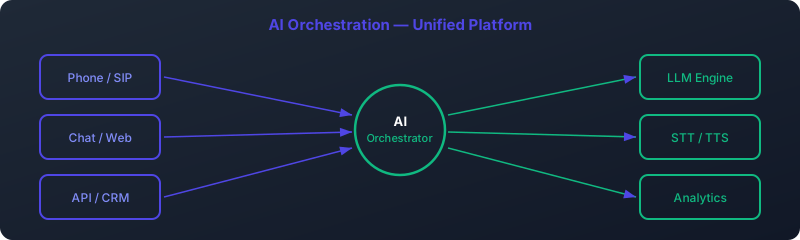
As artificial intelligence becomes increasingly embedded in enterprise workflows, the need for effective AI orchestration has never been more critical. In 2026, organizations are no longer just experimenting with isolated AI models—they are deploying complex, multi-step agent systems that require seamless coordination across tools, data sources, and communication channels.
AI orchestration refers to the process of managing and coordinating multiple AI models, tools, and workflows to achieve a common goal. Whether it's a customer service agent that pulls data from a CRM, schedules appointments via calendar APIs, and escalates issues to human teams—or a voice-enabled call center bot that transcribes speech, reasons over context, and generates natural-sounding responses—orchestration is what makes these intelligent systems function cohesively.
The landscape of AI orchestration tools has bifurcated into two dominant paths: open source frameworks and commercial SaaS platforms. Each offers distinct advantages and trade-offs in terms of cost, control, customization, and deployment speed. This comprehensive guide compares both approaches, evaluates leading tools in each category, and provides a data-driven framework for decision-making.
Key Insight: The choice between open source and commercial AI orchestration tools is no longer binary. Many enterprises now adopt a hybrid approach—using commercial platforms for rapid prototyping and open source stacks for production deployment where data privacy and latency are paramount.
Categories of AI Orchestration Tools
Before diving into specific tools, it's essential to understand the three primary categories of AI orchestration solutions available today:
1. Frameworks
Frameworks like LangChain and CrewAI provide the building blocks for developers to create custom AI workflows. These are typically open source, highly flexible, and require programming expertise. They allow fine-grained control over agent logic, memory, and tool integrations but demand significant engineering investment.
2. Platforms
Commercial platforms such as Vapi, Bland.ai, and Retell offer managed services with pre-built components for voice, text, and multi-modal AI agents. These are ideal for teams that want to deploy AI solutions quickly without deep technical involvement. Pricing is usually usage-based (e.g., per minute of voice processing), and customization is constrained by platform capabilities.
3. Custom-Built Systems
Some organizations, particularly in regulated industries or high-performance environments, opt to build their own orchestration layer from scratch. This approach maximizes control and security but comes with the highest development and maintenance costs. It's often seen in financial services, healthcare, and defense sectors where compliance and latency are non-negotiable.
Open Source AI Orchestration Tools
Open source tools have become the foundation of many cutting-edge AI applications, particularly in environments where data sovereignty, customization, and long-term cost control are priorities. Let’s examine the leading open source solutions shaping the AI orchestration landscape in 2026.
LangChain & LangGraph: Agent Orchestration Powerhouse
LangChain remains one of the most widely adopted frameworks for building AI agent workflows. Originally designed to connect large language models (LLMs) with external data and tools, LangChain has evolved into a full-featured orchestration engine capable of managing complex, stateful agent interactions.
Its newer sibling, LangGraph, introduces a graph-based approach to agent orchestration, enabling developers to define multi-step workflows with conditional logic, parallel execution, and persistent memory. This is particularly valuable for applications like customer support bots that need to maintain context across multiple turns and tools.
Key Features:
- Tool Calling: Seamlessly integrates with APIs, databases, and custom functions
- Memory Management: Supports short-term (conversation history) and long-term (vector store) memory
- Modular Design: Components can be reused across different agents and projects
- Multi-Agent Support: Enables collaboration between specialized agents (e.g., researcher, writer, editor)
LangChain is especially powerful when combined with local LLMs via Ollama or Llama.cpp, allowing fully offline, private AI workflows. However, it requires strong Python skills and careful optimization to avoid performance bottlenecks.
CrewAI: Multi-Agent Workflows Made Simple
CrewAI has emerged as a leading open source framework specifically designed for multi-agent collaboration. Unlike general-purpose tools like LangChain, CrewAI focuses on enabling teams of AI agents to work together on complex tasks, each with defined roles, goals, and tools.
For example, a marketing automation workflow might involve a Researcher agent that gathers market data, a Writer agent that drafts content, and a Critic agent that reviews and improves the output—all coordinated by CrewAI’s orchestration layer.
Advantages of CrewAI:
- Role-Based Agents: Define agents with specific expertise and responsibilities
- Delegation & Feedback Loops: Agents can delegate tasks and provide feedback to each other
- Transparency: Full visibility into agent decisions and reasoning steps
- Integration: Works with any LLM backend, including local models via Ollama
CrewAI is particularly well-suited for knowledge-intensive workflows in legal, research, and content creation domains. Its declarative syntax makes it accessible to non-experts, though advanced use cases still require Python proficiency.
Asterisk + Ollama + Whisper + XTTS: Full Voice AI Stack
For organizations seeking complete control over their voice AI infrastructure, the combination of Asterisk (telephony), Ollama (LLM inference), Whisper (speech-to-text), and XTTS (text-to-speech) forms a powerful, self-hosted voice AI stack.
This open source stack enables fully on-premise deployment of AI voice agents with minimal latency, maximum data privacy, and no per-minute fees. It’s ideal for call centers, healthcare providers, and financial institutions that cannot rely on third-party cloud services.
Architecture Overview:
- Asterisk PBX: Handles SIP calls, call routing, and IVR logic
- Whisper: Transcribes incoming audio in real time (supports 100+ languages)
- Ollama: Runs local LLMs (e.g., Llama 3, Mistral) for reasoning and response generation
- XTTS: Converts text responses to natural-sounding speech with emotional tone control
- Custom Orchestrator: Python-based agent manager that coordinates the flow
This stack can achieve end-to-end latency as low as 335ms with proper GPU optimization, outperforming most commercial platforms. It also allows for fine-tuning models on domain-specific data, ensuring higher accuracy in specialized contexts.
Pro Tip: Use our Asterisk AI PBX guide to deploy this stack in under two weeks. We’ve optimized the configuration for low-latency inference and high concurrency.
LiveKit: Real-Time Audio/Video Infrastructure
LiveKit is an open source platform for building real-time communication applications. While not an AI orchestration tool per se, it plays a critical role in voice and video AI systems by providing low-latency media transport, room management, and SFU (Selective Forwarding Unit) capabilities.
When combined with AI models, LiveKit enables real-time transcription, translation, and agent participation in live calls. For example, a sales call can be transcribed in real time, analyzed for sentiment, and trigger AI-generated prompts to the human agent—all with sub-200ms delay.
LiveKit’s WebRTC-based architecture ensures high-quality audio even on poor networks, and its SDKs support JavaScript, Python, and Go, making integration with AI backends straightforward.
Vocode and Pipecat: Voice AI Frameworks
Vocode and Pipecat are two emerging open source frameworks focused specifically on voice AI orchestration. While less mature than LangChain, they offer specialized features for real-time voice applications.
Vocode provides a clean API for building voice agents with speech recognition, natural language understanding, and text-to-speech in a single pipeline. It supports integration with multiple STT/TTS engines and LLMs, making it flexible for different deployment scenarios.
Pipecat, developed by 30.ai, takes a modular approach to voice AI, allowing developers to chain together audio processing modules like filters, recognizers, synthesizers, and AI models. Its strength lies in real-time performance and support for edge deployment on devices like Raspberry Pi.
Commercial AI Orchestration Platforms
While open source tools offer maximum control, commercial platforms provide speed, reliability, and managed infrastructure—making them attractive for businesses that need to deploy AI agents quickly and at scale.
Vapi: Voice AI Platform with Per-Minute Pricing
Vapi is a leading voice AI platform that enables developers to build and deploy voice agents in minutes. It provides a full-stack solution including speech recognition, LLM integration, text-to-speech, and call handling—all accessible via a simple API.
Vapi’s strength lies in its developer experience: you define an agent’s behavior in JSON, connect it to your backend services, and deploy it with a single API call. It supports real-time voice processing with low latency (typically 600–900ms) and integrates with popular tools like Twilio, Stripe, and Google Calendar.
Pricing is usage-based at $0.024 per minute, making it cost-effective for moderate call volumes. However, costs can escalate quickly at scale, and data flows through Vapi’s cloud, which may be a concern for regulated industries.
Bland.ai: Enterprise Voice Agents at Scale
Bland.ai positions itself as the enterprise-grade voice AI platform for large organizations. It offers advanced features like team-based agent routing, compliance logging, and integration with contact center software (e.g., Zendesk, Salesforce).
Bland.ai’s agents can handle complex workflows such as appointment scheduling, order tracking, and customer onboarding. The platform emphasizes reliability and uptime, with SLAs and dedicated support for enterprise customers.
Pricing is opaque but typically starts at $5,000/month for high-volume deployments. While this is expensive compared to open source alternatives, it includes managed infrastructure, monitoring, and professional services.
Retell AI: Developer-Friendly Voice API
Retell AI stands out for its simplicity and developer-centric design. It offers a REST API for creating voice agents with minimal code, making it ideal for startups and small teams.
Retell supports real-time transcription, LLM integration, and natural-sounding TTS with emotional variation. Latency is competitive at 500–700ms, and the platform includes built-in analytics for monitoring agent performance.
Pricing is transparent: $0.018 per minute for voice processing, with a free tier for testing. Retell is a strong choice for teams that want to iterate quickly without infrastructure overhead.
Azure AI Speech Services: Microsoft’s Ecosystem Play
Azure AI Speech is Microsoft’s comprehensive suite for speech recognition, synthesis, translation, and speaker recognition. It integrates seamlessly with other Azure services like Cognitive Services, Bot Framework, and Dynamics 365.
For enterprises already invested in the Microsoft ecosystem, Azure AI offers a compelling proposition: single sign-on, unified billing, and enterprise-grade security. It supports over 140 languages and offers high accuracy, especially for technical and medical terminology.
Pricing is complex but generally starts at $1 per 1,000 audio seconds (~$0.06/min). Volume discounts are available, and reserved capacity can reduce costs by up to 40%. However, latency is higher than self-hosted solutions (800ms–1.2s).
Google Dialogflow CX: Conversational AI Leader
Google Dialogflow CX remains one of the most mature conversational AI platforms. It excels at building complex, stateful chat and voice bots with visual flow designers, intent recognition, and context management.
Dialogflow integrates with Google Cloud services like BigQuery, Contact Center AI, and Vertex AI, enabling advanced analytics and model customization. Its natural language understanding is among the best in the industry, particularly for multilingual applications.
Pricing is based on requests: $0.007 per text request or $0.036 per audio minute. While not the cheapest option, its reliability and integration depth make it a top choice for global enterprises.
Key Evaluation Criteria for AI Orchestration Tools
When choosing between open source and commercial AI orchestration tools, organizations should evaluate based on the following criteria:
1. Latency
End-to-end response time is critical for voice AI. Human conversation expects responses within 200–500ms. Self-hosted open source stacks can achieve 335–450ms, while commercial platforms typically range from 500–1200ms due to network hops and cloud processing.
2. Cost
Commercial platforms charge per minute or per request, which can become expensive at scale. Open source tools have higher upfront costs (engineering time, infrastructure) but lower long-term expenses. For 10,000 minutes/month, commercial tools cost ~€200–€600, while open source can be under €50 with efficient hosting.
3. Customization
Open source tools offer full control over models, logic, and integrations. Commercial platforms limit customization to their API surface, which may not support niche use cases or proprietary data formats.
4. Data Privacy & Compliance
Self-hosted solutions keep data on-premise, essential for GDPR, HIPAA, or financial regulations. Commercial platforms process data in their cloud, requiring trust in their security practices and compliance certifications.
5. Scalability
Commercial platforms handle scaling automatically. Open source stacks require DevOps expertise to manage load balancing, failover, and monitoring across multiple servers.
6. Language Support
Google and Microsoft lead in multilingual support (100+ languages). Open source models like Whisper and XTTS also support many languages but may require fine-tuning for regional accents.
Detailed Comparison Table
| Tool | Type | Latency | Cost Model | Customization | Data Privacy | Scalability | Languages |
|---|---|---|---|---|---|---|---|
| LangChain | Framework | Variable (300ms+) | Free (self-hosted) | ★★★★★ | ★★★★★ | ★★★☆☆ | Depends on LLM |
| CrewAI | Framework | 350ms+ | Free | ★★★★☆ | ★★★★★ | ★★★☆☆ | Depends on LLM |
| Asterisk+Ollama | Custom Stack | 335ms | Infrastructure only | ★★★★★ | ★★★★★ | ★★★★☆ | 100+ |
| Vapi | SaaS | 600–900ms | $0.024/min | ★★★☆☆ | ★★☆☆☆ | ★★★★★ | 50+ |
| Bland.ai | SaaS | 700–1000ms | $5k+/month | ★★★☆☆ | ★★☆☆☆ | ★★★★★ | 40+ |
| Retell AI | SaaS | 500–700ms | $0.018/min | ★★★☆☆ | ★★☆☆☆ | ★★★★☆ | 30+ |
| Azure AI | SaaS | 800–1200ms | $0.06/min | ★★★☆☆ | ★★★☆☆ | ★★★★★ | 140+ |
| Dialogflow CX | SaaS | 600–1000ms | $0.036/min | ★★★☆☆ | ★★☆☆☆ | ★★★★★ | 100+ |
Total Cost of Ownership (TCO) Analysis: Build vs Buy
To illustrate the financial implications, let’s compare the 12-month TCO for a mid-sized business handling 20,000 voice minutes per month.
Scenario: Small Business (20k min/month)
- Commercial (Vapi): 20,000 × $0.024 × 12 = $5,760
- Open Source: $2,000 (server) + $15,000 (engineering) = $17,000
Verdict: Buy (commercial) is cheaper for small scale.
Scenario: Enterprise (500k min/month)
- Commercial (Vapi): 500,000 × $0.024 × 12 = $144,000
- Open Source: $10,000 (GPU servers) + $20,000 (engineering) = $30,000
Verdict: Build (open source) saves $114,000 annually.
Warning: TCO calculations must include hidden costs: ongoing maintenance, monitoring, model updates, and compliance audits. For small teams, these can negate savings unless automation is robust.
When to Build Custom vs Use a Platform
The decision to build or buy depends on several factors:
- Build if: You handle >100k minutes/month, require sub-500ms latency, operate in a regulated industry, or need deep customization.
- Buy if: You need rapid deployment, have limited engineering resources, or are validating a use case before scaling.
Many successful organizations start with a commercial platform for prototyping and transition to open source for production—a “buy to build” strategy that balances speed and control.
Integration with CRM, Calendar, and Databases
AI agents are only as useful as their ability to interact with business systems. Both open source and commercial tools support integration, but the approach differs:
- Open Source: Use LangChain tools or custom Python scripts to connect to APIs (e.g., Salesforce REST, Google Calendar API, PostgreSQL).
- Commercial: Platforms like Vapi and Bland.ai offer pre-built connectors for popular CRMs and calendars.
For maximum flexibility, open source wins. For speed, commercial platforms are superior.
Pricing Breakdown: Per-Minute and Monthly Costs
| Provider | Per-Minute Cost | Monthly Fee | Infrastructure Cost | Setup Cost |
|---|---|---|---|---|
| Vapi | $0.024 | $0 | Included | $0 |
| Bland.ai | ~$0.01 | $5,000 | Included | $10,000+ |
| Retell AI | $0.018 | $0 | Included | $0 |
| Azure AI | $0.06 | $0 | Included | $0 |
| Dialogflow CX | $0.036 | $0 | Included | $0 |
| Self-Hosted (Asterisk+Ollama) | $0.002 | $0 | $500–$2,000 | $10,000–$20,000 |
Ready to Deploy Your AI Voice Agent?
Self-hosted, 335ms latency, GDPR compliant. Deployment in 2–4 weeks.
Request a Demo Call: 07 59 02 45 36 View Installation GuideFrequently Asked Questions
Conclusion: Choosing the Right Path Forward
The choice between open source and commercial AI orchestration tools is not one-size-fits-all. In 2026, the most successful organizations are those that understand their requirements for latency, cost, privacy, and scalability—and choose accordingly.
For rapid prototyping and small-scale deployments, commercial platforms like Vapi, Retell AI, and Dialogflow offer unmatched speed and simplicity. For large-scale, regulated, or performance-critical applications, open source stacks built on LangChain, CrewAI, and Asterisk provide superior control and long-term value.
Ultimately, the future belongs to hybrid architectures—using commercial tools for experimentation and open source for production. By leveraging the strengths of both worlds, businesses can deploy AI agents that are fast, intelligent, and aligned with their strategic goals.
Whether you're building a voice AI receptionist, automating customer support, or orchestrating multi-agent research teams, the tools exist to make it happen. The key is choosing the right foundation for your journey.