Table of Contents
Introduction
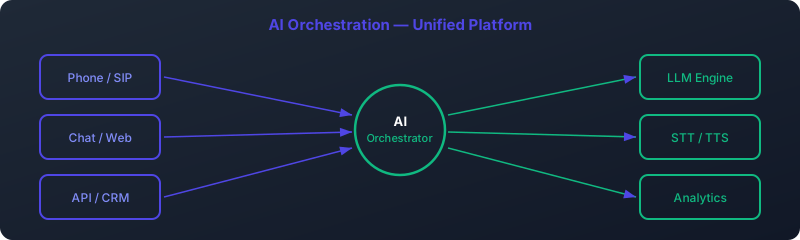
The rapid advancement of artificial intelligence (AI) is not just a software story—it is fundamentally a hardware revolution. As AI models grow exponentially in size and complexity, from millions to trillions of parameters, the demand for specialized hardware has skyrocketed. Traditional computing architectures are no longer sufficient. The rise of AI hardware—including GPUs, TPUs, NPUs, and custom ASICs—has become the backbone of modern machine learning.
Today, organizations and researchers rely on powerful processors to train and deploy AI models efficiently. This article explores the key players in AI hardware, compares leading technologies such as GPU vs TPU vs CPU vs NPU, examines the NVIDIA AI ecosystem, analyzes AMD’s MI300X, reviews edge AI chips, and provides a detailed cloud GPU cost analysis.
CPU vs GPU vs TPU vs NPU: The AI Hardware Showdown
Understanding the differences between these processors is essential for selecting the right hardware for AI workloads.
| Processor | Full Name | Best For | Key Features | Examples |
|---|---|---|---|---|
| CPU | Central Processing Unit | General computing, sequential tasks | Low latency, high clock speed, few cores | Intel Core i9, AMD Ryzen 9 |
| GPU | Graphics Processing Unit | Parallel processing, deep learning training | Thousands of cores, high memory bandwidth | NVIDIA H100, AMD MI300X |
| TPU | Tensor Processing Unit | Tensor operations, inference & training at scale | Custom ASIC, optimized for TensorFlow | Google TPU v5e, v5p |
| NPU | Neural Processing Unit | On-device AI inference, edge computing | Low power, real-time processing | Apple Neural Engine, Qualcomm Hexagon |
The Role of CPUs in AI
CPUs are the traditional workhorses of computing. While they excel at handling sequential tasks and general-purpose operations, they are not optimized for the massive parallelism required by AI. In deep learning, CPUs are typically used for data preprocessing, control logic, and lightweight inference—but rarely for training large models.
GPU Power for AI Workloads
GPUs revolutionized AI by enabling massively parallel computation. Originally designed for rendering graphics, GPUs contain thousands of smaller cores that can perform simultaneous operations—perfect for matrix multiplications in neural networks.
The rise of GPU for AI began with NVIDIA’s CUDA platform, which allowed developers to harness GPU power for general-purpose computing (GPGPU). Today, GPUs dominate AI training in data centers and cloud environments.
TPU: Google’s AI Chip
Introduced in 2016, Google’s TPU (Tensor Processing Unit) is an application-specific integrated circuit (ASIC) built specifically for AI workloads. TPUs are optimized for TensorFlow and deliver superior performance per watt compared to GPUs for certain tasks.
Google uses TPUs internally for Search, Translate, and Photos, and offers them via Google Cloud. TPUs are particularly effective for large-scale model training and batch inference.
NPUs: Edge AI Accelerators
NPUs (Neural Processing Units) are designed for on-device AI inference. Found in smartphones, IoT devices, and edge servers, NPUs enable real-time AI processing without relying on the cloud.
Examples include Apple’s Neural Engine (in A-series and M-series chips), Samsung’s NPU, and Qualcomm’s Hexagon. These chips prioritize energy efficiency and low latency, making them ideal for voice assistants, camera enhancements, and AR/VR.
The NVIDIA AI Ecosystem
NVIDIA has become synonymous with AI hardware. Its dominance stems not only from powerful GPUs but also from a complete software and development ecosystem.
NVIDIA GPUs for AI: H100, B200, Blackwell
NVIDIA’s data center GPUs are the gold standard for AI training:
- H100 Tensor Core GPU: Based on the Hopper architecture, delivers 67 teraflops of FP16 performance and supports transformer engines for faster LLM training.
- B200: Part of the Blackwell architecture, doubles performance over H100 with 20 petaflops of FP4 compute.
- GB200 Superchip: Combines two B200 GPUs with a Grace CPU for ultra-high memory bandwidth.
These GPUs are used in supercomputers, cloud platforms, and enterprise AI clusters.
CUDA and the AI Software Stack
NVIDIA’s secret weapon is CUDA—a parallel computing platform and programming model. CUDA enables developers to write high-performance code for NVIDIA GPUs.
Complementary tools include:
- CuDNN: Optimized library for deep learning primitives.
- TensorRT: High-performance inference optimizer.
- NGC Catalog: Pre-trained models and containers.
This ecosystem creates a high barrier to entry for competitors and ensures developer loyalty.
AMD MI300X: Challenging NVIDIA’s Dominance
AMD’s MI300X is the most serious competitor to NVIDIA’s H100. Built on a chiplet design with 3D stacking, it features:
- 192GB of HBM3 memory (vs. H100’s 80GB)
- 5.2 terabytes per second memory bandwidth
- 153 billion transistors
- Designed for large language model (LLM) inference
Microsoft has already deployed MI300X in Azure for Copilot and other AI services. While software support (ROCm) is still catching up to CUDA, AMD’s aggressive pricing and memory advantages make it a compelling alternative.
| Feature | NVIDIA H100 | AMD MI300X |
|---|---|---|
| Architecture | Hopper | CDNA 3 |
| Memory | 80 GB HBM3 | 192 GB HBM3 |
| Memory Bandwidth | 3.35 TB/s | 5.2 TB/s |
| FP16 Performance | 1,979 teraflops | 590 teraflops |
| Transistors | 80 billion | 153 billion |
| Estimated Price | ~$30,000 | ~$15,000 |
| Software Ecosystem | CUDA (mature) | ROCm (evolving) |
Microsoft has deployed MI300X in Azure for Copilot and other AI services. While ROCm software support is still catching up to CUDA, AMD's aggressive pricing and memory advantages make it a compelling alternative. Meta and Oracle have also adopted MI300X for inference workloads.
Intel Gaudi: The Enterprise Challenger
Intel competes in the AI hardware market with its Gaudi accelerators, specifically designed for neural network training and inference. The Gaudi 3, released in 2024, delivers performance comparable to NVIDIA's A100 with a more open software ecosystem based on standard PyTorch.
Key advantages of Gaudi include:
- Direct PyTorch compatibility: No need to rewrite CUDA code.
- Competitive pricing: Up to 40% cheaper than equivalent NVIDIA solutions.
- AWS availability: Amazon DL1 instances use Gaudi, offering up to 40% lower training costs.
However, Gaudi still lacks the mature ecosystem of optimized libraries that NVIDIA offers, limiting its adoption to cost-sensitive use cases where PyTorch compatibility is sufficient.
Google TPU: Deep Dive into Custom AI Silicon
Google's TPU (Tensor Processing Unit) represents the most specialized chip in the AI hardware market. Designed as an ASIC from scratch to accelerate tensor operations, TPUs have evolved significantly since their introduction in 2016.
TPU Evolution Timeline
| Version | Year | Performance | Primary Use |
|---|---|---|---|
| TPU v1 | 2016 | 92 TOPS (INT8) | Inference only |
| TPU v2 | 2017 | 180 teraflops | Training + inference |
| TPU v3 | 2018 | 420 teraflops | Large-scale training |
| TPU v4 | 2022 | 275 teraflops (BF16) | LLM and multimodal models |
| TPU v5e | 2023 | Cost-optimized | Massive inference |
| TPU v5p | 2024 | 459 teraflops (BF16) | Giant model training |
Google uses TPUs internally to train models like Gemini, PaLM, and BERT, and offers them via Google Cloud Platform. The key advantage is scalability: TPU pods can connect hundreds of chips in a single training cluster with superior energy efficiency. Google trained its Gemini Ultra model on a cluster of over 4,000 TPU v5p chips. TPUs also benefit from native integration with JAX and TensorFlow, making them seamless for teams already in Google's ecosystem. The TPU v5p delivers 459 teraflops of BF16 performance with a custom high-speed interconnect called ICI (Inter-Chip Interconnect), enabling near-linear scaling across large training clusters. Cloud pricing for TPU v5e instances starts at approximately $1.20 per chip-hour, making them cost-competitive with NVIDIA alternatives for large-scale training jobs.
Edge AI Chips: Powering On-Device Intelligence
Edge AI represents a fundamental shift: running AI models directly on end devices rather than sending data to the cloud. This reduces latency, improves privacy, and enables offline operation. The edge AI market is growing at 25% annually, projected to reach $30 billion by 2028.
Key Edge AI Processors
| Chip | Manufacturer | TOPS | Typical Use | Power |
|---|---|---|---|---|
| Jetson Orin Nano | NVIDIA | 40 | Robotics, drones | 7-15W |
| Coral Edge TPU | 4 | IoT, smart cameras | 2W | |
| Snapdragon 8 Gen 3 | Qualcomm | 73 | Premium smartphones | 5-8W |
| Apple Neural Engine (M3) | Apple | 18 | Mac, iPad, iPhone | 5-10W |
| Hailo-8 | Hailo | 26 | Surveillance, vehicles | 2.5W |
Apple Neural Engine
Apple has integrated a Neural Engine into all its A-series (iPhone) and M-series (Mac/iPad) chips. The M3 Ultra's Neural Engine offers 32 neural cores and 38 TOPS of processing power. With Apple Intelligence (launched 2025), Apple runs 3-billion-parameter language models directly on-device, ensuring complete privacy. For complex tasks, the system falls back to Apple's Private Cloud Compute, where data is processed on M2 Ultra servers with no persistent storage.
NVIDIA Jetson Platform
NVIDIA's Jetson platform is the gold standard for edge AI in robotics, drones, and industrial IoT. The Jetson Orin Nano delivers 40 TOPS in a compact form factor, running full CUDA and TensorRT. It supports models like YOLOv8 for real-time object detection at 30+ FPS, making it ideal for autonomous navigation and quality inspection systems.
The Rise of AI PCs and AI Smartphones
2025-2026 marked the emergence of "AI PCs" and "AI smartphones" as a major market category. Intel, AMD, and Qualcomm all ship processors with integrated NPUs delivering 40-75 TOPS, enabling on-device AI features like real-time translation, image generation, and intelligent assistants. Microsoft's Copilot+ PCs require a minimum of 40 TOPS for NPU performance, establishing a new hardware baseline. On the mobile side, the Snapdragon 8 Gen 3 powers features like real-time image segmentation, voice cloning, and on-device LLM inference for models up to 7 billion parameters.
Energy Efficiency Comparison
Energy efficiency is increasingly critical as AI workloads scale. The metric TOPS/Watt (trillions of operations per second per watt) has become the key comparison point:
| Processor | TOPS | TDP (Watts) | TOPS/Watt |
|---|---|---|---|
| NVIDIA H100 (SXM) | 3,958 (INT8) | 700W | 5.65 |
| Google TPU v5p | 459 (BF16) | 250W | 1.84 |
| Apple M3 Ultra NPU | 38 | 10W | 3.80 |
| Hailo-8 | 26 | 2.5W | 10.40 |
| Google Coral | 4 | 2W | 2.00 |
Edge AI chips like the Hailo-8 achieve the highest efficiency ratios, making them ideal for battery-powered and thermally constrained applications. Data center GPUs prioritize raw throughput over efficiency, reflecting different design priorities.
Cloud GPU Cost Analysis: AWS, GCP, Azure
A critical decision for any AI team is choosing between renting cloud GPUs or buying hardware. Both options have trade-offs depending on usage volume and budget.
Cloud GPU Pricing (2026)
| Provider | GPU | Price/Hour | Price/Month (24/7) |
|---|---|---|---|
| AWS | A100 80GB | $3.97 | $2,858 |
| Google Cloud | A100 80GB | $3.67 | $2,642 |
| Azure | A100 80GB | $3.40 | $2,448 |
| Lambda Cloud | A100 80GB | $1.29 | $929 |
| RunPod | A100 80GB | $1.64 | $1,181 |
Break-Even Analysis
An 8-GPU A100 server costs approximately $150,000. At $3,000/month per cloud GPU ($24,000/month for 8 GPUs), the break-even point is reached in approximately 6 months of continuous use. For teams needing permanent GPU access, self-hosted hardware is more cost-effective long-term. For sporadic or variable workloads, cloud remains the most flexible option.
Practical Recommendation
If your GPU usage exceeds 2,000 hours/month, consider self-hosted hardware. Below 500 hours/month or highly variable workloads favor cloud. Many enterprises adopt a hybrid strategy with owned hardware for baseline loads and cloud for demand spikes.
The Future of AI Hardware
The AI hardware landscape is evolving rapidly with several key trends shaping the next decade.
NVIDIA Blackwell Architecture
NVIDIA's next-generation Blackwell architecture (B200, GB200) doubles the performance of Hopper with 20 petaflops of FP4 compute. The GB200 Superchip combines two B200 GPUs with a Grace CPU for ultra-high memory bandwidth. These chips are designed for next-gen foundation models with trillions of parameters.
Photonic Computing
Startups like Lightmatter and Luminous Computing are developing photonic processors that use light instead of electrons for matrix multiplications. Early prototypes demonstrate 10x better energy efficiency than GPUs for specific AI workloads. While still experimental, photonic computing could revolutionize data center economics by 2028-2030.
Quantum-AI Convergence
Although practical quantum computing for AI remains 5-10 years away, progress is significant. Google's Sycamore chip demonstrated quantum supremacy, and IBM is building quantum processors with over 1,000 qubits. Potential AI applications include hyperparameter optimization, quantum machine learning (QML), and massive search space exploration. Hybrid quantum-classical approaches, where quantum processors handle specific sub-problems within a larger classical AI pipeline, are being actively researched by Google, IBM, and IonQ.
Memory-Centric Computing
A fundamental bottleneck in AI hardware is the "memory wall" - the gap between compute speed and memory bandwidth. Processing-in-Memory (PIM) architectures like Samsung's HBM-PIM and SK Hynix's AiM place compute units directly within memory chips, reducing data movement energy by up to 70%. This approach is particularly promising for inference workloads where memory bandwidth, not compute, is the limiting factor. Samsung's HBM-PIM has already been validated with major cloud providers for LLM inference acceleration.
Sustainable AI Hardware
As AI power consumption grows exponentially (estimated at 4.5% of global electricity by 2030), sustainable hardware design becomes critical. Key initiatives include liquid cooling systems that reduce data center energy use by 30-40%, carbon-aware scheduling that runs AI workloads when renewable energy is available, and chip recycling programs. Microsoft's underwater data center project and Google's commitment to 24/7 carbon-free energy by 2030 are leading examples of sustainable AI infrastructure.
Open-Source Hardware Initiatives
The dominance of proprietary hardware has spurred open-source alternatives. RISC-V, an open-source instruction set architecture, is gaining traction for AI accelerators. Companies like Esperanto Technologies and Tenstorrent (led by AI chip pioneer Jim Keller) are building RISC-V-based AI processors that offer competitive performance without licensing fees. The European Processor Initiative (EPI) is developing RISC-V-based chips for AI and HPC, aiming to reduce Europe's dependence on US and Asian chip makers. While still early, open-source hardware could democratize AI infrastructure access, particularly for research institutions and developing nations with limited budgets.
Chiplet and 3D Stacking
AMD's MI300X has proven that chiplet-based design with 3D stacking can deliver more memory and transistors than monolithic chips. This approach is being adopted across the industry, allowing manufacturers to combine specialized compute, memory, and I/O dies on a single package. Expect chiplet designs to become standard for AI hardware by 2027.
Frequently Asked Questions (FAQ)
For local development and inference, the NVIDIA RTX 4090 offers the best price-to-performance ratio with 24GB VRAM at approximately $1,600. For enterprise inference at scale, the AMD MI300X with 192GB memory excels for large language models. For data center training, the H100 and B200 remain the gold standard.
GPUs are versatile and suited for most AI tasks thanks to the CUDA ecosystem. TPUs are Google-designed ASIC chips optimized specifically for tensor operations in neural networks, excelling at large-scale model training within Google Cloud. GPUs are the universal choice, while TPUs are ideal if you work within the Google/TensorFlow ecosystem.
Cloud GPU costs range from $1.29/hour (Lambda Cloud) to $3.97/hour (AWS) for A100 instances. Self-hosted GPU servers cost $10,000-$25,000 per GPU but eliminate recurring fees. The break-even point for self-hosted vs cloud is typically 6 months of 24/7 usage.
Yes, increasingly so. The MI300X offers 192GB of memory (vs H100's 80GB) at roughly half the price, making it excellent for LLM inference where memory is the bottleneck. However, CUDA's software ecosystem remains more mature than ROCm. For memory-bound inference, AMD is compelling; for training with optimized libraries, NVIDIA remains safer.
Edge AI runs AI models directly on end devices (smartphones, robots, cameras) instead of the cloud. This reduces latency to under 10ms, protects data privacy, and enables offline operation. Chips like NVIDIA Jetson Orin, Google Coral, and Apple Neural Engine are purpose-built for edge AI workloads.
How to Choose AI Hardware: Decision Framework
Selecting the right AI hardware depends on multiple factors. Here is a practical decision framework for teams evaluating their options.
Key Decision Factors
- Workload type: Training requires high compute and memory bandwidth (H100, B200, TPU v5p). Inference prioritizes latency and memory capacity (MI300X, RTX 4090).
- Model size: Models under 7B parameters fit on a single RTX 4090 (24GB). Models 7B-70B need A100/MI300X or multi-GPU setups. Models above 70B require multi-node clusters.
- Budget: Cloud is best for variable or short-term needs. Self-hosted breaks even at 6 months of 24/7 usage. Hybrid approaches optimize both cost and flexibility.
- Privacy requirements: Edge AI chips (Jetson, Apple Neural Engine) keep data on-device. Cloud deployments must consider data residency and compliance regulations.
- Software ecosystem: CUDA-dependent workflows favor NVIDIA. Standard PyTorch code runs on Intel Gaudi and AMD ROCm with minimal changes.
Quick Reference Guide
| Scenario | Recommended Hardware | Estimated Budget |
|---|---|---|
| Startup prototyping | RTX 4090 or cloud A100 | $1,600 or $3/hr |
| Enterprise inference | AMD MI300X cluster | $60,000-$120,000 |
| Large-scale training | H100/B200 cluster or TPU pod | $500,000+ |
| Mobile/edge deployment | Jetson Orin or Apple NPU | $200-$1,000 |
Conclusion
The AI hardware ecosystem in 2026 is more diverse and competitive than ever. Here are our recommendations by use case:
- Large-scale LLM training: NVIDIA H100/B200 or Google TPU v5p.
- Enterprise inference: AMD MI300X (best memory-to-price ratio) or NVIDIA A100.
- Local development and research: NVIDIA RTX 4090 (best performance-to-price).
- Mobile AI: Apple Neural Engine or Qualcomm Snapdragon NPU.
- IoT and robotics: NVIDIA Jetson Orin or Google Coral Edge TPU.
- Budget-conscious teams: Intel Gaudi on AWS or AMD MI300X with ROCm.
The key takeaway is that there is no single "best" AI chip. The optimal choice depends on workload type, model size, budget, privacy requirements, and software ecosystem preferences. Organizations should evaluate their specific needs and consider hybrid approaches that combine self-hosted hardware for baseline workloads with cloud resources for peak demand.
To learn more about integrating AI hardware into AI orchestration projects, explore our guides on robotics AI and AI model optimization.