Introduction to AI Call Automation
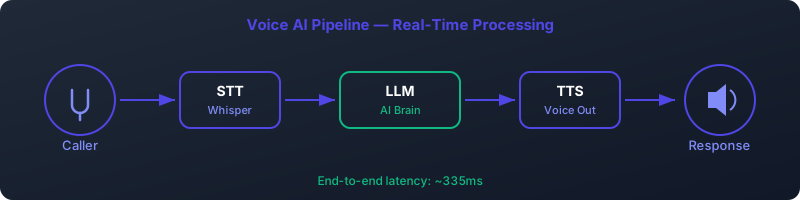
AI call automation is transforming how businesses manage their telephone communications. By leveraging artificial intelligence, companies can now automate both inbound and outbound phone calls at scale—reducing operational costs, improving customer experience, and increasing efficiency across departments such as customer support, sales, and operations.
Unlike traditional Interactive Voice Response (IVR) systems that rely on rigid menu trees and DTMF inputs, modern AI-powered voice agents understand natural language, detect caller intent, and respond contextually in real time. These systems are no longer limited to simple FAQ responses; they can book appointments, qualify leads, send payment reminders, and even escalate complex issues to human agents when necessary.
AI call automation reduces average handling time by up to 60% and cuts call center costs by over 40%. According to recent industry benchmarks, organizations using AI for telephony automation report a 35% increase in first-call resolution rates and a 50% reduction in missed outbound calls.
The evolution from rule-based IVRs to conversational AI marks a significant leap in telephony automation. Today’s AI voice agents use large language models (LLMs), automatic speech recognition (ASR), text-to-speech (TTS), and natural language understanding (NLU) to deliver human-like interactions. They integrate seamlessly with existing telephony infrastructure—whether it's an on-premise PBX, a cloud VoIP provider, or a hybrid setup.
This comprehensive guide explores every aspect of AI call automation, including inbound and outbound use cases, technical architecture, compliance requirements, voice quality optimization, edge case handling, analytics, CRM integration, and cost models. Whether you're evaluating AI for customer service or automating appointment reminders, this guide will equip you with the knowledge to make informed decisions.
Inbound Call Automation
Inbound call automation refers to the use of AI to handle incoming phone calls from customers, prospects, or partners. Instead of routing every caller to a human agent, AI voice agents act as intelligent receptionists, resolving common queries, collecting information, and directing calls based on intent.
Intelligent Call Reception
The first point of contact in any inbound call flow is the greeting and identification phase. AI-powered systems can personalize greetings based on caller ID, previous interactions, or CRM data. For example:
- "Hello Mr. Smith, welcome back! How can I assist you today?"
- "Thank you for calling Acme Support. Please tell me how I can help."
Using speaker diarization and voice biometrics, advanced systems can authenticate callers without requiring PINs or security questions, enhancing both security and user experience.
Intent Detection and Natural Language Understanding
One of the most powerful capabilities of AI call automation is intent detection. Unlike keyword-matching IVRs, modern NLU engines analyze the semantic meaning of spoken phrases to determine what the caller wants.
For instance, a caller saying “I want to reschedule my appointment” might trigger the same workflow as “Can I move my meeting to next week?” Both sentences express the same intent—rescheduling—despite different wording.
Intent classification models are typically trained on thousands of real-world utterances and fine-tuned for specific industries such as healthcare, banking, or e-commerce. This ensures high accuracy in understanding domain-specific language.
Smart Call Routing
Once intent is detected, AI can route the call to the appropriate department or self-service option. For example:
- Billing inquiries → Automated payment processing
- Technical support → Tier-1 troubleshooting script
- Account changes → Secure authentication + update workflow
- Escalation needed → Transfer to live agent with context summary
Contextual routing ensures that human agents receive only the calls that truly require their expertise, reducing idle time and improving resolution speed.
FAQ Handling and Self-Service
Many inbound calls are repetitive and can be fully automated. Common examples include:
- Store hours and locations
- Balance inquiries
- Password resets
- Return policies
- Order tracking
AI voice agents retrieve answers from knowledge bases or databases and deliver them in natural-sounding speech. With TTS engines like Amazon Polly or Google WaveNet, responses are fluent and expressive, mimicking human intonation patterns.
Appointment Booking and Rescheduling
In industries like healthcare, legal services, and salons, appointment management is a major source of inbound calls. AI can automate the entire booking process:
- Ask for preferred date/time
- Check availability in calendar system (e.g., Google Calendar, Outlook)
- Confirm appointment details
- Send SMS/email confirmation
- Add to CRM or patient management software
Some systems even allow rescheduling and cancellations via voice, reducing administrative workload by up to 70%.
Order Status and Tracking
E-commerce and logistics companies benefit greatly from AI that can provide real-time order updates. After authenticating the caller (via phone number or order ID), the AI retrieves shipment data from ERP or logistics APIs and delivers concise updates:
"Your order #12345 was shipped on March 2nd and is expected to arrive by March 5th. It’s currently in transit in Paris."
This level of automation reduces dependency on customer service teams and improves satisfaction through instant access to information.
Want to see how inbound automation works in practice? Explore our complete guide to AI receptionists and learn how to deploy a 24/7 virtual front desk.
Outbound Call Automation
While inbound automation focuses on responding to customer-initiated calls, outbound automation proactively reaches customers with timely, personalized messages. When done correctly, AI-driven outbound calling improves engagement, reduces churn, and increases conversion rates.
Appointment Reminders
No-shows cost businesses billions annually. AI-powered reminder calls reduce missed appointments by up to 50%. The system can:
- Call patients/customers 24–48 hours before scheduled visits
- Allow verbal confirmation or rescheduling
- Update calendars automatically
- Log interactions in CRM
In healthcare, these calls often include pre-visit instructions ("Please fast for 8 hours before your blood test") and consent collection.
Customer Surveys and Feedback Collection
Post-service surveys via phone yield higher response rates than email. AI conducts short interviews using natural conversation:
"On a scale of 1 to 5, how would you rate your experience today? ... Thank you! Would you like to share any additional feedback?"
Responses are transcribed, sentiment-analyzed, and stored for reporting. Open-ended answers are processed using NLP to extract themes and detect dissatisfaction early.
Lead Qualification and Follow-Up
Sales teams waste significant time calling unqualified leads. AI can perform initial qualification by asking key questions:
- "Are you the decision-maker for IT purchases?"
- "What’s your current solution for customer support?"
- "When are you planning to make a change?"
Based on responses, leads are scored and routed to sales reps with full context. Some systems even book discovery calls directly into the salesperson’s calendar.
Payment and Invoice Reminders
AI automates dunning processes by sending polite but firm payment reminders. The tone adjusts based on delinquency level:
- First reminder: “Friendly reminder: your invoice is due tomorrow.”
- Second reminder: “We noticed your payment is overdue. Can we assist?”
- Final notice: “Immediate action required to avoid service interruption.”
Callers can make payments over the phone via secure IVR or be transferred to a collections agent if needed.
Promotional Campaigns and Upselling
With proper consent, AI can deliver targeted offers. For example, a telecom provider might call customers nearing data limits:
"Hi Sarah, you’ve used 90% of your monthly data. Would you like to upgrade to an unlimited plan for €5 more?"
These campaigns must comply with regulations like TCPA and GDPR, which we cover in detail later.
Telephony Stack: SIP, Asterisk, WebRTC, and Gateways
AI call automation doesn't exist in isolation—it integrates with your existing telephony infrastructure. Understanding the components of the telephony stack is essential for successful deployment.
SIP Protocol (Session Initiation Protocol)
SIP is the foundation of modern VoIP communications. It handles call setup, modification, and termination. AI voice agents connect to SIP trunks provided by carriers or cloud platforms like Twilio, Vonage, or Telnyx.
Key advantages of SIP:
- Low latency (critical for real-time AI responses)
- Support for encryption (SIPS/TLS)
- Interoperability with PBX systems
- Scalability for high-volume calling
Asterisk PBX
Asterisk is the world’s most widely used open-source PBX platform. It serves as the bridge between AI systems and traditional telephony networks. With custom dial plans and AGI (Asterisk Gateway Interface), you can route calls to AI agents written in Python, Node.js, or other languages.
Example use case:
exten => 100,1,Answer()
same => n,Agi(agi://ai-server/process-call)
same => n,Hangup()
This dial plan answers incoming calls and forwards audio to an AI server via AGI for processing.
For a full implementation guide, see our Asterisk AI PBX integration tutorial.
WebRTC (Web Real-Time Communication)
WebRTC enables browser-to-phone and app-to-phone calling without plugins. AI voice agents can be embedded directly into web applications using WebRTC, allowing customers to interact via voice from a website or mobile app.
Benefits:
- No phone call charges for users
- Seamless integration with web forms and chatbots
- High-quality audio with Opus codec
PSTN and VoIP Gateways
Gateways convert analog/digital signals between PSTN (Public Switched Telephone Network) and VoIP. For organizations with legacy phone lines, SIP trunks connect through gateways like Sangoma or Cisco to enable AI automation.
Hybrid deployments are common—AI handles digital channels (VoIP, WebRTC), while gateways ensure compatibility with traditional landlines.
Compliance: TCPA, GDPR, and Legal Considerations
Automating phone calls comes with legal responsibilities. Failure to comply can result in fines, lawsuits, and reputational damage.
TCPA (Telephone Consumer Protection Act) – United States
The TCPA regulates automated calls and texts in the US. Key requirements:
- Express written consent is required for prerecorded or AI-generated calls to cell phones.
- Do-not-call lists must be honored (both national DNC and internal lists).
- Caller ID must be accurate and not spoofed.
- Opt-out mechanisms must be available during every call.
Fines can reach $500–$1,500 per violation. In 2023, a company was fined $92 million for illegal robocalls.
GDPR (General Data Protection Regulation) – European Union
GDPR applies to any organization handling EU citizens’ data. For AI call automation:
- Explicit consent is required before recording or processing calls.
- Data minimization: only collect what’s necessary.
- Right to access, rectify, or delete personal data.
- Breaches must be reported within 72 hours.
Fines can be up to €20 million or 4% of global revenue.
Call Recording Consent
Laws vary by jurisdiction:
- One-party consent (e.g., most US states): Only one participant needs to know.
- Two-party consent (e.g., California, Washington): All parties must be informed.
Best practice: Always announce at the start of the call: “This call may be recorded for quality and training purposes.”
Do-Not-Call Lists and Opt-Outs
Maintain an internal DNC list and sync with national registries. AI systems should automatically flag opted-out numbers and suppress future calls.
Never assume consent. Always verify opt-in status before making outbound AI calls. Use double opt-in methods (e.g., email confirmation after sign-up) for compliance.
AI Call Automation Compliance Checklist
| Requirement | TCPA (US) | GDPR (EU) | Best Practice |
|---|---|---|---|
| Express consent for AI calls | Required (written) | Required (explicit) | Double opt-in with confirmation |
| Do-not-call list compliance | Mandatory | Mandatory | Automated suppression system |
| Caller ID transparency | Required | Required | Display real business name |
| Opt-out mechanism | Immediate | Immediate | "Say STOP to unsubscribe" |
| Call recording disclosure | One- or two-party consent | Explicit consent | Verbal notice at start |
| Data storage and encryption | Recommended | Mandatory | End-to-end encryption |
| Retention period | Not specified | Defined by purpose | 90 days unless legally required |
Voice Quality: Codecs, Sample Rates, and Noise Cancellation
High voice quality is critical for AI performance. Poor audio leads to transcription errors, misunderstood intent, and frustrated users.
Audio Codecs and Sample Rates
Codecs compress audio for transmission. Common codecs in AI telephony:
- Opus: 8–48 kHz, ideal for WebRTC and high fidelity
- G.711: 64 kbps, standard for PSTN, 8 kHz sample rate
- G.729: 8 kbps, bandwidth-efficient but lower quality
For AI systems, 8 kHz (narrowband) is often sufficient, but 16 kHz (wideband) improves ASR accuracy by 15–20%, especially for accented speech.
Network Latency and Jitter
AI responses must be delivered within 300–500ms to feel natural. High latency (>800ms) causes awkward pauses and conversation breakdowns.
Solutions:
- Deploy AI servers close to SIP trunks (edge computing)
- Use low-latency TTS engines (e.g., NVIDIA Riva)
- Implement jitter buffers and packet loss concealment
Noise Cancellation and Speech Enhancement
Real-world calls often include background noise—traffic, office chatter, wind. AI systems use deep learning models like RNNoise or Facebook’s Denoiser to clean audio in real time.
Features include:
- Spectral subtraction
- Beamforming (for multi-mic setups)
- Acoustic echo cancellation (AEC)
Preprocessing audio before ASR improves accuracy by up to 30% in noisy environments.
Handling Edge Cases: Accents, Background Noise, Multi-Party Calls
AI voice agents must perform reliably across diverse conditions. Here’s how to handle common edge cases.
Accents and Dialects
Global businesses face callers with varying accents. To improve accuracy:
- Train ASR models on diverse datasets (e.g., Common Voice)
- Use accent-adaptive models that adjust in real time
- Implement fallback to human agent after two misrecognitions
Some platforms offer regional voice models (e.g., “US English,” “Indian English”) to match local pronunciation.
Background Noise and Low Signal
Mobile calls often suffer from poor signal. AI systems should:
- Detect signal-to-noise ratio (SNR) and request repetition if unclear
- Use noise-robust ASR models trained on noisy data
- Support DTMF fallback for critical inputs (e.g., account numbers)
Multi-Party and Overlapping Speech
In conference calls or family discussions, multiple people may speak. Speaker diarization separates voices and assigns labels (“Speaker A,” “Speaker B”).
Challenges:
- Overlapping speech confuses ASR
- Children’s voices are harder to recognize
- Fast turn-taking breaks conversation flow
Solutions include pause detection, voice activity detection (VAD), and turn-taking models.
Call Analytics: Measuring Performance and Sentiment
AI call automation generates rich data for continuous improvement. Key metrics include:
| Metric | Definition | Target |
|---|---|---|
| First Call Resolution (FCR) | Percentage of calls resolved without transfer | ≥ 80% |
| Average Handling Time (AHT) | Duration from answer to hangup | ≤ 180s |
| Customer Satisfaction (CSAT) | Post-call survey ratings | ≥ 4.2/5 |
| Intent Accuracy | Correct intent classification rate | ≥ 92% |
| Escalation Rate | Percentage transferred to human | ≤ 25% |
| Sentiment Score | Positive vs negative emotion detection | ≥ +0.3 |
Sentiment analysis uses NLP to detect frustration, urgency, or satisfaction in caller tone and word choice. This enables proactive interventions—e.g., escalating an angry customer before they hang up.
CRM Integration with Salesforce, HubSpot, and Custom APIs
AI call automation gains maximum value when integrated with CRM systems. Real-time data sync ensures every interaction is logged and actionable.
Salesforce Integration
Using Salesforce APIs, AI systems can:
- Retrieve customer profiles before answering
- Create new cases or tasks post-call
- Update lead status after qualification
- Log call transcripts and recordings
Example: After an outbound sales call, the AI creates a Task in Salesforce: “Follow up with John Doe – interested in premium plan.”
HubSpot Integration
HubSpot workflows can trigger AI calls based on behavioral triggers:
- Abandoned cart → “Did you forget something?” call
- Free trial ending → “Upgrade now” reminder
- Form submission → “Thank you” call + demo offer
Custom API Integrations
For legacy or proprietary systems, RESTful or WebSocket APIs enable bidirectional data exchange. JSON payloads can include:
{
  "call_id": "abc123",
  "caller_number": "+1234567890",
  "intent": "appointment_booking",
  "parameters": {
    "date": "2026-03-10",
    "service": "dental_cleaning"
  },
  "transcript": "I'd like to book a cleaning next week."
}
For developers, check our guide to building AI phone bots in Python.
Cost Analysis: Per-Minute vs Self-Hosted
Two primary deployment models exist: cloud-based (per-minute) and self-hosted (on-premise).
Cloud-Based AI Call Automation
Providers like Twilio, Google Dialogflow CX, or Amazon Connect charge per minute. Typical pricing:
- ASR: $0.004–$0.02 per 15 seconds
- TTS: $0.004–$0.016 per 1,000 characters
- AI processing: $0.01–$0.05 per minute
- SIP trunking: $0.01–$0.03 per minute
Total cost: ~$0.08–$0.12 per minute. For 10,000 minutes/month: $800–$1,200.
Pros: Fast setup, no hardware, scalable. Cons: Ongoing costs, data privacy concerns, vendor lock-in.
Self-Hosted AI Call Automation
Deploy AI on your own servers using open-source tools like:
- Rasa or Mycroft for NLU
- Coqui TTS or Mozilla TTS for speech synthesis
- DeepSpeech or Whisper for ASR
- Asterisk or FreeSWITCH as PBX
Initial setup: ~$5,000–$15,000 (hardware + development). Monthly cost: ~$200–$500 (maintenance, bandwidth).
Break-even point: ~12–18 months. After that, savings exceed 60%.
Pros: Full control, GDPR compliant, lower long-term cost. Cons: Requires technical team, longer deployment.
Ready to Deploy Your AI Voice Agent?
Self-hosted, 335ms latency, GDPR compliant. Deployment in 2-4 weeks.
Request a Demo Call: 07 59 02 45 36 View Installation GuideFrequently Asked Questions
| Feature | Inbound Automation | Outbound Automation |
|---|---|---|
| Primary Use Case | Customer support, FAQs, order tracking | Reminders, surveys, lead follow-up |
| Initiator | Caller (customer) | Business (AI system) |
| Consent Requirement | Implied (by calling) | Explicit (opt-in required) |
| Typical Call Duration | 90–240 seconds | 30–90 seconds |
| Integration Focus | CRM, knowledge base, calendar | Marketing automation, ERP, billing |
| Success Metric | First call resolution rate | Conversion or response rate |