Table of Contents
- What Is AI Voice Orchestration?
- The 7 Key Components of a Voice AI Pipeline
- 6 Benefits of On-Premise AI Voice Orchestration
- How Our Platform Works Step by Step
- On-Premise vs. Cloud SaaS Comparison
- 5 Real-World Use Cases for Voice AI
- How to Get Started with AI Voice Orchestration
- All English Guides and Resources
- Frequently Asked Questions
What Is AI Voice Orchestration?
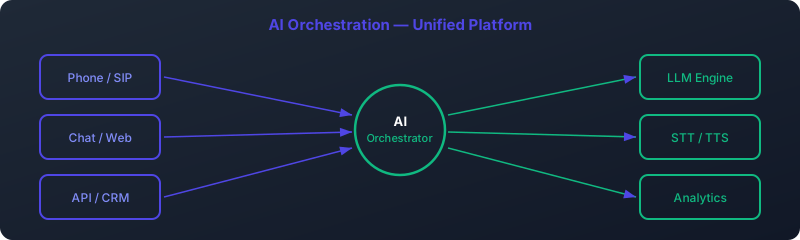
AI voice orchestration is the process of coordinating multiple artificial intelligence components in real time to create seamless, human-like phone conversations. Unlike traditional Interactive Voice Response (IVR) systems that rely on rigid decision trees and keypad inputs, a modern voice orchestration platform uses a large language model (LLM) as its brain, enabling open-ended, context-aware dialogue that adapts dynamically to every caller.
At its core, voice orchestration involves three pillars: Speech-to-Text (STT) to transcribe what the caller says, a Large Language Model to understand intent and generate intelligent responses, and Text-to-Speech (TTS) to convert those responses back into natural-sounding audio. The orchestration layer ties everything together, managing conversation flow, handling interruptions (barge-in), triggering external tools, and maintaining context across multi-turn dialogues.
The challenge is not simply connecting these components. It is doing so with minimal latency so the conversation feels natural. Human conversational turn-taking happens at roughly 200 to 400 milliseconds. Exceed that threshold and callers notice awkward pauses. Our on-premise platform achieves a perceived latency of 335 milliseconds end-to-end, placing it squarely within the human conversational range.
This matters for businesses in 2026 because customer expectations have shifted dramatically. Callers no longer tolerate "Press 1 for sales, Press 2 for support." They expect an intelligent agent that understands natural language, remembers what they said 30 seconds ago, and resolves their issue without transfers or hold music. Companies deploying AI voice agents report up to 60% cost reduction in call center operations while simultaneously improving customer satisfaction scores.
The global voice AI market is projected to reach 45 billion USD by 2028, growing at over 23% annually. Enterprises that adopt orchestrated voice AI now gain a decisive competitive advantage in customer experience, operational efficiency, and data privacy.
The 7 Key Components of a Voice AI Pipeline
Building a production-ready AI voice orchestration system requires understanding each component in the pipeline. Here are the seven essential building blocks that work together to deliver natural phone conversations.
1. Speech-to-Text (STT) Engine
The STT engine is the ears of your voice AI system. It captures audio from the phone call in real time and converts spoken words into text. Modern engines like Whisper large-v3 (optimized via TensorRT or CTranslate2) achieve Word Error Rates below 5% even with background noise, accents, and domain-specific vocabulary. The key metric here is not just accuracy but streaming latency. The best engines begin outputting partial transcriptions within 100 milliseconds of speech onset, enabling the system to start processing before the caller has finished speaking.
2. Large Language Model (LLM)
The LLM is the brain. It receives the transcribed text and generates an intelligent, contextually appropriate response. For on-premise deployment, models like Qwen 2.5 7B, Mistral 7B, or Llama 3 8B offer excellent quality-to-latency ratios. The LLM handles intent recognition, entity extraction, multi-turn context management, and function calling (triggering external actions like CRM lookups or appointment booking). For a complete guide on choosing the right orchestration approach, see our AI orchestration guide.
3. Text-to-Speech (TTS) Engine
The TTS engine is the voice. It converts the LLM's text response into natural-sounding audio streamed back to the caller. Modern TTS like XTTS v2 or Piper support voice cloning from a single audio sample, allowing your AI agent to speak with a consistent brand voice. The critical metric is Time-to-First-Byte (TTFB), which should be under 50 milliseconds to eliminate perceptible pauses. For self-hosted deployment options, check our self-hosted AI voice guide.
4. Telephony Integration (SIP/RTP)
The telephony layer connects your AI pipeline to the actual phone network. Using SIP (Session Initiation Protocol) and RTP (Real-time Transport Protocol), systems like Asterisk or FreeSWITCH handle call routing, audio streaming, and DTMF processing. Our platform integrates natively with any SIP trunk or PBX system. Learn more in our Asterisk AI PBX guide.
5. Orchestration Layer
The orchestration layer is the conductor. It manages the flow between STT, LLM, and TTS, handling critical functions like barge-in detection (stopping TTS playback when the caller interrupts), silence detection (knowing when the caller has finished speaking), turn-taking logic, and error recovery. This layer is what separates a production-quality voice agent from a simple demo. Explore the best tools in our AI orchestration tools comparison.
6. Function Calling and Tool Use
A truly useful voice agent needs to interact with external systems. Through function calling, the LLM can query your CRM, check appointment availability, look up order status, or update a database, all during the live call. This transforms the voice agent from a simple Q&A bot into an autonomous task executor that resolves issues on the first call.
7. Monitoring and Analytics
Production systems require real-time monitoring of latency, accuracy, call completion rates, and user satisfaction. Analytics dashboards track conversation flows, identify common failure points, and measure ROI. This feedback loop is essential for continuous improvement of your voice AI for business deployment.
6 Benefits of On-Premise AI Voice Orchestration
Choosing an on-premise deployment over cloud SaaS is a strategic decision that delivers tangible advantages across security, performance, and cost.
1. Ultra-Low Latency for Natural Conversations
With all processing happening on local hardware, network round-trips to external servers are eliminated. Our platform achieves 335ms end-to-end latency, well within the 200-400ms range of natural human conversation. Cloud solutions typically operate at 500-1200ms, creating noticeable pauses that degrade the caller experience and reduce task completion rates.
2. Complete Data Sovereignty and GDPR Compliance
Every audio recording, transcription, and LLM interaction stays within your infrastructure. No data is transmitted to third-party servers. This guarantees compliance with GDPR, HIPAA, and industry-specific regulations. For sectors like healthcare, finance, and government, this is not optional but mandatory.
3. Full Model Customization and Fine-Tuning
You choose which STT, LLM, and TTS models to deploy. Fine-tune them on your domain-specific vocabulary and use cases. Train a voice clone that matches your brand identity. This level of customization is impossible with most SaaS platforms where you are locked into the provider's model selection.
4. Predictable Costs at Scale
SaaS voice AI platforms charge per minute of conversation. At scale, these costs become significant. With on-premise deployment, after the initial hardware investment, the marginal cost per additional call is effectively zero. For organizations handling thousands of daily calls, the total cost of ownership is dramatically lower over a 24-month period.
5. Zero Vendor Lock-In
Your voice AI system operates independently. No risk of sudden API changes, price increases, or service discontinuations from a third-party provider. You control upgrades, maintenance windows, and model updates on your own schedule.
6. Seamless Integration with Internal Systems
Because everything runs on your local network, integrating with CRMs, ERPs, databases, and internal APIs is straightforward and secure. No need to expose internal endpoints to the internet. Function calling happens over your private network with microsecond-level latency.
How Our Platform Works Step by Step
Understanding the complete flow from incoming call to AI response helps evaluate why architecture matters for real-time voice interactions.
-
Step 1: Call Reception and Audio Capture
An incoming call arrives via SIP trunk and is routed by Asterisk to the EAGI (Enhanced Asterisk Gateway Interface) script. The raw audio stream (8 kHz, 16-bit, mono) is captured in 20ms chunks and fed directly into the processing pipeline. There is no buffering delay.
-
Step 2: Real-Time Speech-to-Text
Audio chunks are processed by the STT engine (Whisper large-v3 optimized with CTranslate2/faster-whisper). Voice Activity Detection (VAD) identifies when the caller is speaking versus silent. Once the caller finishes a sentence (detected by a configurable silence threshold), the complete audio segment is transcribed. Average STT latency: 170ms.
-
Step 3: LLM Processing and Response Generation
The transcription is sent to the LLM along with the full conversation history and system prompt. The model generates a response, typically 1-2 sentences to keep the conversation natural. If the query requires external data, the LLM triggers function calls before formulating its response. Average LLM latency: 360ms.
// Simplified configuration example orchestrator: sip_port: 5060 barge_in_sensitivity: 0.8 stt: model: whisper-large-v3-ctranslate2 device: cuda:0 llm: model: qwen2.5-7b-instruct type: on-premise-ollama max_tokens: 80 temperature: 0.7 tts: model: xtts_v2 device: cuda:0 streaming: true -
Step 4: Streaming Text-to-Speech
As soon as the LLM begins generating text tokens, they are streamed to the TTS engine. The TTS starts producing audio from the very first tokens, achieving a Time-to-First-Byte of under 84ms. The audio is streamed back through Asterisk to the caller as PCM chunks, creating a seamless response with no perceptible gap. To build your own, follow our AI phone bot Python tutorial.
-
Step 5: Barge-In Handling
While the AI is speaking, the system continues monitoring the caller's audio. If the caller starts speaking (detected by an energy threshold above ambient noise), the orchestrator immediately stops TTS playback and switches back to listening mode. This barge-in detection happens in under 80ms, enabling natural interruption just like in a real human conversation.
The combined pipeline delivers a perceived latency of 335 milliseconds from the moment the caller stops speaking to the moment the AI's response begins playing. This places the system within the range of natural human conversational dynamics.
On-Premise vs. Cloud SaaS: Detailed Comparison
When evaluating voice AI platforms, the deployment model has far-reaching implications. This comparison covers the seven most critical factors for enterprise decision-makers evaluating solutions from providers like Vapi, Retell AI, Bland.ai, or Synthflow against our on-premise approach.
| Feature | On-Premise (Our Platform) | Cloud SaaS (Vapi, Retell, etc.) |
|---|---|---|
| End-to-End Latency | 335ms (local processing) | 500-1200ms (network round-trips) |
| Data Sovereignty | Complete. Data never leaves your servers. | Limited. Audio and text processed on third-party servers. |
| Model Customization | Full. Any STT/LLM/TTS, fine-tuning supported. | Limited to platform-offered options. |
| Pricing Model | One-time hardware (CAPEX) + maintenance. Near-zero marginal cost per call. | Subscription + per-minute charges (OPEX). Costs scale with volume. |
| Vendor Dependency | None. Full control over uptime and updates. | Total. Subject to outages, API changes, and price increases. |
| Internal System Integration | Secure and direct via local network. | Requires exposing APIs to the internet. |
| Scalability Cost | Highly favorable at high volumes. | Costs increase linearly with call volume. |
For organizations processing sensitive data or managing high call volumes, the on-premise approach delivers a decisive advantage in security, performance, and long-term cost control.
5 Real-World Use Cases for Voice AI Orchestration
AI voice orchestration transforms how businesses handle phone communications across industries. Here are five proven use cases with measurable business impact.
Healthcare: Appointment Scheduling and Patient Triage
Medical practices deploy AI voice agents to handle appointment booking 24 hours a day, 7 days a week. The agent qualifies the request, checks provider availability, proposes time slots, and confirms appointments. With on-premise deployment, all patient health data remains protected within the facility, ensuring full HIPAA and GDPR compliance. Clinics report a 40% reduction in no-shows through automated reminders and easy rescheduling via the same voice agent.
Real Estate: Continuous Lead Qualification
Real estate agencies receive dozens of inquiry calls daily. The AI voice agent handles 100% of inbound calls, qualifying prospects by asking key questions about property type, budget, location, and timeline. Qualified leads are automatically scheduled for viewings, while the agent answers common questions about listed properties. Agents focus on high-value activities like viewings and negotiations instead of phone screening.
E-Commerce: Scalable Customer Support
For online retailers, the voice AI handles tier-one support inquiries like "Where is my order?" and "How do I process a return?" by integrating directly with the order management system. During peak periods such as holiday sales or flash promotions, the AI absorbs overflow calls, preventing customer service saturation and maintaining response quality. Learn more about AI call automation for business.
Financial Services: Secure Account Assistance
Banks and insurance companies use on-premise voice AI for account balance inquiries, transaction verification, and claims processing initiation. The on-premise deployment is critical here because financial data must never leave the institution's secure environment. The AI handles routine inquiries while seamlessly escalating complex cases to human agents with full context transfer.
Hospitality: Intelligent Reservation Management
Hotels and restaurants automate reservation handling with voice AI that understands complex requests ("a table for 5 tonight around 8pm, terrace if possible"), checks real-time availability, and confirms or proposes alternatives. Staff focus on in-person guest experience while the AI manages the phone channel. For complete AI receptionist implementation, refer to our dedicated guide.
How to Get Started with AI Voice Orchestration
Deploying a production-ready AI voice orchestration system involves five key phases. Here is a practical roadmap for businesses evaluating this technology.
Phase 1: Requirements Assessment
Define your use case, expected call volume, required languages, and integration points. Determine whether you need full on-premise deployment (recommended for regulated industries) or a hybrid approach. Assess your existing telephony infrastructure (SIP trunks, PBX systems) for compatibility.
Phase 2: Infrastructure Setup
Provision the required hardware. A baseline configuration for 25 concurrent calls includes a modern CPU (16+ cores), 64-128 GB RAM, and one or more NVIDIA GPUs (L40S, A10G, or RTX 4090 for development). Install Docker and configure networking for SIP traffic. Our platform ships as containerized services managed via Docker Compose or Kubernetes.
Phase 3: Model Selection and Training
Choose your STT, LLM, and TTS models based on language requirements and quality targets. Fine-tune the LLM on your domain vocabulary and common interaction patterns. Record or select a voice sample for TTS voice cloning. Test and benchmark each component individually before integration. Explore the full landscape of available tools in our AI orchestration tools comparison.
Phase 4: Integration and Testing
Connect the voice AI system to your telephony infrastructure and internal systems (CRM, booking engine, etc.). Run extensive testing with real conversation scenarios, measuring latency, accuracy, and task completion rates. Implement monitoring and alerting for production readiness.
Phase 5: Deployment and Optimization
Launch in production with a controlled rollout. Monitor real conversations to identify edge cases and improvement opportunities. Continuously optimize prompts, model parameters, and conversation flows based on analytics data. Our team provides ongoing support throughout this process.
All English Guides and Resources
Explore our complete library of 21 in-depth guides covering every aspect of AI voice orchestration, from foundational concepts to advanced implementation.
Voice AI and Telephony
Compare the leading AI voice agent platforms and find the right fit for your business needs.
Evaluate the best voice AI APIs for integration into your applications and services.
How businesses achieve 60% cost reduction with voice AI while improving customer experience.
Discover the best open-source frameworks for building your own voice AI platform.
Step-by-step guide to deploying a fully self-hosted voice AI system on your infrastructure.
Automate inbound and outbound calls with the top AI-powered call automation platforms.
Build a 24/7 AI receptionist that handles calls, schedules appointments, and qualifies leads.
Build a functional AI phone bot in under 100 lines of Python with open-source tools.
Orchestration and Architecture
Comprehensive guide to orchestrating AI components for production-ready voice systems.
Side-by-side comparison of the leading AI orchestration tools and frameworks in 2026.
Transform Asterisk into an AI-powered PBX with real-time voice processing capabilities.
AI Technologies and Domains
Understanding generative AI from LLMs to image generation, and their role in voice systems.
How multimodal AI combines text, audio, vision, and more for richer interactions.
Predictive AI methods and how they enhance voice AI with proactive intelligence.
How reinforcement learning optimizes AI agent behavior through trial and error.
Building intelligent recommendation engines with modern AI techniques.
How AI is accelerating scientific discovery across biology, physics, and materials science.
Choosing the right AI hardware: GPUs, TPUs, and specialized accelerators compared.
AI-powered autonomous systems from self-driving vehicles to industrial automation.
The intersection of AI and robotics: 7 application domains transforming industry.
Understanding synthetic media, deepfakes, and the 5 critical risks to manage.
Ready to Deploy the Fastest and Most Secure AI Voice Agent?
Stop letting latency and security constraints hold back your innovation. Discover how our on-premise AI voice orchestration platform can transform your customer communications, cut costs, and give you a decisive competitive edge.
Request a Free Demo Installation GuideFrequently Asked Questions
What is AI voice orchestration and how does it differ from a simple IVR?
AI voice orchestration coordinates real-time components of a voice system (ASR, TTS, NLU, LLM) to create natural, dynamic conversations. Unlike a traditional IVR with rigid decision trees and keypad navigation, orchestration uses a large language model to understand context, handle digressions, trigger external tools via function calling, and make real-time decisions. The result is a conversational experience that is far more natural and effective than any menu-driven system.
Why choose an on-premise AI voice solution over cloud SaaS?
On-premise deployment guarantees three critical advantages. First, data sovereignty: no audio, transcription, or conversation data ever leaves your infrastructure, ensuring GDPR and HIPAA compliance. Second, ultra-low latency: by eliminating network round-trips to cloud servers, our platform achieves 335ms end-to-end, compared to 500-1200ms for typical SaaS solutions. Third, cost predictability: after initial hardware investment, the marginal cost per call approaches zero, which is dramatically cheaper than per-minute SaaS pricing at scale.
What hardware is required to run an on-premise AI voice agent?
A baseline setup for approximately 25 concurrent calls typically includes a modern CPU (AMD EPYC or Intel Xeon with 16+ cores), 64 to 128 GB of RAM, and one or more NVIDIA GPUs. For production, we recommend the L40S or A10G. For development and testing, an RTX 4090 works well. The platform runs as Docker containers, orchestrable via Kubernetes for high availability and elastic scaling. Storage requirements are modest: roughly 50 GB for models and system components.
Can we use our own language models or voice models?
Absolutely. The platform is model-agnostic. You can deploy any STT model compatible with CTranslate2 or TensorRT, any LLM served via Ollama, vLLM, or TensorRT-LLM, and any TTS model including XTTS v2, Piper, or custom-trained models. Fine-tune on your domain vocabulary. Clone a voice from a single audio sample. This flexibility is a core advantage of the on-premise approach.
How long does deployment take from start to production?
Typical deployment timelines range from 2 to 4 weeks, depending on the complexity of your integration requirements. Week 1 covers infrastructure setup and model deployment. Week 2 focuses on prompt engineering, voice training, and integration with your telephony and CRM systems. Weeks 3-4 are dedicated to testing, optimization, and controlled production rollout. Our team provides hands-on support throughout the process.