Contents
- Executive Summary: Open Source vs. Cloud AI Voice Agents
- The 2026 Voice AI Crossroads: Platform or Privacy?
- The Unseen Expense: A Deep Dive into Cost Analysis
- Data Sovereignty vs. Convenience: The Privacy & GDPR Battleground
- The Sound of Silence: Why Every Millisecond Matters in Latency
- From API Key to Kubernetes: The Setup & Maintenance Divide
- Scaling Your Voice AI: Elastic Cloud vs. On-Premise Infrastructure
- Uptime & Freedom: Reliability and the Threat of Vendor Lock-In
- When to Choose Cloud vs. When to Go Open Source
- Detailed Comparison: Vapi vs. Retell vs. Synthflow vs. Self-Hosted
- The Final Verdict: Which Path Is Right for Your Business?
- Frequently Asked Questions
Executive Summary: Open Source vs. Cloud AI Voice Agents
As we approach 2026, the decision between using a cloud-based SaaS platform and building a self-hosted open source AI voice agent has become a critical strategic choice for businesses. This comparison breaks down the key factors to help you decide which model best suits your needs.
| Factor | Cloud AI Voice Agent (e.g., Vapi, Retell) | Open Source AI Voice Agent (Self-Hosted) |
|---|---|---|
| Cost Model | Operational Expense (OpEx): ~$0.15 - $0.30/minute | Capital Expense (CapEx) + Low OpEx: ~$0.003/min (hardware) + API costs |
| Privacy & Data Control | Data processed by third-party vendors; complex GDPR compliance | Full data sovereignty; all data remains on your servers |
| Typical Latency | Medium to High (500ms - 1200ms+) | Ultra-Low (as low as 335ms) |
| Setup Complexity | Low (minutes to hours; API-based) | High (days to weeks; requires DevOps/infra expertise) |
| Scalability | Elastic, pay-as-you-go | Limited by hardware; requires planning and investment |
| Best For | MVPs, startups, variable traffic, non-sensitive data | Enterprises, high-volume calls, regulated industries, custom needs |
The 2026 Voice AI Crossroads: Platform or Privacy?
Conversational AI is no longer a futuristic concept; it's a present-day reality revolutionizing customer interaction. AI-powered voice agents are handling everything from simple appointment bookings to complex customer support inquiries. As this technology matures, businesses are faced with a fundamental architectural decision: Do you leverage a managed cloud platform for speed and convenience, or do you invest in a self-hosted, open source AI voice agent for ultimate control, cost-efficiency, and privacy?
Cloud providers like Vapi, Retell AI, and Synthflow offer incredible ease of use, allowing developers to deploy sophisticated voice agents with just a few lines of code. They handle the complex underlying infrastructure of telephony, speech-to-text (STT), large language models (LLMs), and text-to-speech (TTS). However, this convenience comes at a price—both in dollars per minute and in relinquished control over your data and infrastructure.
The alternative path is the **on-premise AI voice** solution. By using open-source components, businesses can build and deploy their own voice AI stack on their own hardware. This approach, while more technically demanding, offers unparalleled advantages in cost at scale, data privacy, and performance. This article provides a full comparison to illuminate which path is the right one for your organization as you plan your AI strategy for 2026 and beyond.
The Unseen Expense: A Deep Dive into Cost Analysis
Cost is often the most compelling driver for exploring a self-hosted solution. While cloud platforms appear simple, their per-minute pricing can quickly escalate into a significant operational expense. Let's break down the numbers.
Cloud SaaS Pricing: The Meter is Always Running
Leading cloud voice agent platforms typically charge on a per-minute basis. This fee is all-inclusive, covering their orchestration platform, telephony, and the underlying costs of the AI models they use.
- Vapi: ~$0.15 to $0.25 per minute
- Retell AI: ~$0.18 to $0.30 per minute
Let's model this for a business with moderate call volume: 20,000 minutes per month.
- Using a mid-range cloud provider at $0.20/minute:
- Monthly Cost: 20,000 minutes * $0.20/min = $4,000 per month
- Annual Cost: $4,000/month * 12 = $48,000 per year
This is a pure operational expense (OpEx). While predictable, it scales linearly with usage and can become a major cost center for high-volume applications like contact centers or proactive outreach campaigns.
Self-Hosted Open Source Cost: The Upfront Investment
The cost structure for a self-hosted open source AI voice agent is fundamentally different. It's a shift from OpEx to a combination of an initial Capital Expense (CapEx) for hardware and minimal ongoing OpEx for API calls (if not self-hosting the entire stack) and electricity.
1. Hardware Investment (CapEx):
You need a server capable of running the entire voice AI pipeline, which is GPU-intensive. A capable server might look like this:
- Server: Dell PowerEdge or Supermicro chassis
- GPU: NVIDIA A10G 24GB or a consumer-grade NVIDIA RTX 4090
- Total Estimated Cost: $7,000 - $12,000
2. Amortized Hardware & Operational Cost (OpEx):
Let's amortize this hardware over a standard 3-year lifespan and calculate the per-minute cost based on the same 20,000 minutes/month workload.
- Amortized Hardware Cost: $9,000 / 36 months = $250/month
- Electricity & Co-location (Estimated): $150/month
- Total Hardware-Related OpEx: $400/month
- Hardware Cost Per Minute: $400 / 20,000 minutes = $0.02/minute
This is significantly lower than the cloud, but it's not the full picture. You still need the AI models.
3. AI Model API Costs (The Variable OpEx):
Even when self-hosting the orchestration, you might still use cloud APIs for STT, LLM, and TTS for simplicity. Let's calculate these costs per minute.
- STT (e.g., Deepgram Nova-2): ~$0.0045/min
- LLM (e.g., GPT-4o): A 1-minute conversation might involve ~1000 tokens of input and output. At ~$5.00/M tokens, this is ~$0.005/min.
- TTS (e.g., ElevenLabs): A 1-minute conversation might have 30 seconds of AI speech (~800 characters). At ~$0.18/1k chars, this is ~$0.0144/min.
- Total API Cost Per Minute: ~$0.0045 + ~$0.005 + ~$0.0144 = ~$0.024/minute
Total Self-Hosted Cost Per Minute: $0.02 (Hardware) + $0.024 (APIs) = $0.044/minute
Compared to the cloud's $0.20/minute, the self-hosted model offers a ~78% cost reduction at this scale. For businesses with truly massive volume (e.g., 1 million minutes/month), the savings can run into hundreds of thousands of dollars annually, easily justifying the initial hardware and personnel investment.
Note: For ultimate cost savings and privacy, you can also self-host open-source STT (Whisper), LLM (Llama 3), and TTS (Piper) models on the same GPU, bringing the variable API cost to nearly zero, leaving only the amortized hardware cost of ~$0.003/min as mentioned in some benchmarks. This, however, significantly increases setup complexity.
Data Sovereignty vs. Convenience: The Privacy & GDPR Battleground
In an era of increasing data regulation like GDPR, CCPA, and HIPAA, data privacy is not just a feature—it's a requirement. This is where the distinction between cloud and on-premise solutions becomes stark.
Cloud Data Risks
When you use a cloud AI voice agent platform, your data takes a multi-stop journey:
- The audio stream from your customer goes to the voice agent provider (e.g., Vapi's servers).
- Vapi then sends that audio to a third-party STT service (e.g., Deepgram).
- The resulting text is sent to a third-party LLM provider (e.g., OpenAI).
- The LLM's response text is sent to a third-party TTS provider (e.g., ElevenLabs).
- The final audio is streamed back through Vapi's servers to your customer.
This creates a complex chain of data processors. While these companies provide Data Processing Agreements (DPAs), the fact remains that sensitive customer data—including voiceprints, personal details, and confidential information—is being processed and potentially stored on multiple third-party infrastructures. For industries like healthcare, finance, or legal, this can be a non-starter for compliance.
On-Premise Data Sovereignty
A self-hosted AI receptionist or voice agent completely changes the privacy paradigm. By deploying the entire stack on your own infrastructure (either on-premise servers or in your private cloud VPC), you achieve true data sovereignty.
- No External Data Transfer: Audio streams and transcripts never leave your controlled environment.
- Simplified GDPR/HIPAA Compliance: You are the sole data controller and processor, drastically simplifying audits and compliance documentation.
- Reduced Attack Surface: You eliminate multiple points of potential data breach from third-party vendors.
For any organization handling Personally Identifiable Information (PII) or other sensitive data, the privacy and security benefits of an on-premise AI voice solution are paramount.
The Sound of Silence: Why Every Millisecond Matters in Latency
Latency is the delay between when a user stops speaking and when the AI starts responding. High latency creates awkward pauses, leading to a frustrating, unnatural user experience where people talk over the AI. In conversational AI, minimizing latency is critical for creating the illusion of a human-like interaction.
Cloud Latency: The Round-Trip Overhead
The multi-hop architecture of cloud platforms is the primary source of latency. Each network call between services adds tens to hundreds of milliseconds:
User → Vapi Server → STT API → LLM API → TTS API → Vapi Server → User
Even with optimizations like streaming STT and TTS, the cumulative network RTT (Round-Trip Time) between these geographically distributed services creates a significant latency floor. While platforms work hard to minimize this, perceived latency often falls in the 500ms to 1200ms range, which is noticeably slow for natural conversation.
Self-Hosted Latency: The Local Advantage
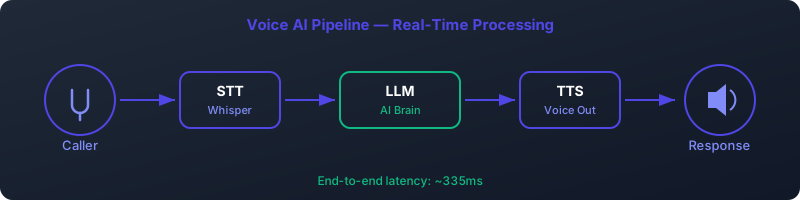
With an open source AI voice agent running on a single, powerful server, you eliminate almost all network latency between components. The data flows through the server's internal memory and PCI-e bus, which is orders of magnitude faster than the public internet.
User → Your Server (STT→LLM→TTS) → User
By co-locating an optimized STT model, a fast LLM inference engine (like vLLM or TensorRT-LLM), and a low-latency TTS model, the entire "thought process" of the AI can be completed in a fraction of the time. Benchmarks for fully optimized on-premise systems show that a perceived latency of ~335ms is achievable. This is close to the threshold of human perception and results in a dramatically more fluid and natural conversation.
From API Key to Kubernetes: The Setup & Maintenance Divide
The trade-off for the power and control of an open-source solution is complexity. The chasm in setup and maintenance effort between cloud and self-hosted is vast.
Cloud: Simplicity as a Service
Getting started with a platform like Vapi or Retell is designed to be as simple as possible:
- Sign up and get an API key.
- Use their SDK (e.g., a Node.js or Python library).
- Write a short script to define the agent's behavior and connect it to your phone number or application.
You can have a functioning agent in under an hour. All the complex backend infrastructure—telephony integration (SIP/PSTN), STT/LLM/TTS orchestration, and server management—is completely abstracted away. Maintenance is zero; the vendor handles it all.
Self-Hosted: The DevOps Challenge
Building your own Vapi alternative open source solution is a significant engineering project. It requires a dedicated team or individual with strong DevOps and backend skills. The process involves:
- Infrastructure Provisioning: Setting up and configuring the physical server or cloud VM, including networking and security.
- GPU Environment Setup: Installing the correct NVIDIA drivers, CUDA Toolkit, and container runtimes (like Docker with NVIDIA Container Toolkit).
- Component Integration: Choosing, deploying, and configuring the individual open-source services:
- Telephony/Signaling: Using tools like Drachtio or FreeSWITCH for SIP integration, or managing WebRTC connections.
- Orchestration: Deploying an orchestration framework like AIO (AI Orchestration) to manage the conversation flow.
- AI Models: Setting up inference servers for STT (e.g., Whisper), LLM (e.g., Ollama or vLLM for Llama 3), and TTS (e.g., Piper or a Coqui TTS server).
- Containerization & Deployment: Using Docker Compose or Kubernetes to manage and scale the services.
- Ongoing Maintenance: You are responsible for monitoring, updates, security patches, and troubleshooting for every component in the stack.
# Example: A simplified docker-compose.yml for a self-hosted agent
version: '3.8'
services:
  aio_orchestrator:
    image: aio-project/orchestrator:latest
    ports:
      - "8080:8080"
  llm_server:
    image: vllm/vllm-openai:latest
    runtime: nvidia
    environment:
      - NVIDIA_VISIBLE_DEVICES=all
  tts_server:
    image: rhasspy/piper:latest
    runtime: nvidia
    # ... and so on for STT and telephony
This complexity is not to be underestimated. It is the primary barrier to adoption for smaller teams or companies without in-house infrastructure expertise.
Scaling Your Voice AI: Elastic Cloud vs. On-Premise Infrastructure
Your scalability needs will heavily influence your choice. How will your system handle going from 10 concurrent calls to 100?
Cloud Scalability
Cloud platforms offer near-infinite, elastic scalability. This is one of their core value propositions. They have massive server farms and auto-scaling mechanisms in place. If you experience a sudden traffic spike, their platform automatically provisions more resources to handle the load. You simply pay for the increased minute usage. This is ideal for businesses with unpredictable or highly variable call volumes, like a marketing campaign hotline.
Self-Hosted Scalability
With an on-premise AI voice agent, scalability is limited by your hardware. A single, powerful GPU server (like one with an A10G) might handle 20-50 concurrent calls, depending on the complexity of the models. To handle more, you must scale your infrastructure:
- Vertical Scaling: Upgrading to a more powerful server with multiple GPUs (e.g., an NVIDIA H100). This is expensive and has an upper limit.
- Horizontal Scaling: Adding more servers and distributing the load between them. This requires a load balancer and a more complex Kubernetes or container orchestration setup.
Scaling a self-hosted solution requires planning, capital investment, and engineering effort. It's less "elastic" than the cloud and not well-suited for handling unexpected, massive spikes in traffic.
Uptime & Freedom: Reliability and the Threat of Vendor Lock-In
Cloud Reliability & Lock-In
Cloud platforms offer high reliability, often with Service Level Agreements (SLAs) guaranteeing a certain percentage of uptime (e.g., 99.9%). However, you are dependent on their entire service chain. An outage at their LLM provider (like OpenAI) or a bug in their own platform can bring your service down, and you have no control over the fix. Furthermore, building your application on a proprietary platform leads to vendor lock-in. Migrating your logic, prompts, and integrations from Vapi to another platform can be a significant undertaking.
Self-Hosted Reliability & Freedom
With a self-hosted system, you control your own uptime. While this means you are also responsible for fixing it when it breaks, you are not at the mercy of a third-party's outage. You have full visibility into every component. More importantly, an open source AI voice agent provides complete freedom. The modular nature allows you to swap out any component at will:
- Don't like the latency of your LLM? Swap Llama 3 for Mistral Large.
- Found a better open-source TTS model? Integrate it in an afternoon.
- Want to switch from a SIP-based system to WebRTC? Change the telephony module.
This modularity future-proofs your investment and prevents you from being locked into a single vendor's ecosystem, pricing model, or technology stack.
When to Choose Cloud vs. When to Go Open Source
The right choice depends entirely on your business context, resources, and priorities.
Ideal Use Cases for Cloud AI Voice Agents
- Startups and MVPs: Quickly validate an idea without a large upfront investment in hardware or DevOps.
- Projects with Unpredictable Traffic: Marketing campaigns, seasonal businesses, or applications where call volume is highly variable.
- Teams without Infrastructure Expertise: Organizations that want to focus on application logic, not managing servers.
- Non-Sensitive Applications: General information bots, restaurant reservations, or basic customer service where PII is not a major concern.
Ideal Use Cases for an Open Source AI Voice Agent
- Enterprises and High-Volume Contact Centers: When call volumes exceed 50,000-100,000 minutes/month, the cost savings of self-hosting become massive.
- Regulated Industries: Healthcare (HIPAA), finance (PCI DSS), and legal sectors where data sovereignty and privacy are non-negotiable. A **self-hosted AI receptionist** in a medical clinic is a prime example.
- Performance-Critical Applications: Scenarios requiring the lowest possible latency for natural, fluid conversations, such as real-time sales agents or negotiation bots.
- Deep Customization Needs: Businesses that need to fine-tune models, integrate proprietary internal systems, or have full control over the AI's logic and voice.
Detailed Comparison: Vapi vs. Retell vs. Synthflow vs. Self-Hosted
Here’s a more granular look at the leading cloud platforms versus a typical self-hosted **AI voice agent comparison** using an open-source orchestrator.
| Feature | Vapi | Retell AI | Synthflow | Self-Hosted (e.g., AIO) |
|---|---|---|---|---|
| Cost / Minute | ~$0.15 - $0.25 | ~$0.18 - $0.30 | ~$0.12 - $0.20 | ~$0.04 (hardware + APIs) or ~$0.003 (full OSS) |
| Latency | Medium (~500-800ms) | Medium (~600-900ms) | Medium-High (~700-12
Prêt à déployer votre Agent Vocal IA ?Solution on-premise, latence 335ms, 100% RGPD. Déploiement en 2-4 semaines. Demander une Démo Guide InstallationFrequently Asked QuestionsOpen-source AI voice agents typically have higher upfront setup and infrastructure costs but lower long-term operational expenses, especially with self-hosted deployment. Cloud-based solutions charge per usage or subscription, which can become expensive at scale but include maintenance and updates. Open-source AI voice agents provide superior privacy since data can be processed on-premises or in private clouds, minimizing third-party access. Cloud-based services may store or process voice data on provider servers, raising compliance concerns for sensitive industries. Self-hosted open-source agents often achieve lower latency (under 200ms) due to local processing and reduced network hops. Cloud-based agents typically have 300–600ms latency, depending on provider infrastructure and user proximity to data centers. Yes, open-source AI voice agents allow full customization of voice models, integrations, and orchestration logic, ideal for domain-specific use cases. Cloud platforms offer limited configurability through APIs and plugins but restrict low-level model changes. Yes, cloud AI voice agents require constant, stable internet connectivity for real-time processing and API access. Open-source agents can operate offline when self-hosted, making them suitable for environments with unreliable connectivity. Open-source deployments require DevOps expertise for scaling, security, and model updates, increasing operational overhead. Cloud solutions offer plug-and-play deployment with managed updates but less control over infrastructure and performance tuning. |