Table of Contents
- The Dawn of a New Sales Era: What is AI Outbound Calling?
- 5 Transformative Use Cases for AI Outbound Calling
- Navigating the Legal Landscape: TCPA Compliance for AI Calls in the USA
- The Open-Source Blueprint: How AI Outbound Calling Works
- Control Your Cadence: Pacing, Throttling, and Scalability
- Your Single Source of Truth: Seamless CRM Integration
- The Unbeatable Economics of Open-Source AI Calling
- SaaS vs. Self-Hosted: A Head-to-Head Comparison
- Frequently Asked Questions
The Dawn of a New Sales Era: What is AI Outbound Calling?
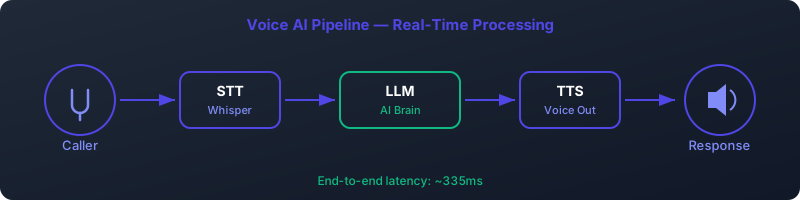
Imagine your best sales development representative (SDR) could make a thousand personalized calls simultaneously, never get tired, and instantly log every interaction in your CRM. This isn't science fiction; it's the reality of AI outbound calling. This revolutionary technology uses advanced voice AI to automate outbound phone calls, engaging prospects and customers in remarkably natural, human-like conversations.
Unlike the robotic, pre-recorded messages of traditional autodialers, modern voice AI outbound systems are different. They leverage a powerful combination of Large Language Models (LLMs)—the same technology behind ChatGPT—and Text-to-Speech (TTS) engines to understand context, respond to questions, and even handle interruptions. An AI outbound dialer can qualify a lead, book a meeting, or collect feedback, all without human intervention.
At its core: AI outbound calling is about creating a scalable, intelligent, and conversational extension of your sales and marketing teams. It's not about replacing humans, but about empowering them to focus on high-value, closing activities while the AI handles the repetitive, top-of-funnel tasks.
By 2026, the distinction between a top-performing sales organization and an average one will be their ability to leverage AI effectively. For outbound campaigns, this means moving beyond simple dialers and embracing intelligent, conversational AI that can execute complex workflows. This article explores the open-source framework that puts this power in your hands, offering unparalleled flexibility and cost savings compared to closed-platform SaaS solutions.
5 Transformative Use Cases for AI Outbound Calling
The applications for AI-powered outbound calls are vast. By automating conversational workflows, you can dramatically improve efficiency and gather valuable data across your entire organization. Here are five high-impact use cases that deliver immediate ROI for sales and marketing teams in the USA.
1. Supercharge Lead Qualification
Your team spends thousands on marketing campaigns that generate a flood of inbound leads. The challenge? Separating the hot prospects from the tire-kickers. This is where AI sales calls shine. An AI agent can:
- Instantly call new leads submitted through your website or CRM (e.g., Salesforce, HubSpot).
- Follow a customized script to ask BANT (Budget, Authority, Need, Timeline) or other qualifying questions.
- Understand natural language responses, ask follow-up questions, and determine if the lead meets your criteria.
- If qualified, the AI can access your sales team's calendar via API and book a meeting directly with a human account executive.
- Automatically log the call outcome, transcript, and summary in the CRM, creating a seamless handoff.
This process transforms your lead funnel from a slow, manual slog into a high-speed, automated engine, ensuring no lead goes cold.
2. Eliminate No-Shows with Smart Appointment Reminders
A booked meeting is only valuable if it happens. No-shows are a silent killer of sales productivity. Studies show that automated appointment reminders can drastically reduce no-show rates. While SMS and email are common, a personalized phone call adds a powerful human touch.
An automated outbound calling system can place a friendly, conversational reminder call 24 hours before a scheduled demo. The AI can confirm the appointment, offer to reschedule if needed, and even answer basic questions like "Who am I speaking with again?". This simple automation protects your sales team's most valuable asset: their time.
3. Gather Customer Feedback at Scale
How do you really know what your customers think? Email surveys suffer from low open rates (typically 20-30%), and the feedback you get is often from the most extreme opinions. Voice AI outbound calls offer a more engaging way to collect nuanced feedback.
You can deploy an AI agent to call customers 48 hours after a service interaction or purchase to:
- Conduct NPS surveys: "On a scale of 0 to 10, how likely are you to recommend our company?"
- Gather CSAT scores: "How satisfied were you with your recent support experience?"
- Ask open-ended questions: "Is there anything we could have done to make your experience better?" The AI can transcribe the free-form answer for later analysis.
This method yields higher response rates and captures the customer's actual tone and sentiment, providing richer data for improving your products and services.
4. Automate and Humanize Payment Reminders
Accounts receivable can be a drain on resources. Chasing overdue invoices is a sensitive task that requires a delicate touch. An AI agent can handle the first-line of payment reminders with a professional, non-confrontational approach.
The AI can be programmed to make a friendly call for invoices that are 15 or 30 days past due. It can state the invoice number, the amount due, and offer to email a copy of the invoice or transfer the customer to a human agent in the billing department to make a payment. This frees up your finance team from making repetitive calls and allows them to focus on more complex collection cases.
5. Win Back Customers with Re-Engagement Campaigns
It's 5-25 times more expensive to acquire a new customer than to retain an existing one. An AI outbound dialer is a powerful tool for running win-back campaigns targeting churned customers. You can create a campaign to call customers who cancelled their subscription 3-6 months ago.
The AI can open with a personalized script: "Hi [Name], this is an AI assistant calling from [Your Company]. We noticed you were a customer with us a few months ago, and we've just launched a new feature we think you'll love. Would you be open to hearing about a special offer to come back?" This proactive, personalized outreach can reignite interest and recover revenue you thought was lost forever.
Navigating the Legal Landscape: TCPA Compliance for AI Calls in the USA
Before launching any AI outbound calling campaign, understanding and adhering to the Telephone Consumer Protection Act (TCPA) is non-negotiable. The TCPA is a federal law in the United States that governs telemarketing calls, auto-dialed calls, and text messages. Failure to comply can result in fines of $500 to $1,500 per violation (per call), which can quickly escalate into millions.
When using an AI outbound dialer or any form of automated calling, you must follow these critical rules:
- Obtain Prior Express Written Consent: For marketing calls to mobile numbers using an autodialer or artificial/prerecorded voice, you must have "prior express written consent." This is a higher standard than simple consent and requires a clear, unambiguous agreement from the consumer to receive such calls. For informational calls (like appointment reminders), "prior express consent" is generally sufficient.
- Disclose It's an AI Agent: Transparency is key. The call must begin with a clear and conspicuous disclosure that the recipient is speaking with an AI agent or a recorded voice. For example: "Hi, this is a call from [Your Company] using an automated AI assistant."
- Do Not Call (DNC) Registry: You must scrub your calling lists against the National Do Not Call Registry and your own internal DNC list. Calling a number on these lists is a direct violation.
- Respect Calling Hours: Outbound calls are restricted to the recipient's local time zone. You may only call between 8:00 a.m. and 9:00 p.m. A robust system must be able to manage time zones accurately.
- Provide a Clear Opt-Out Mechanism: The AI must be programmed to recognize and honor opt-out requests. If a user says "stop calling me," "put me on your do not call list," or "I don't want these calls," the system must immediately end the call and add the number to your internal DNC list to prevent future calls.
Compliance is not a feature; it's a prerequisite. An open-source platform gives you the control to build these rules directly into your calling logic, but the responsibility for compliance rests entirely on your organization. Always consult with legal counsel to ensure your campaigns are fully compliant with federal and state regulations.
The Open-Source Blueprint: How AI Outbound Calling Works
While SaaS platforms like Air AI or Bland AI offer a black-box solution, an open-source approach provides transparency, control, and massive cost savings. The core of a powerful, self-hosted voice AI outbound system is built on a stack of proven, flexible components. The most common architecture involves Asterisk, the world's leading open-source telephony engine.
Here’s a simplified breakdown of how a single AI outbound call is executed:
Asterisk `originate` command → EAGI Script → LLM API → TTS API → Asterisk ChannelLet's unpack what's happening at each step:
- Initiation (Asterisk `originate`): A script or application tells your Asterisk server to start a call. This command specifies the target phone number (e.g., `+1-212-555-1234`) and what to do when the call is answered. In our case, it points to an EAGI script.
- Execution (EAGI - Extended Asterisk Gateway Interface): When the prospect answers the phone, Asterisk executes the EAGI script. This script is the "brain" of the call. It's a program (often written in Python, Node.js, or Go) that controls the conversation flow. It streams the audio from the caller in real-time.
- Comprehension (LLM - Large Language Model): The EAGI script sends the user's spoken audio to a Speech-to-Text (STT) service to get a transcript. This transcript is then sent to an LLM (like OpenAI's GPT-4, Google's Gemini, or an open-source model like Llama 3) with a prompt that defines the AI's persona, goals, and conversational boundaries. The LLM processes the user's words and generates a text-based response.
- Vocalization (TTS - Text-to-Speech): The LLM's text response is then sent to a high-quality, low-latency TTS service (like ElevenLabs, Google TTS, or Amazon Polly). This service converts the text into natural-sounding audio.
- Delivery (Asterisk Channel): The EAGI script streams the generated audio file back through the Asterisk channel to the person on the other end of the line.
This entire loop—listening, thinking, and speaking—happens in a fraction of a second, creating the illusion of a seamless, real-time conversation. By using an open-source framework like Asterisk and our AI orchestration tools, you have complete control over every component, from the choice of LLM to the voice of the TTS engine.
Control Your Cadence: Pacing, Throttling, and Scalability
Running a successful AI outbound calling campaign isn't just about what you say; it's about how many calls you make and when. Uncontrolled dialing can overwhelm your systems, violate carrier policies, and provide a poor customer experience. A professional-grade AI outbound dialer requires sophisticated pacing and throttling controls.
- Pacing (Calls-Per-Hour): This setting determines the overall speed of your campaign. You can configure the system to make, for example, 500 calls per hour. This is crucial for managing list penetration and aligning with marketing goals.
- Throttling (Concurrent Call Limits): This is the most critical control. It defines how many calls can be active at any single moment. This limit is determined by several factors: the capacity of your telephony trunks (from providers like Twilio or Vonage), the processing power of your Asterisk server, and the API rate limits of your LLM and TTS services. A typical self-hosted setup might start with a limit of 10-25 concurrent calls and scale up.
Proper configuration ensures that you maximize throughput without sacrificing call quality or system stability. An open-source platform allows you to fine-tune these settings with granular precision, something often restricted or charged for in SaaS environments.
Your Single Source of Truth: Seamless CRM Integration
An AI calling campaign that doesn't sync with your CRM is a missed opportunity. The true power of AI sales calls is unlocked when every interaction enriches your customer data. A well-designed open-source system is built with APIs in mind, enabling deep, bi-directional integration with major CRMs.
Key Integrations: Salesforce, HubSpot, Pipedrive, Zoho, and more.
Here’s how it works:
- Pulling Data: The AI dialer pulls calling lists directly from your CRM based on specific criteria (e.g., "all leads in California with status 'New'"). It can also pull personalizations tokens like `{{firstName}}` and `{{companyName}}` to use in the call script.
- Pushing Data: After each call, the system automatically logs the activity back to the contact's record in the CRM. This includes:
- Call outcome (e.g., "Qualified," "Wrong Number," "Requested DNC").
- A link to the call recording.
- A full transcript of the conversation.
- An AI-generated summary of the call.
- Any data collected, such as a confirmed appointment time or a key piece of qualifying information.
This automated data entry eliminates manual work for your sales team and creates a perfect, auditable record of every touchpoint, making your CRM the undisputed single source of truth. Learn more about our pre-built CRM connectors.
The Unbeatable Economics of Open-Source AI Calling
This is where the open-source model truly disrupts the market. SaaS platforms for AI outbound calling are convenient, but that convenience comes at a steep premium. Let's break down the costs.
Most SaaS vendors charge on a per-minute basis, which can be unpredictable and expensive. A typical 2-minute lead qualification call can cost a significant amount when scaled.
With a self-hosted, open-source solution, you pay for the raw components, which are dramatically cheaper. Your primary costs are:
- Telephony (Outbound Leg): Using a carrier like Twilio or Vonage, the cost to place an outbound call is typically around $0.004 to $0.013 per minute in the USA.
- AI Services (LLM/TTS/STT): The cost of API calls to your chosen AI models. These costs are falling rapidly.
- Hosting: The cost of the cloud server (e.g., AWS EC2, DigitalOcean) running your Asterisk and EAGI application.
Let's compare the all-in cost for a typical 2-minute call:
| Platform / Model | Pricing Model | Cost for a 2-Minute Call | Cost for 10,000 Calls |
|---|---|---|---|
| Self-Hosted Open-Source | Cost of raw components | $0.03 - $0.06 | $300 - $600 |
| Bland AI | $0.09 / minute (pay-as-you-go) | $0.18 | $1,800 |
| Air AI | $0.11 / minute (estimated standard) | $0.22 | $2,200 |
| Synthflow | Tiered / Per-minute pricing | $0.15 - $0.25 (estimated) | $1,500 - $2,500 |
The math is clear. By moving away from the "SaaS tax" and adopting an open-source framework, you can reduce your automated outbound calling costs by an order of magnitude. This allows you to run campaigns at a scale that would be financially prohibitive on a SaaS platform, giving you a massive competitive advantage.
SaaS vs. Self-Hosted: A Head-to-Head Comparison
While cost is a major factor, it's not the only one. Control, flexibility, and data privacy are equally important. Here’s how a self-hosted open-source solution stacks up against popular SaaS platforms.
| Feature | Self-Hosted Open-Source | SaaS (Bland AI, Air AI, etc.) |
|---|---|---|
| Cost | Extremely low ($0.03-$0.06 per 2-min call). Pay only for usage. | High ($0.18-$0.25+ per 2-min call). Per-minute fees, platform fees. |
| Control & Flexibility | Total control. Choose your own LLM, TTS, voice, and logic. Build any workflow. | Limited. Confined to the platform's features, models, and voices. |
| Data Privacy & Security | Maximum privacy. Data stays within your own hosted environment. Ideal for HIPAA/CCPA. | Data is processed on third-party servers, creating potential compliance risks. |
| Customization | Infinitely customizable. Integrate with any internal tool or database via custom code. | Limited to available integrations (e.g., Zapier) and API capabilities. |
| Speed of Innovation | Instantly adopt the latest, most powerful LLMs or TTS engines as they are released. | Dependent on the SaaS vendor's development cycle to add new models. |
| Setup & Maintenance | Requires initial setup and technical expertise to manage the server. | Easy to start. "Point and click" setup. Maintenance is handled by the vendor. |
The choice comes down to a classic trade-off: convenience vs. power. For small teams running simple, infrequent campaigns, a SaaS solution might suffice. But for organizations serious about scaling their AI outbound calling efforts, maximizing ROI, and maintaining control over their data and technology stack, the open-source path is the clear winner for 2026 and beyond.
Frequently Asked Questions
Is AI outbound calling legal in the USA?
Yes, but it is heavily regulated. You must comply with the TCPA, which includes obtaining proper consent, providing AI disclosure, respecting the National Do Not Call Registry, adhering to calling hours, and offering a clear opt-out mechanism. We strongly recommend consulting with legal counsel to ensure your campaigns are compliant.
How does the AI handle opt-out requests like "stop calling me"?
A properly configured system uses intent recognition within the LLM. The AI is trained to identify phrases related to opting out ("remove me from your list," "don't call again," "stop calling"). When it detects this intent, the control script (EAGI) immediately terminates the call and triggers a workflow to add the number to your internal Do Not Call list to prevent future contact.
What happens if someone asks a question the AI doesn't know how to answer?
This is called a "fallback." The AI's prompt includes instructions for handling unknown questions. A common strategy is to say, "I'm sorry, I don't have that information, but I can have a human specialist call you back to answer that. Would you like that?" This provides a safe exit and a path to human intervention, ensuring a positive customer experience.
How realistic does the AI voice sound? Can people tell it's an AI?
Modern Text-to-Speech (TTS) engines like ElevenLabs or PlayHT are incredibly realistic. They can replicate human-like intonation, pacing, and even "filler" words (like "um" or "uh") to sound more natural. While some people may be able to tell, the goal isn't to deceive, but to be clear it's an AI while providing a smooth, pleasant conversational experience that is far superior to old robotic systems.
Can we use our own voice or a specific accent for the AI agent?
Absolutely. This is a major advantage of an open-source approach. Many advanced TTS services offer voice cloning. You can record a few minutes of audio from your top salesperson (with their permission, of course) and create a custom AI voice that perfectly matches your brand's tone. You can also select from a vast library of pre-made voices and accents.
What kind of technical skills are needed to set up a self-hosted system?
Setting up the system from scratch requires intermediate to advanced technical skills, specifically experience with Linux, cloud hosting (AWS, Google Cloud), and a telephony engine like Asterisk. You'll also need scripting knowledge (Python or Node.js) to write the call logic. However, our managed deployment services can handle the entire setup and provide you with a turnkey solution.
How does this system handle different time zones for TCPA compliance?
This is a critical software feature. The calling application must first perform a lookup on each phone number to determine its likely geographic location and corresponding time zone based on the area code. The dialer then uses this information to ensure it only places calls within the legal window of 8 a.m. to 9 p.m. local time for the recipient, pausing campaigns outside of those hours.
Can the AI dialer leave a voicemail if there's no answer?
Yes. The system can be configured with Answering Machine Detection (AMD). If the AMD detects a voicemail greeting, the system can either hang up silently or play a pre-recorded voicemail message. For example: "Hi, this is an AI assistant from [Your Company]. Sorry we missed you. We were calling about [reason]. We will try again later, or you can reach us at..." This ensures your message can be delivered even without a live connection.