Table of Contents
- What is an AI Orchestration Platform?
- The Challenge: Moving from AI Models to AI Products
- Our Approach: The Conductor of Your AI Symphony
- Anatomy of a Production-Ready Voice AI Pipeline
- Why Orchestration is Non-Negotiable for Voice AI
- Enterprise AI Orchestration: Beyond the Basics
- From Concept to Conversation: Implementation Timeline
- Transforming Industries with Orchestrated Voice AI
- Orchestrated AI vs. The Alternatives: A Comparative Analysis
- Frequently Asked Questions (FAQ)
What is an AI Orchestration Platform?
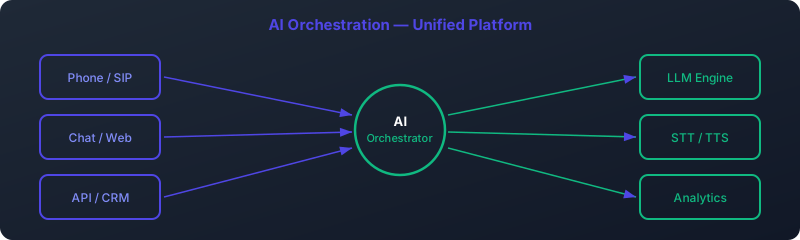
An AI orchestration platform is a sophisticated software layer designed to manage, coordinate, and optimize multiple, disparate AI models and services, weaving them into a single, cohesive, and high-performance system. Think of it as the central nervous system for your AI applications.
In the context of voice AI, this means seamlessly managing the entire conversational flow. Instead of just calling one API after another, an AI orchestration engine intelligently routes data between different components—like Speech-to-Text (STT), Large Language Models (LLMs), and Text-to-Speech (TTS)—to create a fluid, human-like interaction. It’s the crucial technology that transforms a collection of powerful but isolated AI tools into a production-ready, enterprise-grade product.
The Challenge: Moving from AI Models to AI Products
The modern AI landscape is rich with powerful, specialized models. You can access state-of-the-art STT from one vendor, a powerful LLM from another, and hyper-realistic TTS from a third. The temptation is to simply stitch these API endpoints together. This "Frankenstein" approach, however, quickly collapses under the demands of a real-world production environment.
Organizations that attempt this often encounter a cascade of problems:
- Unacceptable Latency: Each sequential API call adds its own latency. A user speaks, you wait for the STT API to finish, then you wait for the LLM API to generate a full response, and finally, you wait for the TTS API. The result is awkward, unnatural pauses that destroy the user experience.
- No Intelligent Failover: What happens if your primary LLM provider has an outage? A simple stitched-together system fails completely. There's no built-in logic to reroute to a backup model or provider.
- Inconsistent Quality: Different models have different strengths. A model that excels at English transcription may fail with a Spanish-speaking user. A simple setup lacks the intelligence to dynamically choose the best tool for the job.
- Complex Error Handling: Managing errors, timeouts, and unexpected responses across three or more independent services requires a massive amount of custom code that is brittle and difficult to maintain.
- Lack of Observability: How do you diagnose a problem? Is the latency coming from STT, the LLM, or the network? Without a unified platform, you're flying blind, unable to pinpoint bottlenecks or measure performance accurately.
The Core Problem: Isolated AI services are powerful ingredients, but they don't make a meal. To build a reliable, scalable, and high-performance AI product, you need a chef—an orchestration layer—to combine them artfully.
Our Approach: The Conductor of Your AI Symphony
We view AI orchestration through the metaphor of a symphony orchestra. You have world-class musicians: the violins (STT), the cellos (LLM), and the woodwinds (TTS). Each is a master of their craft. But without a conductor, their individual brilliance results in cacophony.
Our AI orchestration platform acts as the conductor. It doesn't play the instruments itself; it directs the flow, sets the tempo, and ensures every component plays its part at the precise moment.
- The conductor cues the STT to start listening and signals when the user has finished speaking (endpointing).
- It takes the transcribed text and hands it to the LLM with the right context and instructions (prompting).
- Crucially, it doesn't wait for the LLM's entire solo. As the first notes (tokens) emerge, it immediately cues the TTS to begin playing, creating a seamless, uninterrupted performance.
- If a musician falters (an API fails), the conductor instantly points to the understudy (a backup model) to continue the piece without the audience noticing.
This "conductor" approach moves you from a slow, sequential waterfall model to a dynamic, parallelized, and resilient system. It's the key to building a voice AI pipeline that feels less like a robot and more like a natural conversation.
Anatomy of a Production-Ready Voice AI Pipeline
A high-performance voice AI agent is a complex system. Our platform orchestrates the four core components required for real-time, conversational voice interactions. This is the heart of STT LLM TTS orchestration.
1. Speech-to-Text (STT): The Listener
The STT engine's job is to convert the raw audio stream from the user into accurate text. But in an orchestrated system, it's more than a simple transcription service. Our platform leverages advanced STT features for optimal performance:
- Intelligent Endpointing: We don't rely on simple silence detection. Our platform analyzes the audio stream and interim transcription results to determine the true end of a user's thought, reducing premature interruptions or awkwardly long waits.
- Interim Results Streaming: The platform ingests partial, real-time transcription results. This allows the system to prepare context or even pre-fetch data before the user has even finished their sentence.
- Model Selection: Based on detected language or acoustic environment, the orchestrator can dynamically route the audio to the best-performing STT model (e.g., a model trained for telephony vs. one for web browsers). We integrate with leading providers like Deepgram, Google, and Whisper.
2. Large Language Model (LLM): The Thinker
The LLM is the brain of the operation, responsible for understanding user intent and generating a relevant, coherent response. Orchestration is critical here to manage the inherent latency of large models.
- Time-to-First-Token (TTFT) Optimization: Our platform is engineered to begin processing the LLM's response the instant the first token is generated. We don't wait for the full response.
- Context Management: We manage the conversational history, tool outputs, and other contextual data, feeding the LLM a perfectly formed prompt for each turn of the conversation, ensuring accuracy and coherence.
- Tool & Function Calling: The orchestrator manages the LLM's ability to call external tools, like a CRM API. It formats the request, calls the API, and feeds the result back to the LLM to formulate a final answer.
// Pseudo-code for an orchestrated tool call
function onLLMRequest(transcript) {
  // 1. LLM decides to use a tool
  llm_response = llm.generate(transcript, tools=[get_order_status]);

  if (llm_response.is_tool_call) {
    // 2. Orchestrator executes the tool call
    api_result = crm_api.call(llm_response.tool_name, llm_response.tool_args);

    // 3. Orchestrator feeds result back to LLM for final response
    final_response = llm.generate(transcript, tool_results=[api_result]);
    return final_response;
  }
  return llm_response;
}
3. Text-to-Speech (TTS): The Speaker
The TTS engine converts the LLM's text response into audible speech. The primary challenge is to start speaking as quickly as possible without sounding robotic or choppy.
- Streamed Synthesis: This is the most critical function of STT LLM TTS orchestration. Our platform takes the streaming tokens from the LLM and immediately feeds them into the TTS engine. The TTS begins synthesizing and streaming audio back to the user *while the LLM is still generating the rest of the sentence*. This single technique can cut perceived latency by 50-80%.
- Voice Persona Consistency: The orchestrator ensures the chosen voice persona (e.g., from ElevenLabs or Play.ht) is used consistently, matching the personality defined in the LLM prompt.
- Interruptible Audio (Barge-in): The platform constantly monitors the user's audio stream. If the user starts speaking while the TTS is playing, the orchestrator can immediately stop the playback and switch focus back to the STT listener, enabling natural turn-taking.
4. Telephony & Connectivity: The Connection
Finally, the entire system must connect to the outside world. Our platform provides a robust, carrier-grade telephony layer to manage the real-time communication.
- Protocol Management: We handle all the complexities of SIP (Session Initiation Protocol), WebRTC, and RTP (Real-time Transport Protocol), ensuring a stable connection whether the user is on a phone call or a web app.
- Global Infrastructure: Our infrastructure is globally distributed to ensure low-latency connections to users anywhere in the world, minimizing network-related delays.
Why Orchestration is Non-Negotiable for Voice AI
The difference between a demo-worthy AI and a production-ready one lies in orchestration. It directly impacts the three pillars of a successful voice AI service: latency, reliability, and quality.
Radical Latency Optimization
In conversation, a pause of more than 500 milliseconds feels unnatural. A simple, sequential API chain can easily introduce 2-3 seconds of dead air. Our AI orchestration platform is built from the ground up to eliminate this latency.
Through parallel processing, predictive logic, and most importantly, end-to-end streaming from STT to LLM to TTS, we achieve conversational speeds that feel truly human. The goal isn't just to reduce the total time, but to reduce the *perceived* latency for the user.
This isn't a theoretical number. 335ms is the measured median time from the moment a user finishes speaking to the moment our AI agent begins its spoken response. This is the speed of natural conversation, made possible only through sophisticated orchestration.
Intelligent Failover and Redundancy
Enterprise systems cannot tolerate downtime. An enterprise AI orchestration platform provides mission-critical reliability.
- Provider Redundancy: If your primary STT provider experiences an outage, our platform can automatically and instantly reroute audio to a secondary provider.
- Model Failover: If a specific LLM fails to generate a valid response or times out, the orchestrator can retry the request with a different, perhaps more stable, model.
- Graceful Degradation: In a catastrophic failure scenario, the system can be configured to fall back to a simpler, rules-based response or intelligently transfer the call to a human agent with full context.
Consistent Quality and Cost Management
Orchestration gives you fine-grained control over the quality and cost of your service.
- A/B Testing: Easily test two different LLMs or TTS voices against each other in a live environment to see which performs better on your specific use cases.
- Dynamic Model Routing: Why use an expensive, powerful model like GPT-4 Turbo for a simple "yes/no" question? The orchestrator can analyze the user's query and route it to the most cost-effective model that can handle the task. A simple intent can go to a fast, cheap model, while a complex, multi-step query is routed to a state-of-the-art model. This alone can reduce operational costs by over 40%.
Enterprise AI Orchestration: Beyond the Basics
A true enterprise AI orchestration platform goes beyond just connecting models. It provides the tools for security, customization, integration, and analysis that large organizations demand.
Custom Voice Personas
Define a unique voice and personality for your brand. Our platform allows you to pair a specific, high-quality TTS voice with a detailed LLM system prompt that dictates the agent's personality, tone, and knowledge base. This ensures every interaction is consistently on-brand.
Dynamic Language Detection & Switching
Serve a global audience seamlessly. The platform can detect the language a user is speaking within the first few seconds of a call and automatically switch the entire voice AI pipeline—STT, LLM, and TTS—to that language, without requiring the user to select from a menu.
Seamless CRM and API Integration
An AI agent is most powerful when it has context. Our platform provides secure and robust tools to integrate with your existing systems of record.
- CRM Connectivity: Pull customer history from Salesforce, Zendesk, or HubSpot to personalize the conversation. After the call, push a summary and any relevant updates back to the CRM.
- Backend APIs: Allow the AI agent to perform real-world actions like checking an order status, booking an appointment, or processing a payment by securely connecting to your internal APIs.
Comprehensive Analytics and Observability
You can't improve what you can't measure. We provide a rich analytics dashboard that gives you a complete view of your voice AI's performance.
- Performance Metrics: Track key indicators like average latency, transcription accuracy, and first-call resolution rates.
- Conversation Analysis: Review full transcripts, identify common user intents, and see where conversations are succeeding or failing.
- Cost Tracking: Monitor your token usage and costs across different models (STT, LLM, TTS) to optimize your spend.
From Concept to Conversation: Implementation Timeline
Deploying a production-ready voice AI agent is faster than you think. Our structured implementation process, powered by our mature AI orchestration platform, delivers value in weeks, not years.
Phase 1: Proof of Concept & Initial Results (2-4 Weeks)
We work with you to identify a high-impact initial use case. Within a month, we deploy a functional voice agent that can handle this core task. This allows you to validate the technology, experience the conversational quality firsthand, and gather early user feedback.
Phase 2: Full Deployment & Integration (2-3 Months)
Building on the successful POC, we expand the agent's capabilities. This phase involves integrating with your core systems (like CRMs and backend APIs), adding more complex conversational flows, and refining the agent's performance based on real-world data. We also set up your custom analytics dashboards and train your team on managing the platform.
Transforming Industries with Orchestrated Voice AI
Our platform is enabling a new generation of intelligent voice agents across a wide range of industries, moving beyond simple call routing to autonomous issue resolution.
- Customer Service: AI agents that can authenticate users, understand complex problems, and fully resolve issues like processing a return, changing a subscription, or troubleshooting a device—24/7.
- Healthcare: HIPAA-compliant agents that automate appointment scheduling, send pre-op instructions, conduct post-discharge follow-ups, and answer common patient questions.
- Real Estate: AI-powered assistants that answer calls from property listings, qualify leads by asking intelligent questions, provide detailed property information, and schedule viewings with human agents.
- E-commerce: Proactive voice agents that can call customers to confirm a high-value order, provide shipping updates, or walk them through a complex return process.
- Telecommunications: Automated technical support agents that can diagnose network issues, guide users through router resets, and schedule technician appointments if the issue can't be resolved.
Orchestrated AI vs. The Alternatives: A Comparative Analysis
How does a modern, orchestrated voice AI stack up against traditional solutions? The differences in capability, scalability, and user experience are stark.
| Feature | Orchestrated Voice AI | Traditional IVR | Human Agent |
|---|---|---|---|
| Response Latency | Very Low (~300-500ms) | Low (but rigid) | Low (but variable) |
| Scalability | Virtually unlimited | Limited by system capacity | Limited by headcount |
| 24/7 Availability | Yes, 100% uptime | Yes | No (requires shifts) |
| Cost per Interaction | Very Low | Lowest | High |
| Personalization | Extremely High (uses CRM data) | Very Low ("Press 1 for English") | High (with CRM access) |
| Task Complexity | High (can handle multi-turn, complex logic) | Very Low (simple menus) | Very High (human intelligence) |
| Consistency | 100% consistent | 100% consistent | Variable (mood, training) |
| Natural Language | Yes, fully conversational | No ("Press or say...") | Yes |
faq">Frequently Asked Questions (FAQ)
What is the main difference between AI orchestration and a simple API wrapper?
An API wrapper is a thin layer that simplifies calling a single API. AI orchestration is a comprehensive system that manages the entire lifecycle and interaction between multiple AI services. It includes features like end-to-end streaming for low latency, intelligent failover between providers, dynamic model routing for cost optimization, and unified analytics—capabilities far beyond a simple wrapper.
Can I bring my own AI models (BYOM) or accounts?
Yes. Our platform is model-agnostic. While we offer managed access to leading models, you can also connect your own accounts with providers like OpenAI, Anthropic, Deepgram, and ElevenLabs. The orchestration layer works on top of your chosen models, allowing you to maintain your existing relationships and billing while benefiting from our platform's performance and reliability features.
How does your platform handle data privacy and security?
Security is paramount. Our platform is designed with enterprise-grade security controls. We are compliant with standards like SOC 2 Type II and offer HIPAA-compliant solutions for healthcare clients. All data is encrypted in transit and at rest, and we provide tools for PII (Personally Identifiable Information) redaction to ensure customer data is handled safely.
What specific STT, LLM, and TTS providers do you support?
We maintain pre-built integrations with a wide array of best-in-class providers and are constantly adding more. This includes STT from Deepgram, Google, and AssemblyAI; LLMs from OpenAI (GPT series), Anthropic (Claude series), Google (Gemini), and open-source models like Llama 3; and TTS from ElevenLabs, Play.ht, and Google. Our flexible architecture allows us to integrate new models quickly based on customer needs.
How do you measure and guarantee low latency?
We measure latency from two perspectives: "end-to-end" and "perceived." End-to-end is the total time from user audio input to AI audio output. Perceived latency, the more critical metric, is the time from when a user *stops* speaking to when the AI *starts* speaking. We guarantee this through our streaming architecture and provide detailed latency analytics (P50, P90, P95) in our dashboard so you can monitor performance in real-time.
What is the pricing model for your AI orchestration platform?
Our pricing is typically usage-based, often calculated per-minute of active conversation. This aligns our costs with your usage and value. The rate depends on the scale of your deployment and the specific enterprise features required. We also offer custom enterprise packages with dedicated infrastructure and support. We work with you to create a predictable cost model that is significantly more cost-effective than scaling a human agent team.
Can the voice AI handle interruptions and "barge-in"?
Absolutely. This is a core feature of a well-orchestrated system. Our platform continuously listens for user speech, even when the AI is talking. If a user interrupts (barge-in), the platform immediately stops the TTS playback, clears the audio buffer, and processes the new user input. This creates a much more natural and efficient conversational flow.
How does the platform manage conversation context over a long call?
We use a sophisticated context management system. It maintains a summarized history of the conversation, including key entities and user intents. For very long conversations, it uses summarization techniques to keep the context window provided to the LLM efficient and relevant, preventing context loss or performance degradation over time. This context can also be enriched with data pulled from external systems like a CRM.
What kind of support is included during and after implementation?
We provide end-to-end support. During implementation, you'll have a dedicated solutions architect to guide you through the process. Post-launch, we offer tiered support plans, including 24/7 on-call support for critical issues, regular performance reviews, and proactive monitoring of your voice agents. We see ourselves as your long-term partner in AI automation.