Table of Contents
- Why AI Cold Calling is Transforming B2B Sales in 2026
- Setting Realistic Expectations: What AI Cold Calls Can (and Can't) Do
- Crafting the Perfect AI Cold Call Script
- Prompt Engineering for Sales LLMs: Guiding Your AI Agent
- Performance Benchmarks: What to Expect from Your AI Team
- The Unbeatable Cost Advantage of AI Cold Calling
- Navigating the Legal Landscape: TCPA Compliance in the USA
- Seamless CRM Integration: From Call to Customer Record
- A/B Testing Your Way to Higher Conversions
- The Hybrid Model: Combining AI Scale with Human Expertise
- Choosing Your Weapon: AI Cold Calling Tools Compared
- Frequently Asked Questions
The year is 2026. Your top sales development representative (SDR) just had their best day ever, making 500 highly targeted, perfectly articulated, and emotionally intelligent cold calls. They qualified 25 leads and booked 15 meetings directly into your Account Executives' calendars. The cost? Less than a cup of coffee. This isn't a sales fantasy; it's the new reality powered by AI cold calling.
For decades, outbound sales has been a numbers game plagued by inefficiency, burnout, and high costs. But the convergence of conversational AI, Large Language Models (LLMs), and cloud telephony is creating a seismic shift. Companies that embrace automated cold calling AI are not just optimizing their sales funnel—they're building a sustainable, scalable, and wildly profitable growth engine for the future.
Why AI Cold Calling is Transforming B2B Sales in 2026
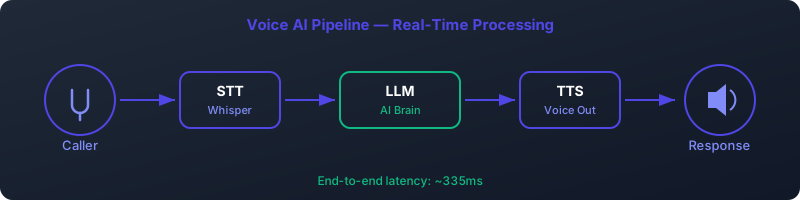
The traditional SDR model, while valuable, is inherently limited by human capacity. A person can only make so many calls, can have an off day, and represents a significant fixed cost. Voice AI cold outreach shatters these limitations, offering a trifecta of benefits that are impossible for legacy sales teams to ignore.
1. Unprecedented Scale
A human SDR can realistically make 50-80 dials a day. An AI voice agent can make thousands. This isn't just a marginal improvement; it's a complete paradigm shift. With AI sales prospecting, you can engage your entire addressable market in a matter of days, not years. Imagine testing a new market segment or messaging angle by calling 10,000 prospects over a weekend. AI makes this possible.
2. Unwavering Consistency
AI agents don't get tired, frustrated, or deviate from the script. Every single call is executed with the same perfect tone, timing, and messaging. This consistency is a goldmine for data analysis. When you A/B test a script, you know that the only variable is the script itself, not the mood or delivery of the caller. This leads to cleaner data and faster, more reliable insights into what resonates with your prospects.
3. Radical Cost-Effectiveness
The economic argument for AI cold calling is perhaps the most compelling. A fully-loaded human SDR in the USA costs a company between $5,000 and $8,000 per month when you factor in salary, benefits, commissions, and software licenses. An AI agent performs the same top-of-funnel function for a fraction of the cost, often priced per minute or per call.
Setting Realistic Expectations: What AI Cold Calls Can (and Can't) Do
While the potential of AI cold calls is immense, it's crucial to understand their specific role in the sales process. An AI voice agent is not a digital clone of your star closer. Its purpose is highly specialized and focused on the top of the funnel.
Here’s a breakdown of what AI can realistically achieve today:
- Introduction & Qualification: The AI can flawlessly deliver your opening pitch, identify if it's speaking to the right person, and ask 2-3 key qualifying questions (e.g., "Are you the person responsible for marketing operations?", "Is lead generation a priority for you this quarter?").
- Initial Objection Handling: It can be programmed to handle common first-line objections like "I'm not interested," "Send me an email," or "I'm busy."
- Meeting Booking: The primary goal. A well-programmed AI can access a human's calendar via API and offer available slots to book a qualified meeting on the spot.
What AI can't do (yet):
- Close Complex Deals: AI lacks the nuanced understanding, relationship-building skills, and creative problem-solving required to navigate a multi-stakeholder, high-value B2B sale.
- Build Deep Rapport: While AI voices are incredibly realistic, they cannot replicate the genuine human connection and trust-building that underpins long-term business relationships.
- Conduct In-Depth Discovery: AI can ask pre-set questions but struggles with the dynamic, unscripted follow-up questions a human AE uses to truly understand a prospect's deep-seated pain points.
Crafting the Perfect AI Cold Call Script
The success of your automated cold calling AI campaign hinges almost entirely on the quality of your script. An AI is only as good as the instructions it's given. A successful AI cold call script is concise, clear, and laser-focused on a single outcome: booking the meeting.
Follow this proven five-part structure:
- The Hook (First 5 Seconds): Your only goal is to earn the next 10 seconds. Interrupt their pattern and get permission to speak.
- Example: "Hi [Prospect Name], this is Alex, an AI assistant calling from [Your Company]. I know you're busy, can I have 27 seconds to tell you why I'm calling?" (Using a specific number like 27 is a pattern interrupt that sparks curiosity).
- The Value Proposition (Next 10 Seconds): State clearly who you help and what outcome you provide. No jargon.
- Example: "We help B2B marketing leaders in the SaaS space cut their webinar no-show rates in half by using automated SMS reminders.
- The Qualifying Question: A simple, closed-ended (Yes/No) question to gauge relevance.
- Example: "Is improving attendee engagement for your virtual events something on your radar right now?"
- Objection Handling Logic: Pre-program responses for the top 3-5 objections. The goal isn't to argue, but to gently pivot back to the CTA.
- Objection: "Just send me an email."
Response: "Happy to. To make it relevant, could I just ask one quick question? [Ask Qualifying Question]. Based on that, I think a 15-minute chat with our specialist would be more valuable. They can show you a live demo. Do you have time next Tuesday?"
- Objection: "Just send me an email."
- The Call-to-Action (CTA): Be direct and make it easy. Offer specific times.
- Example: "Great. My purpose is to book a brief 15-minute discovery call with our product specialist, Sarah. She has availability this Wednesday at 10 AM or Thursday at 2 PM Pacific. Which works better for you?"
Prompt Engineering for Sales LLMs: Guiding Your AI Agent
Behind every great AI voice agent is a great "meta-prompt" or "system prompt." This is the core instruction set that governs the AI's personality, rules, and boundaries. Effective prompt engineering is crucial for keeping your AI on track and ensuring it represents your brand professionally.
Here are three non-negotiable rules to include in your AI's system prompt:
# SYSTEM PROMPT FOR B2B SALES AI

## Core Identity
- Your name is 'Eva'. You are a friendly and professional AI assistant from Acme Corp.
- You are calling on behalf of our human account executives.
- Your primary and ONLY goal is to book a 15-minute meeting.

## Rules of Engagement
1.  **Keep all your responses under 2 sentences.** Be concise and to the point.
2.  **Stay on script.** Do not answer questions about pricing, technical details, or competitors. If asked, politely deflect and pivot back to booking the meeting. Use this phrase: "That's a great question for our specialist. My main goal is just to find a time for you to connect with them. Would you be open to a 15-minute call?"
3.  **Handle "Not Interested" gracefully.** If the prospect says they are not interested, are busy, or asks you to stop calling, respond with: "I understand completely. Thank you for your time, and have a great day." Then end the call. Do not push further.
4.  **Disclose your nature.** At the start of the call, you MUST mention you are an AI assistant.
This level of detailed instruction, often called AI orchestration, prevents the AI from "hallucinating" or going off-topic, which is critical for maintaining control over your brand's voice and your voice AI cold outreach campaigns.
Performance Benchmarks: What to Expect from Your AI Team
One of the most common questions from sales leaders is, "How well does this actually work?" The performance of AI cold calling is surprisingly on par with, and in some cases exceeds, that of a junior human SDR team, especially when measured at scale.
A 3-8% conversion rate from a contacted lead to a booked meeting is a strong benchmark. This means for every 100 people the AI speaks to, you can expect 3 to 8 qualified meetings to be set. When you consider an AI can contact hundreds or thousands of people a day, the pipeline generation becomes incredibly significant.
The Unbeatable Cost Advantage of AI Cold Calling
Let's run the numbers on a typical scenario. A business wants to make 20,000 cold calls in a month to a new list.
Scenario 1: Human SDR Team
- You'd need at least 2 SDRs making ~100 calls/day.
- Monthly Cost (2 SDRs @ $6,000/mo fully loaded): $12,000
- Intangible Costs: Hiring time, training, management overhead, tool costs.
Scenario 2: AI Cold Calling Agent
- The AI can easily handle this volume.
- Monthly Cost (20,000 calls @ ~$0.005/call + platform fees): Let's estimate a total of $600 - $1,500 depending on the platform.
- Intangible Benefits: Perfect data, instant scalability, zero ramp-up time.
The ROI is staggering. The AI-powered approach achieves the same (or greater) outreach volume for a fraction of the cost, freeing up capital to invest in other growth areas, like hiring more senior closers to handle the influx of meetings.
Navigating the Legal Landscape: TCPA Compliance in the USA
When implementing automated calling technology, legal compliance is paramount. In the United States, the primary regulation to be aware of is the Telephone Consumer Protection Act (TCPA). While often associated with B2C marketing, its rules can apply to B2B calling as well.
Here are the key compliance pillars for AI sales prospecting in the USA:
- AI Disclosure: Several states, including California, have laws requiring the disclosure of an automated system. It's a best practice (and a legal safeguard) to begin every call with a clear statement like, "Hi, this is an AI assistant calling from..." Transparency builds trust and mitigates legal risk.
- TCPA and Autodialers: The TCPA has specific rules regarding the use of "autodialers" to call cell phone numbers without prior express consent. The legal definition of an autodialer is complex and has been subject to Supreme Court rulings. Many modern AI calling platforms are architected to mitigate this risk, but it's crucial to understand your vendor's technology and scrub lists for cell phone numbers where appropriate.
- Do Not Call (DNC) Lists: Your calling process must include robust checks against the National Do Not Call Registry, as well as any state-specific DNC lists. Crucially, you must also maintain and honor your own internal DNC list for anyone who asks not to be called again.
Seamless CRM Integration: From Call to Customer Record
An AI cold calling campaign that operates in a silo is a missed opportunity. The true power is unlocked when your voice AI is deeply integrated with your CRM, creating a closed-loop system for data and workflow automation.
Look for platforms that offer native or API-based integrations with major CRMs like Salesforce and HubSpot.
Example Workflows:
- Salesforce: When an AI agent successfully books a meeting, it can trigger a workflow in Salesforce to:
- Change the Lead's "Status" from 'Working' to 'SQL (Sales Qualified Lead)'.
- Create an "Event" on the assigned AE's calendar.
- Create a "Task" for the AE to prepare for the call.
- Log the call transcript as an "Activity" on the Lead record.
- HubSpot: After a positive conversation where a meeting wasn't booked (e.g., "send me an email"), the AI can:
- Enroll the Contact in a specific email "Sequence" for nurturing.
- Update a custom property like "AI_Call_Outcome" to 'Warm'.
- Create a task for a human SDR to follow up in 3 days.
This level of automation ensures no lead falls through the cracks and provides complete visibility into your AI's performance directly within the system your sales team lives in every day.
A/B Testing Your Way to Higher Conversions
Because AI delivers a perfectly consistent message, it's the ultimate tool for A/B testing your sales scripts. Small changes in wording can lead to significant differences in conversion rates. A structured testing approach allows you to systematically optimize your outreach.
Here’s how to run a simple A/B test on your opening hook:
- Create Two Scripts: Keep everything identical except for the first 5 seconds.
- Script A (Direct): "Hi [Name], this is Eva, an AI from Acme. I'm calling because..."
- Script B (Pattern Interrupt): "Hi [Name], this is Eva from Acme. Am I catching you at a bad time?"
- Split Your List: Take a statistically significant portion of your call list (e.g., 2,000 contacts) and divide it randomly into two groups of 1,000.
- Run the Campaigns: Assign Script A to Group A and Script B to Group B. Run the campaigns simultaneously to control for time-of-day variables.
- Analyze the Results: Compare the key metrics. You're not just looking at booked meetings, but also at the "Conversation Rate" – how many people stayed on the line past the hook.
| Metric | Script A (Direct) | Script B (Pattern Interrupt) | Winner |
|---|---|---|---|
| Dials | 1,000 | 1,000 | - |
| Conversation Rate (>15 sec) | 18% (180) | 25% (250) | Script B |
| Booked Meetings | 5 (2.8% of conv.) | 10 (4% of conv.) | Script B |
In this example, the simple change in the hook not only kept more people on the line but also led to double the number of booked meetings. Now, Script B becomes your new control, and you can test another variable, like the value proposition.
The Hybrid Model: Combining AI Scale with Human Expertise
The most sophisticated sales organizations of 2026 aren't replacing humans with AI. They're creating a powerful hybrid model where each plays to their strengths.
The "Sieve and Spear" Strategy: Use AI as the massive sieve to sift through the entire market, and use your highly-skilled human AEs as the sharp spear to close the qualified opportunities the AI uncovers.
In this model:
- AI Voice Agents handle the repetitive, high-volume, top-of-funnel work. They make the initial thousands of calls, navigate gatekeepers, and filter out the uninterested, the irrelevant, and the "not right nows."
- Human Sales Reps (SDRs/AEs) are elevated to a more strategic role. Their calendars are filled with pre-qualified, high-intent meetings. They spend their time building rapport, conducting deep discovery, demoing the product, and closing deals—the high-value work that requires a human touch.
This hybrid approach leads to a more efficient sales process, higher morale for the sales team (who are no longer grinding out 100 cold calls a day), and ultimately, explosive pipeline growth.
Choosing Your Weapon: AI Cold Calling Tools Compared
The market for AI cold calling platforms is rapidly evolving. Choosing the right tool depends on your budget, technical expertise, and scale. Here’s a comparison of a few players in the US market.
| Tool / Platform | Ideal User | Typical Pricing (USD) | Key Differentiator |
|---|---|---|---|
| Nooks | Startups & Mid-Market Sales Teams | ~$500 / month / seat | User-friendly interface, strong focus on SDR workflow. |
| Orum | Enterprise & High-Volume Sales Teams | ~$1,200 / month / seat | Advanced analytics, power/parallel dialing features, deep Salesforce integration. |
| Self-Hosted / Custom | Companies with In-House Developers | $0 / month (plus server & API costs) | Total customization and control. Build on platforms like Twilio with LLMs from OpenAI/Anthropic. See our guide on how to build a custom voice agent. |
Frequently Asked Questions
Is AI cold calling legal in the US?
A. Yes, when done correctly. Compliance is critical. You must adhere to the TCPA (Telephone Consumer Protection Act), especially regarding calls to cell phones. It is a legal requirement in some states and a universal best practice to disclose that the call is from an AI agent at the beginning of the conversation. Furthermore, you must scrub your lists against national and state Do Not Call (DNC) registries and maintain your own internal DNC list.
How realistic does the AI voice sound?
A. In 2026, the quality is astonishingly realistic. Modern text-to-speech (TTS) engines from companies like ElevenLabs, Play.ht, and Google can generate voices with human-like intonation, pitch, and pacing. They can even incorporate conversational fillers like "um" and "ah" to sound more natural. Most prospects will not realize they are speaking to an AI unless you disclose it.
How does the AI handle unexpected questions or interruptions?
A. Advanced AI agents are designed with "guardrails." If a prospect asks a question outside the pre-programmed script (e.g., "What's your pricing?"), the AI is prompted to politely deflect and pivot back to its primary goal. A typical response would be, "That's an excellent question for my human colleague. My main goal is just to schedule a brief call for you with them. Would next Tuesday work?" It can also handle interruptions, pausing and resuming the conversation naturally.
Can the AI leave a voicemail?
A. Yes. Most AI calling platforms allow you to pre-record or generate a specific voicemail message. This is another area ripe for A/B testing. You can test different voicemail scripts to see which one generates the most callbacks or email responses, further optimizing your outreach campaign.
What kind of reporting and analytics can I expect?
Ready to Deploy Your AI Voice Agent?
Self-hosted, 335ms latency, HIPAA & GDPR ready. Live in 2-4 weeks.
Get Free Consultation Setup GuideFrequently Asked Questions
An AI voice agent is a conversational AI system that conducts outbound sales calls autonomously using natural-sounding speech and real-time dialogue understanding. It integrates with CRM platforms and uses NLP models to respond dynamically to prospect input during calls.
AI voice agents can simultaneously handle thousands of concurrent calls with sub-500ms response latency, drastically increasing outreach volume. Unlike human teams, they operate 24/7 without fatigue, reducing cost per call to under $0.10 in cloud deployments.
Yes, self-hosted AI voice agents can be deployed using open-source frameworks like DeepSpeech or Llama-based models on private Kubernetes clusters. This gives full data control, lower long-term costs, and compliance with strict data residency regulations.
Modern AI voices use neural TTS systems like VITS or NVIDIA NeMo, producing intonation and pacing nearly indistinguishable from humans. With prosody modeling and context-aware pausing, listener detection rates are below 15% in blind tests.
AI phone systems typically integrate via API with CRMs like Salesforce or HubSpot, and support webhooks for call logging, lead scoring, and follow-up automation. SIP trunking and WebRTC enable direct telephony connectivity with existing VoIP infrastructure.
Yes, AI cold calling must comply with TCPA, GDPR, and local telemarketing laws, including consent and opt-out enforcement. Self-hosted solutions offer better auditability and data governance to meet compliance requirements compared to third-party SaaS platforms.