Table of Contents
- Why Traditional Call Center Models Are Unsustainable
- The Per-Minute Trap: Exposing the Flaws of Cloud AI Call Center SaaS
- Introducing the Future: A Self-Hosted AI Call Center with Unlimited Agents
- Architecture Deep Dive: How Our AI Contact Center Software Works
- Scalability by Design: From 10 to 10,000 Concurrent Calls
- Full-Spectrum Communication: Inbound and Outbound AI Capabilities
- Features Built for Enterprise: More Than Just a Voicebot
- Connect Everything: Native Integrations and a Powerful REST API
- Built for Trust: Enterprise-Grade Security and Compliance
- The ROI of Self-Hosting: A Clear Financial Calculation
- Case Study: How a National Logistics Firm Reduced Costs by 95%
- Frequently Asked Questions
The world of customer service is on the brink of a revolution, but many enterprises are caught between two failing models. On one hand, the traditional, human-powered call center is buckling under the weight of exorbitant costs, high turnover, and the demand for 24/7 availability. On the other, the promise of cloud-based AI has been tarnished by punitive, per-minute pricing that punishes scale and creates unpredictable, spiraling expenses.
For VPs of Customer Service, IT Directors, and Operations Managers, the challenge is clear: how do you deliver exceptional, instant, and intelligent customer experiences without bankrupting the company? The answer isn't to choose the lesser of two evils. The answer is to change the game entirely.
This article introduces a new paradigm for enterprise communications: a self-hosted AI call center software that provides unlimited AI agents, eliminates per-minute and per-seat fees, and puts you back in control of your data, your costs, and your customer experience destiny. This is the blueprint for the AI contact center of 2026 and beyond.
Why Traditional Call Center Models Are Unsustainable
For decades, the call center has been the frontline of customer interaction. But this model, built for a different era, is showing its age. The operational and financial strains are becoming impossible for forward-thinking US enterprises to ignore.
The Unrelenting Agent Costs
The most glaring issue is the direct cost of labor. A US-based call center agent's fully loaded cost—including salary, benefits, training, and overhead—ranges from $25 to $45 per hour. A small team of 20 agents operating during standard business hours can easily cost over $1 million annually. Scaling to provide 24/7 coverage triples this cost, making it a non-starter for all but the largest corporations.
The Revolving Door of High Turnover
The high-pressure, repetitive nature of call center work leads to notoriously high attrition rates, often exceeding 40% per year. This constant churn creates a vicious cycle:
- Recruitment Costs: Continuously spending resources to find, interview, and hire new staff.
- Training Overhead: New agents require weeks of training before they are productive, draining resources and impacting initial quality.
- Loss of Knowledge: Experienced agents leave, taking valuable institutional and customer knowledge with them.
- Inconsistent Service: A constant influx of new, inexperienced agents leads to inconsistent and often subpar customer experiences.
The 9-to-5 Constraint in a 24/7 World
Your customers operate around the clock, and they expect you to do the same. Limiting support to business hours frustrates customers and leads to missed opportunities. While offshore or extended-hours teams are an option, they introduce significant new costs, management complexity, and potential quality control challenges.
The Per-Minute Trap: Exposing the Flaws of Cloud AI Call Center SaaS
Recognizing the limitations of human agents, many companies turned to cloud-based AI call center SaaS platforms. These services promised a futuristic solution: intelligent, automated agents available 24/7. While the technology is impressive, the business model is fundamentally flawed for any organization operating at scale.
The core problem is the "cloud tax"—a pay-per-minute or pay-per-interaction pricing model that directly penalizes growth and success. As your call volume increases, your costs skyrocket in a linear, predictable, and painful fashion.
The SaaS Cost Explosion: A Simple Calculation
Let's consider a common scenario for a mid-sized enterprise:
- Cloud SaaS Rate: $0.25 per minute
- Monthly Call Volume: 100,000 inbound calls
- Average Call Duration: 1.5 minutes
Monthly Cost: 100,000 calls × 1.5 min/call × $0.25/min = $37,500 per month
That's $450,000 per year for a single, automated Tier 1 support channel. This cost offers no economy of scale; if your volume doubles, your bill doubles.
Beyond the punitive pricing, this model introduces other significant business risks:
- Vendor Lock-In: Once your workflows, scripts, and integrations are built on a proprietary cloud platform, migrating away becomes a monumental task.
- Data Sovereignty & Security: Your sensitive customer data, including call recordings and transcripts, resides on a third-party's servers. This can be a major hurdle for compliance in regulated industries like healthcare (HIPAA) and finance (PCI DSS).
- Limited Customization: You are confined to the features, models, and integration capabilities offered by the vendor. True, deep customization to match your unique business logic is often impossible.
This is not a sustainable AI call center solution for enterprises that plan to grow.
Introducing the Future: A Self-Hosted AI Call Center with Unlimited Agents
There is a better way. By decoupling the AI technology from the per-minute business model, you can achieve the holy grail of customer service automation: unlimited scale at a fixed, predictable cost.
Our self-hosted AI call center software is an enterprise-grade platform that you deploy on your own infrastructure, whether on-premises or in your private cloud (AWS, Azure, GCP). This architectural shift fundamentally changes the economic equation.
The Ownership Advantage
With a self-hosted model, you are no longer "renting" your AI agents by the minute. You own the engine. This means:
- Zero Per-Minute Fees. Ever.
- Zero Per-Seat Fees. Deploy 10, 100, or 1,000 AI agents for the same software cost.
- Unlimited Concurrent Calls. Your capacity is limited only by your hardware, not your contract.
- Predictable, Low OpEx. Your costs are reduced to hardware amortization, power, and a fixed annual support/license fee.
- Total Data Control. All voice data, transcripts, and customer information stay within your secure infrastructure.
This approach transforms your conversational AI call center from a massive cost center into a lean, efficient, and powerful strategic asset. You can finally handle 100% of your call volume, 24/7/365, without worrying about a surprise bill at the end of the month.
Architecture Deep Dive: How Our AI Contact Center Software Works
Our platform is built for reliability, scalability, and performance, leveraging a combination of battle-tested open-source components and proprietary AI orchestration. This hybrid approach delivers the best of both worlds: the stability of a mature telephony core and the intelligence of a cutting-edge AI stack.
The Core Components:
- Telephony Engine (Asterisk): At the heart of the system is Asterisk, the world's most widely deployed open-source communications platform. It handles all the low-level Session Initiation Protocol (SIP) trunking, call routing, queueing, and audio stream management. Its proven stability ensures carrier-grade reliability. This makes our solution a commercially supported evolution of the open source AI call center concept.
- AI Gateway (EAGI Instances): Asterisk communicates with our AI engine via the Extended Asterisk Gateway Interface (EAGI). Multiple EAGI processes run in parallel, acting as bridges that pass the real-time audio from each call to the AI processing layer and stream the AI's spoken response back to the caller.
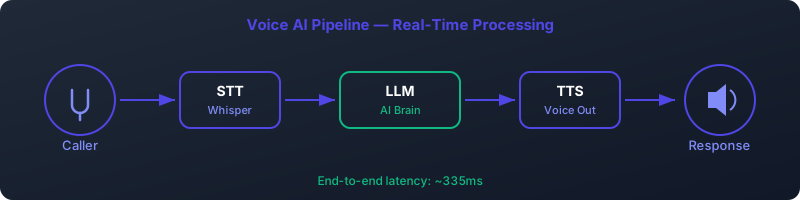
- AI Orchestration & GPU Server: This is the brain of the operation. A dedicated server equipped with one or more powerful NVIDIA GPUs runs the AI models. It performs three key tasks in a continuous loop for each call:
- Speech-to-Text (STT): Converts the caller's speech into text in real-time.
- Natural Language Understanding (NLU): Processes the text using a Large Language Model (LLM) to understand intent, access knowledge bases, query APIs, and formulate a response.
- Text-to-Speech (TTS): Synthesizes the AI's text response into natural-sounding human speech.
This decoupled architecture is the key to massive scalability. You can scale the telephony layer (Asterisk) and the AI processing layer (GPU servers) independently based on your specific needs.
--- Call Flow Diagram ---

[Caller] --dials--> [SIP Trunk Provider]
    ^                       |
    | (Audio Stream)        v
    |                  [Asterisk Server] --> [EAGI Process #1] --> [GPU Server]
    |                       |                                          |
    | (AI Response)         v                                          v (STT -> LLM -> TTS)
    +------------------ [EAGI Process #1] <-- (Audio Response) <-- [GPU Server]
                            |
                            v
                        [Asterisk Server]
                            | (Manages another call)
                            v
                        [EAGI Process #2] --> [GPU Server] ...and so on.
Scalability by Design: From 10 to 10,000 Concurrent Calls
Unlike SaaS platforms where scaling means a bigger bill, our self-hosted AI contact center software scales with simple hardware additions. The primary bottleneck in any real-time voice AI system is GPU processing power for the AI inference.
Our system is highly optimized to maximize the throughput of modern GPUs. A single, consumer-grade NVIDIA RTX 4090 graphics card—a piece of hardware that costs around $2,000—can comfortably handle 20 to 40 simultaneous, real-time AI conversations. For reference, this capacity would cost between $30,000 and $60,000 per month with a typical SaaS provider.
Scaling your AI call center is as simple as:
- Vertical Scaling: Adding more GPUs to a single server. A server with 4 or 8 PCIe slots can house multiple cards, dramatically increasing capacity.
- Horizontal Scaling: Adding more GPU servers to your cluster. Our AI orchestration layer can load-balance requests across multiple machines, allowing for virtually limitless capacity.
This means you can start with a single server for a pilot project and scale up to a multi-server cluster capable of handling thousands of concurrent calls as your needs grow, all while maintaining a low, fixed operational cost.
Full-Spectrum Communication: Inbound and Outbound AI Capabilities
A modern AI contact center software must be more than just an intelligent answering machine. Our platform provides a comprehensive suite of tools for managing both inbound customer service and proactive outbound campaigns.
Advanced Inbound Call Handling
- 24/7 Tier 1 Support: Let AI agents handle the vast majority of repetitive inbound queries, such as order status checks, password resets, store hours, and product FAQs.
- Intelligent ACD & Routing: Configure sophisticated routing rules based on caller ID, IVR selections, or natural language intent to direct calls to the right AI agent or human queue.
- Dynamic Queue Management: Even with AI, peak times can require queueing. Our system can provide estimated wait times, offer automated callback options, or handle the query entirely while the caller waits.
- Seamless Human Escalation: When a query is too complex, a caller is frustrated, or a specific keyword is mentioned ("speak to a manager"), the AI can transfer the call to a human agent instantly. Crucially, the full transcript and context of the AI conversation are passed to the human agent's screen, so the customer never has to repeat themselves.
Proactive Outbound Campaigns
Leverage your unlimited AI agents to engage customers proactively. All outbound campaigns are designed with TCPA compliance in mind, including features for time-of-day calling restrictions and Do-Not-Call list management.
- Automated Appointment Reminders: Drastically reduce no-shows for appointments in healthcare, sales, and service industries with automated, interactive reminder calls.
- Payment Reminders & Collections: Handle sensitive collections conversations with professional, consistent, and tireless AI agents.
- Customer Satisfaction Surveys: Conduct post-interaction CSAT or NPS surveys via automated voice calls, gathering valuable feedback at scale.
- Lead Qualification & Follow-Up: Automate the top of your sales funnel by having AI agents make initial contact with new leads, ask qualifying questions, and schedule a follow-up with a human sales representative if the lead is a good fit.
Features Built for Enterprise: More Than Just a Voicebot
Our platform is an end-to-end AI call center solution packed with the features enterprises need to manage, monitor, and optimize their customer communications.
- Dynamic Scripting Engine: Move beyond rigid, tree-based IVRs. Our visual scripting engine allows you to build complex, stateful conversations where the AI can remember context, ask clarifying questions, and dynamically change its path based on the caller's responses.
- Real-Time Knowledge Base Integration: Connect the AI directly to your internal knowledge bases (Confluence, SharePoint, internal wikis). When a customer asks a question, the AI can perform a real-time vector search to find the most relevant information and provide an accurate answer, even if it wasn't explicitly scripted.
- Sentiment Analysis: The system analyzes the caller's tone of voice and word choice in real-time to gauge sentiment. This can be used as a trigger for escalating a frustrated caller to a human agent.
- Full Call Recording and Transcription: Every call is recorded, and a highly accurate transcript is generated. This is invaluable for quality assurance, compliance audits, and training your AI models on real-world conversations.
- Comprehensive Analytics Dashboard: A web-based portal provides deep insights into your call center's performance. Track metrics like call volume, average handle time, AI containment rate, sentiment trends, and common customer intents. Explore our analytics features.
- Multi-Language and Accent Support: Serve a diverse customer base with support for multiple languages and a wide range of regional accents.
Connect Everything: Native Integrations and a Powerful REST API
An AI agent is only as effective as the systems it can connect to. Our AI call center software is designed for deep integration into your existing tech stack, allowing AI agents to do more than just talk—they can take action.
We offer native, out-of-the-box integrations with the most popular enterprise platforms:
- Salesforce: Look up contact records, create new leads, log call activity, and create cases directly in Sales Cloud or Service Cloud.
- HubSpot: Sync contact data, update deal stages, and log call outcomes automatically.
- Zendesk: Create, update, and retrieve support tickets, allowing the AI to provide real-time ticket status updates to customers.
- Microsoft Dynamics 365: Seamlessly connect with your Microsoft-based CRM and ERP ecosystem.
The Power of API-Driven Actions
Our robust REST API is the key to unlocking true automation. Your AI agents can be configured to make API calls to any of your internal or third-party systems. This enables powerful, custom workflows such as:
- E-commerce: "I see your order #54321 was delivered yesterday. Can I help with anything else?"
- Finance: "I've just processed your payment of $55.30. Your new balance is zero."
- Logistics: "I've located your shipment. It's currently out for delivery on truck #87 in Austin, Texas."
- IT Help Desk: "I have successfully reset your network password. A temporary password has been sent to your registered mobile number."
With our API, the AI agent becomes a true extension of your business applications. Learn more about our integration capabilities.
Built for Trust: Enterprise-Grade Security and Compliance
In today's regulatory environment, data security and compliance are not optional. The self-hosted nature of our platform provides a foundational security advantage by keeping all sensitive data within your control.
The Shared Responsibility Model
While our software provides the architecture and tools to build a compliant system, your organization is ultimately responsible for the proper configuration, management, and auditing of your environment to meet specific regulatory requirements.
Our platform is designed with the following compliance frameworks in mind:
- HIPAA (Health Insurance Portability and Accountability Act): By deploying within your own secure data center, you can maintain full control over Protected Health Information (PHI), a critical requirement for healthcare organizations and their business associates.
- PCI DSS (Payment Card Industry Data Security Standard): Our scripting engine and API integrations can be configured to use tokenization services, ensuring that the AI agent never "hears" or stores raw credit card numbers. Call audio can be automatically paused and resumed during payment capture to keep sensitive data out of recordings.
- GDPR & CCPA (General Data Protection Regulation & California Consumer Privacy Act): The self-hosted model makes it easier to manage data subject rights, such as the right to access or erasure, as all data resides in a known location under your control.
- TCPA (Telephone Consumer Protection Act): For outbound campaigns, the platform includes essential tools for managing consent, call times, and internal do-not-call lists to mitigate compliance risk.
The ROI of Self-Hosting: A Clear Financial Calculation
The financial argument for switching to a self-hosted AI call center is overwhelming. Let's compare the total cost of ownership (TCO) for a typical enterprise scenario against the leading cloud SaaS model.
Scenario: An enterprise handling 100,000 inbound calls per month, with an average duration of 2 minutes.
| Cost Component | Cloud AI SaaS Model | Self-Hosted AI Model |
|---|---|---|
| Monthly Call Volume | 200,000 minutes | 200,000 minutes |
| Per-Minute Cost | $0.20 (average) | $0.00 |
| Monthly Minute Cost | $40,000 | $0 |
| One-Time Hardware Cost | $0 | ~$15,000 (2 servers + 2x RTX 4090s for redundancy) |
| Monthly OpEx (Power, Cooling, Rack Space) | $0 | ~$500 |
| Annual Software License & Support | (Bundled into minute cost) | ~$30,00
Ready to Deploy Your AI Voice Agent?Self-hosted, 335ms latency, HIPAA & GDPR ready. Live in 2-4 weeks. Get Free Consultation Setup GuideFrequently Asked QuestionsIt means you can deploy as many concurrent AI voice agents as needed without additional licensing or per-agent fees. The self-hosted architecture scales with your infrastructure, ideal for high-volume customer service operations. Yes, the platform is fully self-hosted with Docker and Kubernetes support, giving you full data control and compliance. You can deploy on-premises or in your private cloud with low-latency WebRTC and SIP integration. No, there are no per-seat, per-minute, or API call fees. Once deployed, your costs are limited to your own infrastructure, making it cost-efficient at scale. The system uses on-device streaming ASR and TTS with sub-300ms end-to-end latency, optimized for natural conversation. Self-hosting eliminates third-party API delays, ensuring reliable real-time interactions. Core orchestration and agent logic are open-source (Apache 2.0), allowing full customization of workflows, integrations, and voice models. Developers can extend with custom NLU, databases, or CRM connectors. It supports SIP, WebRTC, and PSTN gateways for telephony, plus REST APIs and webhooks for Salesforce, HubSpot, and custom CRMs. Pre-built connectors and SDKs accelerate integration with minimal downtime. |